In a nutshell: Cold wash (20-30 °C): delicate fabrics, bright colors, synthetic fibers. 40 °C: everyday laundry, regular clothing. 60 °C: sheets, towels, baby clothes, allergy-prone textiles. 90 °C: sanitization only (white cotton, heavily soiled dish towels). Heating the water accounts for most of the energy used — wash cold whenever possible.
How Water Hardness Affects Washing
Just looking for the definition of cold wash?
For the most precise answer, also read
cold wash: what temperature to actually choose?
. The article distinguishes true cold (20 to 30 °C), cases where 40 °C makes more sense, and situations where 60 °C is still necessary.
Two common questions now have their own guides
If your question isn’t “what temperature for each fabric?” but rather 30 or 40 °C for everyday laundry, or on the contrary
which clothes to wash at 60 °C
, check out these dedicated pages: they answer these two specific questions faster.
In the Toulouse area, water is often rated moderately hard to hard depending on the neighborhood, which reduces the apparent effectiveness of an under-dosed detergent and promotes limescale deposits on laundry and machines.
Water hardness refers to the concentration of calcium (Ca²⁺) and magnesium (Mg²⁺) ions, measured in French degrees (°f). The harder the water, the more dissolved minerals it contains — and the more laundry washing is affected.
How Hard Water Affects Washing
Calcium ions react with some of the cleaning agents and form insoluble deposits. This has two direct consequences:
- Reduced cleaning power: part of the detergent works less effectively when the water contains more calcium and magnesium. In practice, this often means a need for dose adjustment or a duller result if the dose stays the same. Opt for a concentrated eco-friendly detergent↗ whose agents are active from 15 °C.
- Deposits on fibers: limescale residue settles into textiles, making them rough to the touch and grayish over time. This is especially noticeable on towels and white laundry. To protect delicate fabrics washed at low temperature, a fine-mesh laundry bag↗ reduces friction while letting water circulate.
Water Hardness in France
Hardness varies significantly by region: from less than 15 °f in Brittany or the Massif Central, to over 30 °f in the Paris area, the North, or the Paris basin. In Toulouse and Blagnac, the water sits around 25-30 °f depending on the neighborhood — a transition zone between moderately hard and hard. The useful benchmark is not an absolute number, but the fact that above 20 °f, detergent dosage and machine maintenance require more attention.
The table below places the main ranges in relation to laundry washing thresholds.
| Classification | Hardness (°f) | Impact on washing |
|---|---|---|
| Soft water | 0-15 °f | Little limescale, simple dosing |
| Moderately hard | 15-25 °f | Adjustment sometimes useful depending on detergent |
| Hard water | 25-30 °f | Deposits and rough laundry more frequent without adjustment |
| Very hard water | > 30 °f | Extra care needed for dosing and maintenance |
Hard Water and Temperature: An Important Interaction
The washing temperature also influences limescale deposit formation. Hot cycles remain useful for hygiene on sheets or towels, but they require more frequent machine maintenance in hard water areas. To keep your home machine in good shape, check our guide to cleaning your washing machine.
What Our Laundromat Machines Do
The Speed Queen machines in our laundromats use professional detergent dosed automatically. This formulation is calibrated for the local water profile:
- dosing consistent with the soil level and cycle type,
- formulation designed to limit the loss of effectiveness caused by limescale,
- automation that eliminates the common risk of under-dosing or over-dosing.
This is a concrete advantage over home washing, where most users don’t consider their water type when adjusting detergent dosage. To learn more, check our guide on the ecological impact of laundromat washing.
Temperature and Sorting: Two Related Questions, Two Different Answers
This page answers the question “at what temperature should I wash?” If your real question is first how to separate whites, colors, delicates, and towels before even choosing a temperature, the table below covers both dimensions.
The right order is simple:
- first, sorting to avoid color transfer and bad mixes;
- then, temperature based on the care label and hygiene needs.
Need a real guide for sorting?
The dedicated sorting guide covers separating whites / lights / darks, towels, wool, delicates, the color-fastness test, and practical organization before coming to the laundromat. Here, we stay focused on the useful temperatures once the load is already sorted.
At a Glance
The care label is the reference — the temperature shown is a maximum, never a minimum.
Cold = safe — a low-temperature wash suits the majority of everyday laundry.
Hot = specific cases — bedding, heavily soiled whites, fabrics requiring enhanced hygiene.
Modern detergents work cold — today's formulations are effective without heat.
Wool and silk = always cold — animal fibers cannot handle heat.
Summary Table
| Temperature | Suitable Fibers | Risk If Too Hot |
|---|---|---|
| Cold (≤ 30 °C) | Wool, silk, synthetics, bright colors, sportswear | Felting (wool), warping (synthetics), fading |
| Warm (40 °C) | Colored cotton, everyday laundry, moderately soiled clothes | Color bleeding, premature fiber wear |
| Hot (≥ 60 °C) | White cotton, sheets, towels, dish towels, bedding | Shrinkage of natural fibers, irreversible fading |
Temperatures by Garment and Fabric
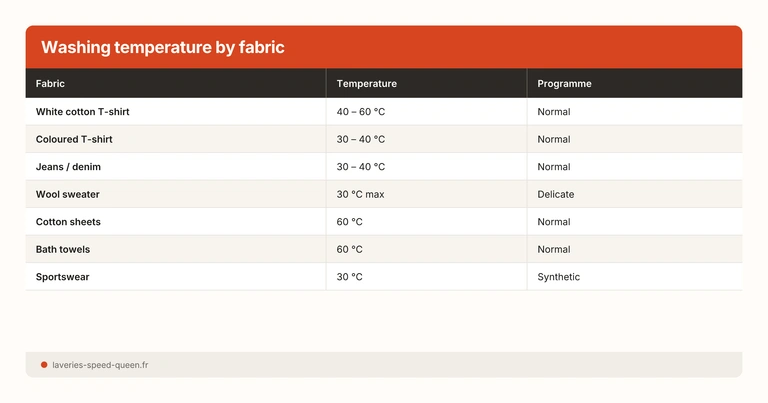
This table details the recommended temperature and program for each garment type — print it or save it so you never hesitate in front of the machine.
| Garment/Fabric | Temperature | Program | Notes |
|---|---|---|---|
| White cotton t-shirt | 40-60°C | Normal | 60°C if heavily soiled |
| Colored cotton t-shirt | 30-40°C | Normal | Turn inside out before washing |
| Jeans/denim | 30-40°C | Normal | Turn inside out, close zipper |
| Cotton shirt | 40°C | Normal | Unbutton the collar |
| Wool sweater | 30°C max | Wool/very delicate | Minimum or no spin |
| Cotton underwear | 40-60°C | Normal | 40°C for daily use, 60°C if sturdy cotton and targeted hygiene needed |
| Synthetic underwear | 30°C | Delicate | Laundry bag recommended |
| Cotton sheets | 60°C | Normal | Wash alone (bulk) |
| Bath towels | 60°C | Normal | No fabric softener (reduces absorbency) |
| Sportswear | 30°C | Synthetic | Turn inside out, don’t overload |
| Synthetic puffer jacket | 30°C | Delicate | 18 kg machine at the laundromat |
| Synthetic duvet | 40°C | Normal | 18 kg machine required |
| Down duvet | 30°C | Delicate | 600 rpm max spin |
| Canvas shoes | 30°C | Delicate | Remove laces, use laundry bag |
For the weight of each item, check our laundry weight chart. For care label symbols, see our complete symbol guide.
What Temperature Does to Fabrics
A temperature that’s too high causes irreversible damage: felting of wool from a poorly set 40 °C, warping of synthetics, and color bleeding.
Heat is not neutral for fibers. It triggers different physical reactions depending on the fabric type, and these effects are often irreversible.
Protein fibers contract
Wool and silk are animal fibers made of proteins (keratin for wool, fibroin for silk). Under heat, these proteins tighten and the fabric shrinks. For wool, the effect is amplified by its microscopic scales that open with heat and tangle together: this is felting, an irreversible process. To protect your clothes, check our complete guide to preventing shrinkage.
Colors migrate
Heat opens the fabric fibers, making it easier for pigments to escape. A colored garment washed too hot can bleed onto other items in the drum. This is why dark fabrics and bright colors should be washed at low temperature: cold keeps fibers closed and retains pigments.
Synthetics warp
Polyester, nylon, and elastane are polymers sensitive to excessive heat. Washed too hot, they can permanently wrinkle, lose their stretch, or deform. A cold or warm wash preserves their structure and elasticity, especially for fleece items (see [how to wash a fleece blanket](/blog/textiles-delicats/)). For technical winter gear, check our guide to washing your ski gear.
Cotton handles heat better
Cotton fibers are plant-based (cellulose) and naturally resist heat better than wool or synthetics. This is why white cotton sheets, towels, and dish towels can handle hotter programs — though that doesn't mean it's always necessary.
The Three Temperature Zones
Simple rule: 20-30 °C for delicates and colors, 40 °C for everyday laundry, 60 °C and above for white cotton, sheets, and towels.
Rather than exact numbers, think in three zones. Each zone matches a use case and a fabric type.
🧊 Cold Wash
For: delicate fabrics, wool, silk, bright colors, synthetics, sportswear.
Why: preserves fibers, retains colors, prevents shrinkage. Modern detergents are formulated to dissolve everyday soil without heat.
Label reference:
🌡️ Warm Wash
For: colored cotton, everyday laundry, moderately soiled clothes.
Why: good compromise between cleaning and preservation. Moderate heat helps dissolve body oils without damaging fibers.
Label reference:
🔥 Hot Wash
For: white cotton, sheets, bath towels, dish towels, heavily soiled bedding.
Why: high temperature helps remove stubborn soil and enhances hygiene for fabrics in direct contact with the body.
Label reference:
Cold Wash: What Temperature Exactly?
Cold washing (15-30 °C) covers the majority of everyday garments as long as they are lightly to moderately soiled and treated with an enzyme-based detergent.
Cold covers most of your needs
Most everyday laundry — t-shirts, shirts, jeans, synthetic underwear, sportswear — doesn’t need heat to get clean. Modern detergents contain enzymes active at low temperature that break down organic stains (sweat, food, sebum) without heating the water.
Cold washing is not a compromise — it’s often the best choice. Here’s why:
Colors preserved
Colored fabrics keep their vibrancy longer at low temperature. Cold prevents fibers from opening and retains pigments in the fabric.
Shape maintained
No fiber contraction, no elastic deformation, no felting. Cold is the ally of fabrics that need to keep their fit.
Energy saved
Heating water from 15 to 60 °C uses ~1 kWh per cycle. Washing at 30 °C instead of 60 °C cuts the cycle's electricity consumption by ~60% (source: ADEME). Over 200 cycles/year, that's ~120 kWh and €20-30 in savings.
When Heat Is Useful
Go up to 60 °C mainly for bedding, towels, and heavily soiled white cotton — these are the cases where hygiene truly justifies the heat.
Hot washing remains relevant in certain situations where hygiene or the type of soil requires it.
If you want the most actionable breakdown by garment type, also see our dedicated 60 °C guide, which isolates this topic from the general chart.
Heat = enhanced hygiene
For bedding (sheets, duvet covers, pillowcases), bath towels, and dish towels, high temperature helps remove accumulated organic residue and maintain an appropriate level of hygiene. It’s also the right choice for heavily soiled or stained white cotton.
White cotton handles hot programs without risk of fading or significant deformation. Sheets and towels washed regularly at high temperature stay fresh and clean longer. For duvets, check our dedicated guide to machine-washing duvets, and for thick living room textiles our guide on washing a throw blanket in the machine.
On the other hand, save heat for fabrics that can handle it. A hot program applied to a delicate or synthetic garment does more harm than good.
The Classic Mistake: Too Hot “Just to Be Safe”
For everyday laundry, going from 30-40 °C to 60 °C increases fabric wear and energy consumption without a proportional gain in cleanliness.
Hotter does not mean cleaner
This is the most common and most costly reflex. Many people crank up the temperature thinking heat washes better. In reality, modern detergents are designed to work effectively at low temperature. Excessive heat damages fibers, shrinks fabrics, and fades clothes — without significantly improving the cleaning of everyday laundry.
The cases where high temperature makes a real difference are limited: heavily soiled whites, bedding, fabrics requiring enhanced hygiene. For everything else, a warm or cold wash with a good detergent produces an identical result while preserving your clothes.
The real cleaning factor is the combination of detergent + mechanical action + cycle time — not temperature alone.
Understanding the Care Label
The tub number is a ceiling: a garment marked 40 °C can be washed at 30 °C, but never at 60 °C.
Your garment’s care label contains all the information needed to choose the right temperature. The tub symbol shows the maximum allowed temperature, not the recommended temperature. You can always wash below this limit, never above.
The tub = the maximum temperature
The number inside the tub symbol shows the limit not to exceed. A bar under the tub means gentle treatment (reduced spin). Two bars mean very delicate treatment. For a full review of the symbols and their meaning, check our care label guide.
If the label is unreadable or missing, apply the precautionary principle: delicate program, low temperature, moderate spin. A wash that’s too gentle never cleans as poorly as a wash that’s too aggressive damages.
At the Laundromat: The Programs Do the Work
At the laundromat, choosing the right program is usually enough, as the machine automatically adjusts temperature, duration, and spin based on the selected cycle.
Pre-set cycles for every need
At a Speed Queen laundromat, you don’t have to guess the right temperature. Professional machines offer pre-set programs (normal, delicate, hot) that automatically adjust temperature, spin, and cycle duration. Choose the program suited to your fabric, and the machine does the rest.
Professional machines offer a key advantage: consistency. They maintain the chosen temperature steadily throughout the cycle, guaranteeing reproducible results and reliable protection for your fabrics. Find our laundromats in Toulouse and Blagnac and use our laundry weight calculator to check your load before choosing a program.
Mistakes to Avoid
- Raising the temperature "just in case" — washing too hot damages more than it cleans
- Washing wool or silk on hot — irreversible felting for wool, degradation for silk
- Mixing delicates and cotton in a hot program — delicates undergo unsuitable treatment
- Ignoring the label because "it's cotton" — blended or colored cotton doesn't wash like pure white cotton
- Washing bright colors at high temperature — risk of fading and color transfer to other items
Apply these guidelines directly at the laundromat: professional machines, automatic dosing, and consistent results on every fabric. First time visiting? Check our first time at the laundromat guide. Our Toulouse Croix-Daurade laundromat and our Blagnac laundromat are open 7j/7 de 7h à 22h. Check our prices and our FAQ. Question about the ideal temperature? Contact us for personalized advice.
As an Amazon Associate, we earn a small commission on purchases made through the affiliate links in this article — at no extra cost to you. This helps us maintain this site and produce free guides.
Methodology and Sources
- The temperature limits by fabric are primarily based on standardized care symbols (ISO 3758 / GINETEX).
- The practical advice (cold/warm/hot) is then written for realistic use at the laundromat and at home, with caution for delicate fabrics.
- When in doubt or with an unreadable label, the approach is conservative: lower temperature and delicate cycle.