In a nutshell: a fleece blanket or throw should be machine washed at 30 °C max, delicate cycle, no fabric softener (it clogs the fibers and destroys softness). Replace softener with white vinegar in the rinse. Dry at very low heat or air dry. For large throws, 18 kg laundromat machines provide the space needed.
At a glance
30 °C maximum — fleece is polyester that warps in heat.
NO fabric softener — it clogs the fibers and destroys softness. White vinegar in the rinse.
Wash inside out in a laundry bag — protects the surface from friction and reduces pilling.
Low-heat or air drying — never iron (polyester melts).
Laundromat for large throws — 18 kg machine for blankets >150x200 cm.
Understanding fleece
Fleece is not a traditional fabric. It’s a technical textile invented in 1979 by Malden Mills (now Polartec) in collaboration with Patagonia. Its structure explains why it requires a specific washing protocol.
How fleece keeps its softness
Fleece is made from polyester (PET, polyethylene terephthalate). The base fabric is mechanically brushed on one or both sides: metal brushes raise the surface fibers to create a layer of raised pile. This layer traps air and gives fleece its softness and thermal insulation properties.
Each raised fiber acts as a micro-pillar supporting an air pocket. Trapped air is an excellent thermal insulator. When the fibers are flattened (by softener, heat or friction), the air pockets disappear and the fleece loses both its softness and insulating power.
Why fabric softener is the enemy of fleece
Traditional fabric softener contains cationic agents (quaternary ammonium compounds) and waxes/silicones that coat fibers to make them slippery. On cotton, this effect is beneficial — rough fibers become soft to the touch. On fleece, it’s destructive:
- The softener film sticks the raised fibers together — they flatten.
- The air pockets are blocked — the fleece loses its fluffiness.
- The greasy residues weigh down the fabric — it droops instead of staying lofty.
- The natural hydrophobicity of polyester is altered — the fleece absorbs moisture instead of repelling it.
White vinegar↗ (100 ml in the softener compartment) is the ideal substitute: it softens the fabric by neutralizing static charges, without leaving any residue on the fibers. See our article on fabric softener: useful or not? to understand the alternatives.
Preparation before washing
Shake the throw outside — remove pet hair, crumbs, hair and dust. Fleece is a particle magnet thanks to static electricity.
Treat stains — dab food stains with a little neat dish soap before washing. Dish soap is the best spot degreaser.
Turn the throw inside out — softest side (the outer face) facing inward. Friction in the drum wears the contact surface — by turning it, you protect the visible side.
Use a large mesh laundry bag — for thin throws and delicate fleeces. The bag reduces mechanical friction and therefore pilling.
Remove pet hair — use a lint roller or a damp rubber glove on the surface. Pet hair clogs the machine filter and redeposits on wet laundry. See our guide to removing pet hair from laundry.
Machine washing
The settings
Temperature: 30 °C maximum. Polyester is a thermoplastic — its fibers soften in heat. At 30 °C, the fibers stay rigid and maintain their raised structure. At 40 °C+, they start sticking together and the fabric loses its fluffy texture. If the throw is lightly soiled (slight odor, no stains), cold washing (20 °C) is sufficient. For more on temperatures, see our guide 30 or 40 degrees.
Program: delicate or synthetic. The delicate program uses gentle agitation and reduced spin — exactly what fleece needs. The synthetic program is also suitable (it’s designed for fibers like polyester).
Spin: 600 rpm maximum. A strong spin compresses the fibers and creates creases that persist after drying. Fleece dries naturally fast thanks to polyester’s hydrophobicity — an intense spin is unnecessary.
Detergent: reduced dose. Fleece doesn’t absorb as much water and detergent as cotton. A reduced dose (50-70% of the normal amount) is sufficient. Excess detergent leaves residues that weigh down the fibers. For the right detergent dosage, see our guide.
What to add (and what not to add)
White vinegar (100 ml)
In the softener compartment. White vinegar softens the fabric, neutralizes odors and reduces static electricity. It leaves no residue and the smell disappears during drying.
Baking soda (2 tbsp)
In the drum, directly on the throw. Baking soda deodorizes, softens the water and helps lift grime. Particularly useful if the throw smells musty or of pets.
Traditional fabric softener
Forbidden. Cationic agents and silicones destroy fleece structure by flattening the fibers and blocking the air pockets. The effect is cumulative — each wash with softener degrades the softness a little more.
Bleach or percarbonate
Bleach yellows polyester and weakens the fibers. Sodium percarbonate is an oxygen-based whitener — unnecessary and potentially discoloring on colored fleece.
Pilling: understanding and preventing it
Pilling (formation of small fiber balls on the surface) is the number one aesthetic problem with fleece. It’s inevitable over time but can be considerably slowed down.
Why fleece pills
Pilling occurs when surface fibers are mechanically stressed (friction): they partially detach, tangle with each other and form small balls held in place by the remaining fibers. Fleece is particularly prone to pilling because its surface is entirely composed of raised and exposed fibers. See our complete guide on pilling: removing and preventing it.
How to reduce pilling
- Wash inside out — the visible side is protected from friction against the drum and other textiles.
- Mesh laundry bag — reduces mechanical contact with the drum.
- Don’t overload the machine — an overfull drum increases friction between items.
- Delicate program — gentle agitation puts less stress on the surface fibers.
- Wash fleece with fleece — fabrics of similar hardness rub without damaging each other. Avoid washing fleece with denim (it’s very abrasive).
Removing existing pills
A fabric shaver (or lint remover↗) is the most effective tool. Glide it gently over the throw surface, keeping it flat, without pressing. The blades cut pills at fabric level without damaging the underlying fibers. Allow 15-20 minutes for a large throw.
Drying
Tumble dryer: very low heat only
Fleece dries quickly because polyester absorbs very little water (less than 0.4% of its weight, compared to 7% for cotton). A short cycle at very low heat (40 °C max) is sufficient.
Melting risk
Polyester melts from 180 °C, but starts warping well before that. “High heat” tumble dryer programs reach 70-80 °C in the drum — enough to soften the surface fibers and stick them together. The fleece comes out stiff, shiny in places, and has permanently lost its softness. Stay below 40 °C.
Tip: add 2-3 wool dryer balls↗ in the drum. They beat the fleece during the cycle and keep the fibers raised. They also absorb residual moisture and reduce drying time.
Air drying: the safest method
Lay the throw flat on a drying rack or across two chairs side by side. Avoid hanging it by one edge — the weight of residual water stretches the fibers. Fleece dries in 2-4 hours indoors, 1-2 hours outdoors in dry weather.
Never dry fleece in prolonged direct sunlight. UV rays degrade polyester and fade colors. Drying in the shade or indoors is preferable.
Static electricity
Fleece is one of the most statically charged fabrics. Polyester is an excellent electrical insulator — charges generated by friction don’t dissipate, they accumulate. Result: crackling, hair standing on end, small shocks when touched. For complete solutions, see our guide on laundry static electricity.
How to reduce static electricity
White vinegar in the rinse
100 ml in the softener compartment. Acetic acid leaves a microscopic layer that conducts charges — they dissipate instead of accumulating. It's the most effective and simplest solution.
Wool dryer balls
Wool is hygroscopic — it absorbs ambient moisture. By maintaining residual moisture in the drum, it prevents over-drying (the leading cause of static). 3 balls for a throw.
Misting after drying
If the throw crackles, lightly mist the surface with water (spray bottle). Surface moisture conducts and eliminates charges. The effect lasts a few hours.
Don't over-dry
Over-drying (too-long tumble dryer cycle) is the leading cause of static. Remove the throw from the dryer while still very slightly damp to the touch. Residual moisture evaporates in 30 minutes in open air and prevents charge buildup.
Large throws: why the laundromat
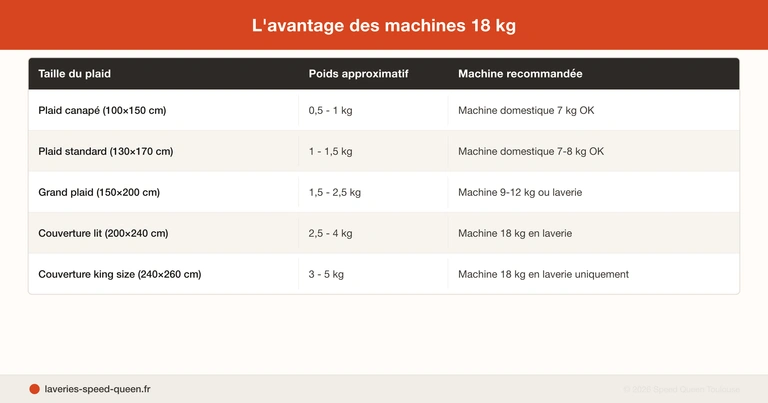
Fleece blankets and large throws pose a volume problem. A 150x200 cm throw weighs 1.5 to 2.5 kg — the 7-8 kg home machine seems suitable. But weight isn’t the only factor.
Volume matters more than weight
Fleece is a bulky fabric because of its raised fibers. A 2 kg throw takes up much more drum space than a 2 kg pair of jeans. For a throw to be properly washed and rinsed, it needs to unfold and turn over in the drum during the cycle. In a 52-58 liter machine (7-8 kg), a large throw is compressed and spins on itself without unfolding.
The advantage of 18 kg machines
Professional laundromat machines offer a 180 liter drum — three times the volume of a home machine. The throw unfolds fully, water and detergent circulate properly, and the rinse is complete. This is also why duvets and weighted blankets wash better at a laundromat.
| Throw size | Approximate weight | Recommended machine |
|---|---|---|
| Couch throw (100x150 cm) | 0.5 - 1 kg | Home machine 7 kg OK |
| Standard throw (130x170 cm) | 1 - 1.5 kg | Home machine 7-8 kg OK |
| Large throw (150x200 cm) | 1.5 - 2.5 kg | 9-12 kg machine or laundromat |
| Bed blanket (200x240 cm) | 2.5 - 4 kg | 18 kg laundromat machine |
| King size blanket (240x260 cm) | 3 - 5 kg | 18 kg laundromat machine only |
Washing frequency
Frequency depends on usage and skin contact.
Couch throw (daily use, no direct skin contact): every 2 to 4 weeks. The throw accumulates dust, pet hair, crumbs and contact sweat.
Bed blanket (direct skin contact): every 2 weeks, like sheets. How often to wash clothes and linens depends on skin contact.
Occasional throw (infrequent use): once a month or before each season change. Even unused, a throw stored in a closet accumulates dust.
For allergies: every 2 weeks at 30 °C minimum. Fleece traps dust mites in its fibers — regular washing is essential.
Common stains on a throw
Coffee / tea
Dab immediately with a cold damp cloth. Apply dish soap, leave for 10 min, then machine wash. See our guides: coffee stain, tea stain.
Chocolate
Scrape off excess. Cold water (not hot — chocolate contains proteins that coagulate). Dish soap on the stain, 15 min, machine. Guide: chocolate stain.
Red wine
Immediately sprinkle with fine salt (absorbs the wine). Rinse with cold water. Apply white vinegar or percarbonate in a soak. Guide: red wine stain.
Pet urine
Blot immediately. Dab with pure white vinegar (neutralizes ammonia odor). Sprinkle baking soda for 30 min for residual odor. Machine wash at 30 °C. Guide: urine stain.
Storage between seasons
For seasonal throws (winter blankets stored in summer), proper storage preserves softness and hygiene.
- Wash before storing — never store a dirty throw. Stains and organic residues attract moths and dust mites during storage.
- Dry completely — a throw stored while still damp develops mold and a musty smell.
- Fold loosely — don’t compress in a vacuum bag. Prolonged compression crushes the raised fibers and reduces softness.
- Cotton cover or pillowcase — protects from dust while letting the fabric breathe. No plastic bags.
- Add a lavender sachet — naturally repels moths and lightly scents.
Mistakes to avoid
- Traditional fabric softener — destroys fleece softness by flattening the fibers and blocking the air pockets. Use white vinegar.
- Washing above 30 °C — polyester warps and loses its structure in heat. The fleece becomes flat and rough.
- High-heat tumble dryer — softens and sticks surface fibers together. The fleece permanently loses its softness.
- Ironing — polyester melts at 180 °C. The iron creates shiny, stiff areas that are irreversible.
- Overloading the machine — increases friction and therefore pilling. One throw alone with space around it.
- Washing with denim or zipped clothing — denim abrades fleece, zippers catch and tear the fibers.
En tant que Partenaire Amazon, nous percevons une petite commission sur les achats effectués via les liens partenaires de cet article — sans surcoût pour vous. Cela nous aide à maintenir ce site et à produire des guides gratuits.
Your large throws and fleece blankets wash best in our 18 kg machines. Our laundromats in Blagnac, Croix-Daurade and Montaudran offer delicate programs at 30 °C with detergent included, and low-temperature tumble dryers. Payment CB sans contact ou espèces. Prices.