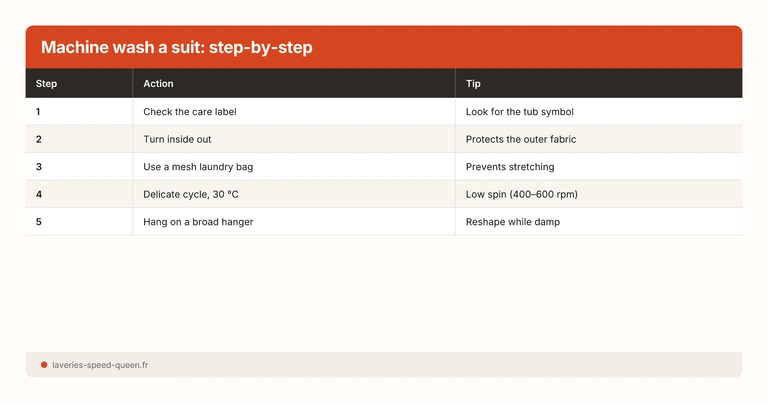
In a nutshell: Suits made of polyester, synthetic blends, or washable cotton can go in the machine at 30 °C on a delicate cycle, inside a mesh laundry bag. Suits that are 100 % wool, silk, or have a fused lining must go to the dry cleaner. Always check the label: a circle symbol (dry clean) without a cross means “professional cleaning recommended.” Machine vs dry cleaning cost: roughly 5 EUR versus 15-25 EUR.
At a Glance
Check the label — if it allows machine washing, you're good.
Mesh laundry bag is a must — protects the fabric and buttons.
Delicate cycle — low or no spin.
Hang immediately — put it on a hanger as soon as the cycle ends to prevent creases.
Never tumble dry — the suit deforms under heat.
Which Suits Can Be Machine Washed?
A polyester or synthetic-blend suit can generally be washed at 30 °C on a delicate cycle, while a 100 % fine wool suit should stay at the dry cleaner.
| Fabric | Machine? | Advice |
|---|---|---|
| 100 % Polyester | Yes | Easiest to care for, delicate cycle |
| Polyester/viscose | Yes | Delicate cycle, mesh laundry bag |
| Cotton (chino, summer) | Yes | Gentle cycle, may shrink slightly |
| Wool/polyester blend | If label ok | Wool program if label allows |
| 100 % Fine wool | Dry clean | Risk of felting in the machine |
| Silk / acetate lining | Dry clean | Loses shape and lustre |
| Pure linen | Possible but wrinkles | Gentle cycle, accept the natural crinkle |
Dry cleaning is mandatory for
Suits made of 100 % fine wool, designer suits with silk or acetate lining, and any suit whose label bears the  “dry clean only” symbol. See our delicate textiles guide and our dry cleaning guide.
By Fabric: Detailed Protocol
Each fabric reacts differently to washing. Here is the protocol suited to each fabric commonly used in suits.
Polyester and Synthetic Blends
Polyester is the easiest fabric to care for in the machine. It doesn’t shrink, doesn’t lose its shape, and dries quickly. This applies to the majority of off-the-rack suits (Zara, H&M, Mango, Celio).
Protocol: delicate or synthetic cycle, 30 °C, normal spin (800 rpm), dry on a hanger. Polyester even tolerates light ironing at low temperature (1 dot).
Cotton (Summer Suit, Chino)
Cotton is washable but can shrink, especially on the first wash. Pre-shrunk washed cotton summer suits are more stable.
Protocol: delicate cycle, 30 °C, moderate spin (600-800 rpm). Remove immediately and hang on a hanger. Iron while slightly damp to restore a clean drape. See our guide on preventing shrinkage.
Wool Blend (Wool/Polyester)
Wool/polyester blend suits (typically 50/50 or 60/40) can sometimes go in the machine, only if the label allows it. The polyester in the blend stabilizes the wool and limits felting.
Protocol: wool program only, 30 °C maximum, very gentle spin (400 rpm) or none. Mesh laundry bag mandatory. Dry flat or on a padded hanger.
Linen
Linen wrinkles naturally and this gets worse with washing. A linen suit can go in the machine, but you need to accept the “relaxed crinkle” that is part of the fabric’s aesthetic.
Protocol: delicate cycle, 30 °C, low spin. Iron while still damp at high temperature (3 dots) if a neater look is desired. Linen irons well when wet but very poorly once dry.
100 % Fine Wool (Super 100, 110, 120+)
Does not go in the machine. Fine wool felts on contact with hot water and mechanical agitation. Felting is irreversible: the fibre scales lock together and the fabric contracts, hardens, and loses all its drape.
Solution: dry cleaning, or professional aqua cleaning (specialist dry cleaner). See our guide to dry cleaning and its alternatives.
Suit Trousers vs Jacket: Separate Treatment
The jacket and trousers do not undergo the same stresses when worn and are not washed in exactly the same way.
Trousers: More Exposed, Easier to Wash
Suit trousers get dirty faster than the jacket (contact with chairs, perspiration, hems brushing the floor). They also handle washing better because they have no shoulder pads, no complex lining, and no structured buttonholes.
Specific tips:
- Wash them in a separate laundry bag from the jacket
- Pre-treat the seat and inner thigh areas (the most stressed zones)
- To re-form the centre crease, iron while still slightly damp by aligning the side seams
The Jacket: More Delicate, Handle With Care
The jacket contains the structural elements (shoulders, buttons, lining, lapels) that can lose their shape in the machine.
Specific tips:
- Mesh laundry bag mandatory, buttons fastened, turned inside out
- No spin or very low spin (400 rpm maximum)
- Remove immediately and hang on a padded hanger (not a wire hanger)
- Reshape the shoulders and lapels by hand while the fabric is still damp
Wash the trousers more often than the jacket
It is perfectly normal to wash the trousers 2 to 3 times more often than the jacket. The trousers are in direct contact with the body and surfaces. The jacket, worn over a shirt, stays cleaner for longer. This difference in rhythm does not affect the suit’s overall consistency.
Pre-treat Before Washing
Pre-treating stains is important for a suit, because delicate cycles do not have the power of an intensive cycle.
Collar and Cuffs: Sebum and Perspiration
The jacket collar accumulates sebum, sweat, and sometimes makeup. Gently rub the area with damp Marseille soap↗ before machine washing. For yellowed sweat marks, apply a baking soda paste for 30 minutes. See our guide to sweat stains and yellow marks for stubborn cases.
Sleeves and Trouser Hems
Jacket cuffs and trouser hems pick up dust, contact marks, and splashes. A dab of Marseille soap as a pre-treatment is enough in most cases.
Spot Stains (Sauce, Coffee, Wine)
For a food stain, treat it as quickly as possible before it sets. See our guides for tough stains, coffee stains, or red wine stains.
Preparation
Prepare each piece separately in a mesh laundry bag after emptying pockets and fastening buttons, to minimize friction on the jacket and trousers.
Empty all pockets — inside and outside.
Fasten all buttons — the jacket keeps its shape during washing.
Turn inside out — protects the outer fabric from friction.
Place in a mesh laundry bag — one bag per piece (jacket separate from trousers if possible).
Pre-treat stains — collar, cuffs, and trouser hems. Damp Marseille soap, rub gently.
Washing
Wash at low temperature with low or no spin, because a high spin permanently marks creases into suit fabrics.
Gentle cycle
Delicate or wool program depending on the label. Heat deforms shoulder pads and linings and can shrink the fabric.
Low or no spin
A high spin creates deep-set creases that are impossible to remove without ironing. Ideally: no spin at all if the fabric is thin.
Wash alone or with delicates
Do not mix a suit with jeans, towels, or heavy laundry. The agitation from heavy items damages the suit's fine fibres.
The Laundromat for Suits: An Alternative to Dry Cleaning
The self-service laundromat is an overlooked but highly relevant option for caring for washable suits. Professional machines offer several advantages over a home machine.
Why the Laundromat Works
- Large drum — Professional machines (9 or 18 kg) offer more space, which reduces friction and creasing. The suit is not compressed like in a 5-7 kg machine.
- Professional delicate cycle — Speed Queen machines offer dedicated programs with precise temperature and spin control.
- Pre-dosed detergent — No risk of overdosing that would leave residue on the suit fabric. The included detergent is mild and suitable.
- Cost — 4.90 to 5.50 EUR versus 15-25 EUR at the dry cleaner, i.e., 3 to 5 times cheaper.
The Right Program at the Laundromat
Choose the delicate cycle at 30 °C. If your suit is a wool blend, select the wool program if available. Set the spin to minimum. Remove the suit immediately at the end of the cycle and hang it on a hanger. For detailed pricing, see our dedicated page.
Drying and Finishing
Hang the suit as soon as the cycle ends and let it dry for about 24 hours on a wide hanger, without using a tumble dryer.
Drying is the key to a well-washed suit.
Never tumble dry
The tumble dryer deforms a suit: the shoulders crush, the fabric shrinks, the lining wrinkles. Hanger drying only.
Remove immediately — do not leave the suit in a ball inside the machine.
Hang on a padded hanger — a thin hanger creates marks on the shoulders. A padded or wooden hanger maintains the shape.
Smooth the fabric by hand — gently pull the fabric to eliminate creases while still damp.
Let dry for 24 hours — in a ventilated area, never pressed against other garments.
Garment steamer: the pro secret
A portable garment steamer (from 30 EUR) removes the last creases without touching the fabric. It is more effective and safer than ironing for suits. Free alternative: hang the suit in the bathroom during a hot shower — the steam relaxes the fibres.
Suit Trousers: Restoring the Centre Crease
To re-form the centre crease, iron the trousers while still slightly damp or hang them by the waist during full drying.
The trousers wash the same way as the jacket, but with special attention to the centre crease.
Restoring the trouser crease
The centre crease disappears in the wash. To restore it: iron the trousers while still slightly damp, pressing the crease with the iron. If you don’t have an iron, hang the trousers by the waist with clips, aligning the side seams — the weight of the water will partially re-form the crease. For ironing tips, see our guide to ironing a shirt, whose principles also apply to trousers.
Storage and Care Between Washes
A well-maintained suit on a daily basis needs fewer washes, which preserves its structure and lifespan.
The Hanger: First Investment
Invest in wide wooden hangers (not wire hangers from the dry cleaner). A proper hanger maintains the jacket’s shoulder shape and prevents deformation. The horizontal bar of the hanger should be wide enough to support the trousers folded at the centre crease.
Brushing After Each Wear
A natural-bristle clothes brush removes dust, lint, and dead fibres without damaging the fabric. Brush in the direction of the nap, from top to bottom. This 2-minute routine significantly extends the time between washes.
Mandatory Airing
Never put a suit straight into the wardrobe after wearing it. Hang it on a wide hanger in a ventilated room for 12-24 hours to release body moisture and odours. This airing time is essential for wool and blends.
Protective Garment Bag
Store your suits in breathable fabric garment bags (cotton or non-woven), never in dry-cleaner plastic that traps moisture. The bags protect against dust and moths while letting the fabric breathe.
Spot Treating Stains
For an isolated stain (drop of sauce, coffee), dabbing with damp Marseille soap is often enough. No need for a full wash for a single spot. See our tough stains guide for specific cases.
Steam Refresh
A vertical garment steamer is the best investment for a suit. It removes creases without contact or pressure, unlike an iron which can give the fabric an unwanted shine. For a full ironing guide, see our dedicated article.
Cost Comparison
A complete suit costs about 4.90-5.50 EUR at the laundromat versus 15-25 EUR at the dry cleaner, a gap of 10 to 20 EUR per wash.
| Service | Speed Queen Laundromat | Dry Cleaner |
|---|---|---|
| Complete suit (jacket + trousers) | 4.90-5.50 EUR | 15-25 EUR |
| Shirt only | ~1 EUR (in a load) | 3-5 EUR |
| Trousers only | ~3 EUR (in a load) | 6-10 EUR |
| Annual savings (1 suit/month) | ~66 EUR/year | ~240 EUR/year |
| Turnaround time | ~1 h (wash + dry, detergent included) | 2-5 days |
| Detergent | Included | Chemical solvents |
For a full overview of laundromat pricing or our laundromat vs dry cleaner comparison, see our guides.
Recommended Washing Frequency
| Wearing frequency | Washing frequency | Alternative |
|---|---|---|
| Daily (office) | Every 15-20 wears | Brushing + airing after each wear |
| Weekly | Every 2-3 months | Spot cleaning stains |
| Occasional (events) | 1-2 times per year | Brushing before storage |
Over-washing is as harmful as under-washing. Each machine cycle wears the fibres, loosens the structure, and fades the colours. A suit worn to the office with a t-shirt underneath (not directly on the skin) needs fewer washes than one worn in direct contact. For a full guide on clothing washing frequency, see our dedicated article.
When Dry Cleaning Remains Essential
Whenever a label says dry clean only, or if silk, acetate, or Super 100+ wool is present, the dry cleaner is the safest option to avoid deformation and felting.
Fine wool suits (Super 100+): dry cleaning preserves the fabric’s structure.
- Garments with acetate or silk lining: water can deform the lining.
Structured coats (trench, overcoat): shoulder pads and shape require dry treatment.
- Evening dresses, silk, velvet: always dry clean.
For a detailed breakdown of the selection criteria, see the full laundromat vs dry cleaner comparison.
Mistakes to Avoid
- Machine washing a fine wool suit — irreversible felting and deformation
- High spin — deep-set creases impossible to remove
- Tumble dryer — the suit will be deformed
- Leaving it in a ball after washing — permanent creases guaranteed
- Ironing too hot — burns synthetic fibres and creates an unwanted shiny finish
- Thin wire hanger — deforms the jacket shoulders and leaves marks
- Dry-cleaner plastic as a garment bag — traps moisture and encourages mould
As an Amazon Partner, we earn a small commission on purchases made through affiliate links in this article — at no extra cost to you. This helps us maintain this site and produce free guides.
Wash your suit with confidence at our laundromats in Blagnac and Croix-Daurade. Delicate cycle, detergent included, from 4.90 EUR. 3 times cheaper than the dry cleaner. See our pricing.