In a nutshell: A puffer jacket should be washed at 30 °C on a delicate programme (natural down) or 30-40 °C (synthetic), zipped up and turned inside out. Drying is the key step: low-temperature programme with 2-3 tennis balls to restore loft, checking every 15-20 minutes. Laundromat cost: around EUR 10-15 all in, versus EUR 15-30 at the dry cleaners.
At a glance
18 kg machine — the puffer jacket is bulky and needs space.
Delicate programme — heat damages the filling and membranes.
Low spin — to avoid crushing the down.
Drying with dryer balls — essential to restore loft.
Take out and shake every 15-20 min — redistributes the filling and speeds up drying.
Down vs synthetic puffer: the method changes
The filling composition fundamentally changes the washing approach. A synthetic puffer jacket is more forgiving, while a natural down jacket requires a strict protocol.
Synthetic puffer: more tolerant
Polyester fibre filling (Primaloft, Thermolite, standard wadding) absorbs little water. It dries quickly and regains its volume without any particular effort. If the filling clumps during washing, it redistributes easily during drying.
The synthetic protocol:
- Delicate or synthetic programme at 30 °C
- Moderate spin (600 rpm)
- Drying with balls: 2-3 cycles are usually enough
- Error tolerance: good (one cycle too hot will not be fatal)
Down puffer: demanding but not impossible
Natural down (goose or duck) is the best insulator for its weight, but it reacts badly to water. When wet, it clumps into compact masses that take a very long time to dry. It is in these clumps that mould develops if drying is incomplete.
The down protocol:
- Delicate programme at 30 °C maximum (ideally a wool programme)
- Very gentle spin (400 rpm) to avoid breaking the down clusters
- No fabric softener (it coats the feathers and reduces their loft)
- Long drying: 3 to 5 cycles at low temperature
- Take out and shake vigorously every 15-20 minutes
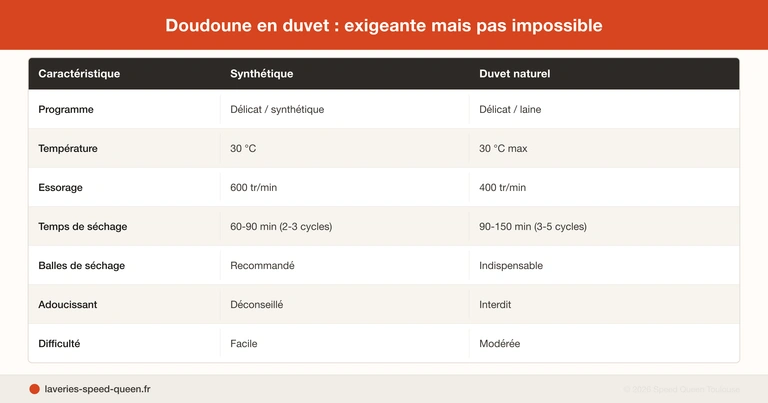
| Feature | Synthetic | Natural down |
|---|---|---|
| Programme | Delicate / synthetic | Delicate / wool |
| Temperature | 30 °C | 30 °C max |
| Spin | 600 rpm | 400 rpm |
| Drying time | 60-90 min (2-3 cycles) | 90-150 min (3-5 cycles) |
| Dryer balls | Recommended | Essential |
| Fabric softener | Not recommended | Prohibited |
| Difficulty | Easy | Moderate |
Preparation before washing
Check the care label — confirm that machine washing is allowed. See our delicate textiles guide if in doubt.
Empty all pockets — forgotten items can puncture the thin fabric of the jacket.
Close all zips and velcro — they can snag and tear the fabric during washing.
Turn the jacket inside out — the outer fabric will be less exposed to friction.
Pre-treat stains — collar, cuffs and pockets are often the dirtiest areas. Rub with damp Marseille soap.
Remove the fur-trimmed hood
If your puffer jacket has a fur-trimmed hood (real or synthetic), detach it before washing. Fur cannot withstand the machine: it felts, loses its volume and cannot be recovered.
Step-by-step washing
Wash a puffer jacket alone in an 18 kg machine, on a delicate programme at 30 °C with a gentle spin (400 to 600 rpm) to protect the filling.
Choose an 18 kg machine — the puffer jacket takes up a lot of space. A machine that is too small compresses the filling and prevents proper rinsing.
Select a delicate programme — too much heat can damage the seams, membranes and filling.
Start the cycle — detergent is included in our Speed Queen machines. No need to add any.
After the cycle, shake the jacket — redistribute the filling by hand before drying.
Wash only one puffer jacket at a time
Even in an 18 kg machine, a puffer jacket takes up a lot of space once wet. Wash it alone to ensure a proper wash and rinse.
Drying: the step that makes the difference
To restore a puffer jacket’s loft, dry it on a low heat setting with 2 to 3 dryer balls↗ and shake it every 15-20 minutes until the damp clumps are gone.
This is where the final result is decided. Poor drying = a flat jacket, with the filling clumped into balls that no longer insulate. See our complete drying guide to master this step.
Why the puffer jacket goes flat after washing
The filling (feathers or synthetic fibres) clumps together during washing. Water weighs down the feathers, which stick together. Without intervention, they dry in this compact position and the jacket permanently loses its loft. That is why active drying (with balls + shaking) is essential.
How to restore the loft
The process takes patience, but the result is guaranteed if you follow these steps:
- First cycle — Place the jacket in the tumble dryer on a low heat setting with 2-3 dryer balls. Start a cycle.
- Take it out after 15-20 minutes — Shake the jacket vigorously in all directions. Tap the compartments to break up clumps of filling.
- Start another cycle — Put the jacket back with the balls. Repeat the process (take out, shake, restart) until the filling is evenly distributed and dry to the touch.
- Final check — Press firmly on different areas, especially the seams and bottom (where moisture accumulates). If you feel cold or damp clumps, continue drying.
Dryer balls: the mechanism
Dryer balls (or clean tennis balls) bounce around in the drum and hit the filling with each rotation. This mechanical action breaks up clumps of feathers or fibres and redistributes them within the compartments. Without them, the filling stays stuck in clumps.
Low temperature is mandatory
Gentle heat, never high. Excessive heat melts synthetic membranes and damages feathers. Drying takes longer, but the result is better. Patience is the key.
Shake every 15-20 minutes
Take the jacket out and shake it vigorously in all directions to redistribute the filling. This step is just as important as the dryer balls. The more you shake, the more the loft returns.
Check drying is complete
Press different areas of the jacket, especially the seams and bottom. If you feel damp clumps, continue drying in short bursts. Filling that is still damp will develop mould and smell bad. A down jacket can seem dry on the surface while the inside is still damp.
Ultralight puffer vs thick winter jacket
The two types of puffer jacket are not treated the same way in the machine.
Ultralight puffer (packable)
Ultralight puffers (Uniqlo, Decathlon, Patagonia Nano Puff) are designed for lightness. The outer fabric is very thin (often 20-30 denier ripstop nylon), which makes it vulnerable to snags in the machine.
Specific precautions:
- Place the jacket in a mesh laundry bag to protect the fabric
- Spin at the absolute minimum (400 rpm)
- Drying is faster as the filling is thinner (2 cycles are enough)
- Watch out for zips: make sure they are fully closed, as an open zip can puncture the thin fabric
Thick winter puffer (ski, extreme cold)
Thick puffers (ski, expedition, extreme cold) contain denser filling and more resilient outer fabric. The main challenge is drying: the volume of filling means moisture takes much longer to escape.
Specific precautions:
- 18 kg machine essential (the jacket is too bulky for a 9 kg)
- Long drying: allow 4-5 tumble dryer cycles with shaking between each one
- Seams and the bottom of the jacket trap moisture: check these areas in particular
- For your other winter gear (fleece, Gore-Tex, merino), see our complete guide to washing ski gear
Special cases
Waterproof puffer jacket
Puffer jackets with a waterproof membrane may lose their water-repellency during washing. After thorough drying, apply a re-waterproofing spray if needed.
Quilted coat (not really a puffer)
Quilted coats in cotton or thick polyester (workwear style) are more resilient. They can handle a normal spin if the care label allows it. Check the label for the right setting. For classic coats and parkas, see our dedicated guide to washing a coat or parka.
When to use dry cleaning
Dry cleaning is the best option in certain specific situations:
- Leather puffer jacket — water washing would warp and stain the leather
- High-end technical membrane — some Gore-Tex or similar membranes need specialist treatment that only a specialist dry cleaner can provide
- Very high-end pieces — Moncler, Canada Goose with a non-removable fur collar, Dior: the cost of dry cleaning (EUR 25-40) is justified to protect an investment of several hundred euros
- Label says “dry clean only” — if the crossed-out washtub symbol is present, follow the manufacturer’s instructions
For a full comparison between laundromats and dry cleaners, see our laundromat vs dry cleaner guide.
Specialist dry cleaner ≠ standard dry cleaner
For high-end puffer jackets, look for a specialist “technical clothing” or “outdoor” dry cleaner that uses aqua cleaning (water-based, no solvent) with suitable products. A standard dry cleaner using perchloroethylene can damage the filling. See our guide on
dry cleaning and its alternatives
.
When to wash your puffer jacket
At the end of winter
Wash your puffer jacket before storing it for the season. A garment stored clean will not develop bad odours and will not attract moths. For all your winter gear, see our complete guide to washing ski gear.
At the start of winter
If your puffer jacket has spent 6 months in a cupboard, a quick wash freshens it up and restores the filling's loft. Professional drying restores the loft lost during storage.
Recommended washing frequency
A puffer jacket worn daily in winter (November to March) benefits from 2 washes per season: one mid-winter if odours or stains appear, and an end-of-season wash before storage. Occasional wear (weekends, outings) only requires one wash per year, at the end of the season.
The collar, cuffs and inner pockets are the areas that get dirty fastest. If only these areas are affected, spot cleaning with Marseille soap↗ may be enough without a full wash. For a general guide on clothing washing frequency, see our dedicated article.
How much does it cost
A full puffer jacket wash at a laundromat typically costs EUR 14-16 (EUR 9.80-10 for washing + EUR 4.50-6 for drying), versus EUR 15-25 at a dry cleaner.
| Service | Speed Queen laundromat | Dry cleaner |
|---|---|---|
| Puffer jacket wash | EUR 9.80-10 (18 kg machine) | EUR 15-25 |
| Drying | EUR 4.50-6 (depending on duration) | Included |
| Total | EUR 14-16 | EUR 15-25 |
| Detergent | Included | Chemical solvents |
| Turnaround | ~1h30 (wash + dry) | 3-5 days |
For a full overview of laundromat prices or Speed Queen rates in Toulouse, see our dedicated guides.
Laundromat vs dry cleaner: what is the difference
A dry cleaner charges EUR 15-25 for a puffer jacket, with a 3-5 day turnaround. At Speed Queen, washing + drying costs EUR 14-16 and takes ~1h30, with detergent and softener included.
Dry cleaning remains relevant for leather puffers, structured coats or very high-end pieces whose label specifically recommends dry cleaning. For a standard puffer jacket (synthetic or down), the washing machine is sufficient and the result is often better thanks to the water wash, which removes odours and perspiration more effectively than solvent. For a detailed laundromat vs dry cleaner comparison, see our complete guide.
End-of-season storage
After the end-of-winter wash, storage is the next step. Proper storage preserves the loft and avoids unpleasant surprises in autumn.
Do not compress — avoid vacuum bags that crush the filling for months. Store the jacket loosely folded in a breathable fabric garment bag, or hang it on a wide hanger in an airy cupboard.
Store in a dry place — residual moisture in the filling generates mould and odours within weeks. Make sure the jacket is perfectly dry before storing.
Moth protection — moths only attack animal fibres (goose down, feathers). If your jacket is natural down, add a lavender sachet or cedar block in the cupboard. Synthetic puffers are not affected.
For all your winter gear (fleece, Gore-Tex, merino), see our complete guide to washing ski gear.
Mistakes to avoid
- Machine too small — the compressed jacket will not be properly washed or rinsed
- Excessive heat — damages filling, seams and membranes
- High spin — compresses the down and can tear the internal baffles
- Forgetting dryer balls — clumped filling guaranteed
- Storing a still-damp jacket — mould and musty smell
- Washing fur in the machine — it will be permanently ruined
- Using fabric softener — reduces the loft of feathers and synthetic fibres
- Skipping the shake between cycles — the filling stays in clumps and the jacket dries poorly
As an Amazon Associate, we earn a small commission on purchases made through the affiliate links in this article — at no extra cost to you. This helps us maintain this site and produce free guides.
Does your puffer jacket need a good wash? Our laundromats in Blagnac, Croix-Daurade and Montaudran have 18 kg machines ideal for puffer jackets and coats. Detergent included, professional drying, payment CB sans contact ou espèces. See our prices.
Sources and references
- Delicate textiles: gentle programmes
- Drying guide (loft and residual moisture)
- Laundromat vs dry cleaner: choosing criteria
- Washing a coat or parka
- Washing ski gear
- Laundromat prices in 2026
- Textile care symbols (GINETEX / ISO 3758) (lien externe)
- European Outdoor Group: Down Washing Guidelines (lien externe) (accessed March 2026)