In a nutshell: Jeans should be washed at 30 °C, turned inside out, on a delicate cycle with spin limited to 800 rpm. Raw denim (selvedge) should be washed as rarely as possible (every 6 months). Stretch jeans are most vulnerable to tumble-dryer heat, which destroys elastane. Black jeans require a special dark-clothes detergent and white vinegar to keep their intensity.
At a glance
Always turn inside out — to protect the fibres and the indigo colour.
30 °C maximum — to prevent shrinkage and fading.
800 rpm spin max — a faster spin creates permanent white lines (creases).
No tumble dryer — especially for stretch jeans (elastane).
5 to 10 wears between washes — washing too often wears out denim prematurely.
Why jeans bleed: the chemistry of indigo
Unlike most garments where the dye penetrates to the core of the fibre, classic blue jeans use indigo. It is what is called a vat dye: the pigment is deposited in successive layers on the surface of the fibre, without a strong chemical bond.
It is this characteristic that allows jeans to “patina” and develop unique fading at areas of friction. However, in the machine, this instability becomes a drawback. With each wash cycle, mechanical friction removes a thin layer of indigo.
The salt and vinegar myth
You often hear that soaking jeans in salted or vinegared water “sets” the colour. Scientifically, this is inaccurate for modern industrial indigo, which is already set at the factory. Vinegar can help neutralise the alkalinity of harsh detergents and temporarily close the fibres, but it will not stop the natural loss of pigment. The only real protection remains cold washing and turning inside out.
Raw vs pre-washed jeans: two different approaches
A pre-washed jean (the majority sold in shops) has already undergone industrial treatment: washing, sanding, enzymes. The fabric is stabilised, the colour is set and shrinkage has already occurred. Care is straightforward: machine at 30 °C, delicate cycle, no special precaution.
A raw jean, on the other hand, has not been washed after weaving. The fabric is stiff, starched, and the indigo dye is at maximum intensity. It is a different product, with a different philosophy.
The first wash of raw jeans: the crucial step
The first wash of raw denim determines its future. The wear marks (whiskers at the thighs, honeycombs behind the knees) form during the months of wear before this first wash. That is why denim enthusiasts wear their jeans 6 months to 1 year before soaking them.
How to proceed for the first wash:
- Fill a bath with cold water (never above 20 °C)
- Submerge the jeans turned inside out without crumpling
- Add a teaspoon of white vinegar↗ to neutralise the pH
- Soak for 45 minutes without agitating
- Rinse with clean water and gently wring by hand
- Dry flat, in the shade, away from direct sunlight
After this first soak, care is similar to regular jeans, but always cold and sparingly.
Pre-washed jeans: standard care
For pre-washed jeans (stretch, slim, regular, bootcut), care is more flexible. The fabric has been treated to withstand the machine. Simply follow the basic rules: 30 °C, inside out, moderate spin. For more on washing temperatures, see our dedicated guide.
Raw, stretch or stonewashed: which treatment?
Not all denims are created equal when it comes to the washing machine. Depending on the composition and type of fabric, the treatment must vary.
Raw / Selvedge jeans
Wash as rarely as possible (ideally every 6 months) to create your own wear patterns. Cold water only, no detergent or very little, to preserve the starch.
Stretch jeans (elastane)
The most fragile. Never exceed 30 °C. Heat degrades the polyurethane in elastane, causing the jeans to 'bag' at the knees and seat.
Stonewashed jeans
Already stabilised at the factory, they handle frequent washes better. 30-40 °C is possible, but always inside out to prevent the drum from creating white marbling.
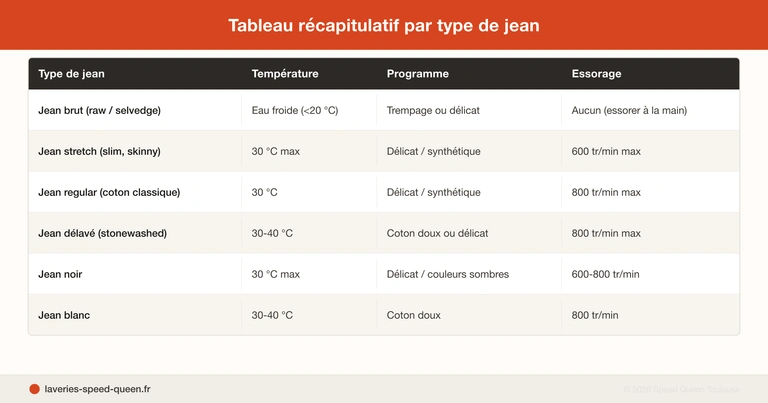
Summary table by jean type
| Jean type | Temperature | Cycle | Spin | Wash frequency |
|---|---|---|---|---|
| Raw denim (raw / selvedge) | Cold water (<20 °C) | Soak or delicate | None (hand wring) | Every 6 months |
| Stretch jeans (slim, skinny) | 30 °C max | Delicate / synthetic | 600 rpm max | Every 5-7 wears |
| Regular jeans (classic cotton) | 30 °C | Delicate / synthetic | 800 rpm max | Every 7-10 wears |
| Stonewashed jeans | 30-40 °C | Gentle cotton or delicate | 800 rpm max | Every 5-8 wears |
| Black jeans | 30 °C max | Delicate / dark colours | 600-800 rpm | Every 5-7 wears |
| White jeans | 30-40 °C | Gentle cotton | 800 rpm | Every 3-5 wears |
The step-by-step washing method
To ensure the longevity of your jeans, follow these essential steps when machine-washing.
Preparation — Close buttons and zips (the metal teeth can damage the fabric during tumbling). Turn the jeans inside out.
Temperature — Set to 30 °C. See our guide on washing temperatures to understand the thermal impact on fibres.
Cycle — Choose a delicate or synthetic cycle. Avoid intensive "cotton" programmes that crease the fabric too much.
Spin — 800 rpm is the recommended maximum. A faster spin (1,200+ rpm) creates permanent white lines on the fabric (creases).
Sorting — Wash jeans with other dark clothes to prevent colour transfer. To estimate your machine load, see our article on the weight of jeans.
Preserving colour: the complete method
Fading is the number one problem with jeans. While it is unavoidable in the long run, you can slow it considerably by combining several techniques.
Turn jeans inside out: mechanical protection
This is the most effective and simplest action. By turning jeans inside out, friction against the drum and other clothes occurs on the inner surface, sparing the visible side. This simple habit can double the lifespan of the colour.
Dark-clothes detergent: chemical protection
Standard detergents contain optical brightening agents that gradually dull dark colours. Use a liquid detergent labelled “dark colours” or “black”, formulated without optical brighteners. Powder detergents are more abrasive and not recommended for denim.
Cold water: thermal protection
The hotter the water, the more the cotton fibre pores open, and the more indigo escapes. At 30 °C, colour loss is noticeably lower than at 40 °C. For raw or black jeans, cold washing (below 20 °C) is ideal.
White vinegar: anti-limescale protection
A glass of white vinegar in the softener compartment neutralises limescale residue that makes denim dull and greyish. It is not a colour fixative in the chemical sense, but it helps maintain the fabric’s lustre. For more on white vinegar and laundry, see our dedicated guide.
No conventional softener
Softener deposits a film on fibres that can dull the surface of denim. If you want to soften your jeans, white vinegar fulfils this function without the drawbacks. See our article on softener: useful or not for more information.
Wash frequency: the right balance
There are two schools of thought. On one side, denim purists (and even the CEO of Levi’s) recommend never (or almost never) washing jeans. On the other, the reality of daily hygiene.
The ideal compromise? Wash your jeans every 5 to 10 wears. This range is a consensus among denim brands and textile experts. A day at the office (sitting) puts less strain on jeans than a full day of outdoor walking.
Between washes: the alternatives
- Airing — Hang the jeans in the open air (balcony, hanger near a window) for 24 hours. Air eliminates most odours without stressing the fibres.
- Spot cleaning — For a small stain, clean locally with a damp cloth and a little neutral soap. Gently rub the area without wetting the entire garment.
- The freezer — A controversial but popular method among raw denim enthusiasts. Place the jeans in a plastic bag in the freezer for 24 hours. The cold kills some odour-causing bacteria. Scientists are divided on actual effectiveness, but this method poses no risk to the fabric.
- Textile deodorising spray — Effective between washes to neutralise perspiration odours without wetting the fabric. Spray and leave to dry.
The Speed Queen tip
If your jeans are starting to stretch out, a quick wash at 30 °C will help the cotton fibres contract to restore shape. This is particularly effective on regular jeans in 100% cotton.
Black jeans: extra precautions
Black jeans pose a specific challenge: the black dye (sulphur or reactive) is even more unstable than blue indigo. Black jeans can turn grey in just a few washes without precautions.
Why black fades faster
Unlike indigo, which creates an appreciated “patina” effect, a black jean that bleeds simply looks dull and unattractive. Black dye bonds differently: it penetrates the fibre more but remains sensitive to the chemical agents in detergents.
The black jeans protocol
- Always inside out — non-negotiable for black
- Liquid detergent for dark clothes — without optical brighteners or bleaching agents
- 30 °C maximum — ideally cold
- White vinegar — half a glass in the softener compartment with every wash
- No tumble dryer — heat accelerates dulling
- Shade drying — direct sunlight fades black even faster than blue
- Wash only with other blacks — to prevent colour transfer to lighter garments
For a complete guide on how often to wash clothes, see our dedicated article.
Tumble dryer: yes or no?
The tumble dryer is the number one enemy of jeans. Why?
- Shrinkage: Moist heat causes cotton fibres to contract. This is the number 1 cause of jeans becoming too short after a machine cycle. More info on why the tumble dryer shrinks clothes.
- Elastane damage: If your jeans contain more than 1% elastane (skinny, slim), the heat cooks the plastic. Result: the jeans lose their stretch and no longer snap back into shape.
- Accelerated fading: Heat opens fibre pores and releases more pigment. One tumble-dry cycle is equivalent, in terms of colour loss, to 2-3 washes.
The alternative: Flat drying, away from direct sunlight (which fades indigo even faster than the machine). For all best practices, see our complete drying guide.
Do jeans shrink in the wash?
Yes, almost systematically during the first water wash. Cotton is a natural fibre that moves.
| Jean type | Estimated shrinkage | Prevention tip |
|---|---|---|
| Raw denim (Sanforized) | 1 to 3% | Cold wash, flat drying |
| Raw denim (Unsanforized) | 5 to 10% | Buy 2 sizes up, cold soak |
| Stonewashed / Stretch | Less than 1% | Keep to 30 °C, no tumble dryer |
To avoid unpleasant surprises, see our full guide to preventing clothes from shrinking.
Special cases
- White jeans: Wash separately to prevent them turning grey or blue. Using sodium percarbonate↗ can help maintain their brightness. See our guide to sodium percarbonate for laundry.
- Embroidered jeans or jeans with patches: Use a laundry bag to prevent threads catching in the drum.
- Coated or waxed jeans: Never put them in the machine. A simple wipe with a damp sponge is enough, as washing would destroy the wax layer.
- Tailored / suit jeans: For lightweight denim suit trousers, follow the advice in our guide to washing a suit in the machine.
- Grease-stained jeans: Pre-treat with Marseille soap↗ or washing-up liquid before machine washing. See our guide to removing grease stains.
Mistakes to avoid at all costs
- Hot water (40 °C+) — your jeans risk losing a size and elastane degrades.
- Overloading the machine — jeans need space to avoid permanent fading creases.
- Too much detergent — chemical residue can weaken cotton fibres and dull the colour.
- Leaving jeans in a ball after the cycle — hang them immediately to prevent musty odours and creases.
- Bleach — even on white jeans, it yellows and weakens the denim.
- 1,200 rpm spin — creates irreversible white creases on seams and pockets.
- High-heat tumble dryer — guaranteed shrinkage, especially on new or stretch jeans.
As an Amazon Partner, we earn a small commission on purchases made through the affiliate links in this article — at no extra cost to you. This helps us maintain this site and produce free guides.
A large professional drum reduces friction and limits colour loss from your jeans. Our laundromats in Blagnac, Croix-Daurade and Montaudran offer machines with pre-dosed detergent (no risk of overdosing). Payment CB sans contact ou espèces. Prices.
Sources and references
- Preventing clothes from shrinking
- Washing temperature guide
- How much do jeans weigh?
- Laundry care symbols and labels
- White vinegar and laundry: uses and limits
- How often to wash clothes
- Levi’s: The Definitive Guide to Caring for Your Jeans (lien externe) (accessed March 2026)
- Nudie Jeans: To Wash or Not to Wash (lien externe) (accessed March 2026)
- Washing chinos or corduroy trousers
- Heddels: The Ultimate Guide to Raw Denim (lien externe) (accessed March 2026)