In a nutshell: In a professional tumble dryer, allow 20-30 minutes for thin fabrics and 40-60 minutes for thick textiles (towels, jeans). Low heat for synthetics and delicates, medium for cotton. Don’t overload the drum: laundry must be able to tumble freely. Common mistake: drying too long damages fibres and wastes energy.
At a glance
Prepare properly -- spin suited to durable fabrics and sort by thickness to save time.
Choose the right setting -- follow the care label and match the most delicate fabric.
Check at the end of the cycle -- feel the thick areas and add short increments if needed.
Drying times by fabric type
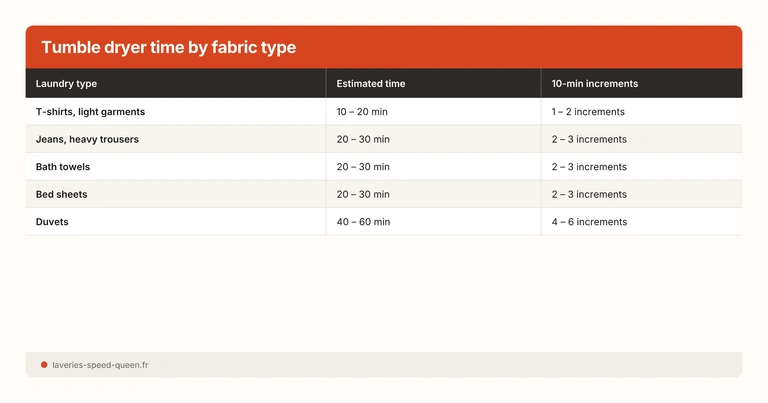
In practice, allow 10-20 minutes for lightweight items, 20-30 minutes for jeans/towels, and up to 40-60 minutes for a duvet.
To speed up drying of bulky loads (duvets, towels), toss 2-3 wool dryer balls↗ into the drum: they separate fabrics and improve air circulation. If you’re drying delicate items (lingerie, fine knits), protect them with a mesh laundry bag↗ to prevent snagging in the drum.
Here are the approximate times for a properly loaded drum (about two-thirds full) after a standard spin cycle:
| Type of laundry | Estimated time | 10-min increments |
|---|---|---|
| T-shirts, lightweight clothing | 10-20 min | 1-2 increments |
| Jeans, heavy trousers | 20-30 min | 2-3 increments |
| Bath towels | 20-30 min | 2-3 increments |
| Sheets | 20-30 min | 2-3 increments |
| Duvets | 40-60 min | 4-6 increments |
Times by machine programme
Each dryer programme is a temperature + duration combination optimised for a specific fabric type — choosing the wrong one can add 15 to 20 minutes to the cycle.
The times below are approximate for a properly loaded 14 kg professional dryer (two-thirds of the drum):
| Programme | Estimated time | Temperature |
|---|---|---|
| Cotton (normal) | 40-60 min | High heat ~80 °C |
| Synthetic | 25-40 min | Warm air ~45 °C |
| Delicate / Wool | 30-50 min | Cool air ~30 °C |
| Express (small load) | 15-25 min | High heat |
| Bulky (duvets, pillows) | 50-90 min | Medium temperature ~65 °C |
Recommended temperatures
The practical benchmarks are simple: ~80 °C for durable cotton, ~65 °C for everyday items, and ~45 °C for synthetics and sportswear.
The common temperature trap
Most guides stop at “low” or “medium” temperature. In practice, the most common mistake is not lacking heat but choosing a temperature too high for the fibre or mixing fabrics with different needs. If you’re mainly wondering why a load comes out still damp, also read
our full diagnosis for damp laundry after tumble drying
.
| Setting | Temperature | Suitable fabrics |
|---|---|---|
| High heat | ~80 °C | Towels, cotton sheets, tea towels |
| Medium temperature | ~65 °C | T-shirts, shirts, jeans, cotton underwear |
| Warm / cool air | ~45 °C | Synthetics, sportswear, leggings, swimwear |
These times vary depending on the initial spin speed, fabric thickness, and how full the drum is. An overloaded drum can double the drying time. When in doubt, run a short cycle and check before running another.
In practice, a full wash + dry cycle at a laundromat in Toulouse takes about 1 hour. Our professional Speed Queen dryers dry faster than a domestic appliance thanks to a higher airflow rate. See the drying prices by location, our guide to choosing the right machine, and use our laundry weight calculator to estimate your load before you come.
Detailed chart by fabric type
The right setting depends on the fibre AND the use. A 100% cotton t-shirt doesn’t dry at the same temperature as a cotton fitted sheet — the t-shirt has seams, prints, and sometimes elastane that can’t handle the same heat.
| Fabric | Recommended temperature | Typical programme | Precaution |
|---|---|---|---|
| White cotton sheets, pillowcases | High (70-85 °C) | Cotton / Intensive | Remove promptly to limit creasing |
| Terry towels | High (70-85 °C) | Cotton / Intensive | Take longer than clothing — don’t mix |
| Cotton tea towels | High (70-85 °C) | Cotton | Durable, handles heat well |
| Cotton t-shirts, polos | Medium (55-65 °C) | Mixed / Everyday | Watch out for prints and cotton-elastane blends |
| Jeans, denim | Medium (55-65 °C) | Mixed / Everyday | Remove slightly damp to prevent shrinkage |
| Cotton/linen shirts | Medium (55-65 °C) | Mixed / Ironing | Remove slightly damp to make ironing easier |
| Cotton underwear | Medium (55-65 °C) | Mixed | Elastane in briefs/boxers limits maximum heat |
| Sportswear (polyester) | Low (40-50 °C) | Synthetic / Delicate | Heat degrades membranes and elasticity |
| Lingerie, lace | Low or cool air | Delicate | Use a mesh laundry bag in the drum |
| Wool (if label allows) | Low (40 °C max) | Wool / Delicate | Risk of felting — always check the label |
| Silk | No tumble dryer | — | Air-dry flat only |
| Synthetic duvet | Medium (55-65 °C) | Bulky / Duvet | Add dryer balls, check the centre |
| Down/feather duvet | Low to medium (50-60 °C) | Delicate / Bulky | No fabric softener. Dryer balls to redistribute filling |
Preparing laundry before drying
A proper spin cycle and sorting by thickness often saves a full 10-minute increment on a mixed load.
Preparation makes a real difference to drying time. A few simple habits save time.
Spinning
Well-spun laundry retains much less water. If your machine allows it, use the highest spin speed suited to durable fabrics.
Shaking out
Shake each item before placing it in the dryer. This separates the fibres so hot air circulates better.
Sorting by thickness
T-shirts dry much faster than jeans. Whenever possible, separate thin items from thick ones.
Two cases where the dryer helps beyond just drying
Loading the drum properly
The best efficiency is achieved with a drum filled to two-thirds, leaving free space for hot air to circulate.
An overfilled drum blocks airflow; an underfilled drum dries less efficiently. The goal: two-thirds full with laundry evenly spread.
Leave space -- keep roughly a hand's width above the laundry so air can circulate.
Spread items out -- avoid bunched-up sheets or covers, as they dry much more poorly.
Match the most delicate fabric -- if mixing, choose the setting suited to the most fragile textile.
Close zips and buttons -- this prevents snagging and unnecessary friction.
Choosing the right setting
When mixing fabrics, always choose the setting for the most delicate item, even if the cycle runs 10 minutes longer.
The setting depends on the fabric type and care label. Here are the broad guidelines:
High heat
Reserved for durable fabrics: bath towels, cotton sheets, tea towels. The heat also helps keep towels soft and fluffy.
Medium temperature
The versatile setting for most everyday clothing: t-shirts, shirts, jeans, cotton underwear.
Cool or warm air
Essential for technical and synthetic fabrics: sportswear, leggings, swimwear. High heat can deform these materials and make them lose their stretch. For technical winter gear, see our guide to washing ski gear.
Drying symbols on the care label
The care label is the only reliable reference for each garment. The tumble-dry symbol is a square with a circle inside (GINETEX / ISO 3758 standard). The dots indicate the maximum heat level.
One dot (●) = low temperature
Drying allowed only at low temperature (~40-50 °C). This is the setting for synthetics, lingerie, and some treated wools. At a laundromat, use the "warm air" setting.
Two dots (●●) = normal temperature
Drying at normal temperature is allowed (~60-80 °C). This covers most cottons, household linens, and durable fabrics. At a laundromat, "medium" or "high" settings are fine.
Crossed-out symbol (✕) = prohibited
Machine drying is discouraged or prohibited. This is common for silk, some wools, items with glued elements, and certain technical garments. Air-dry instead.
To decode all care symbols (washing, drying, ironing, bleaching), see our complete care label guide.
When to use cool air
Cool air (or “air fluff”) tumbles the drum without heating — it’s the gentlest setting, suitable for almost all fabrics.
Refreshing a garment
10-15 minutes on cool air removes light creases and odours without washing or heating. Handy for a coat or blazer between wearings.
Softening stiff fabric
Air-dried towels can become stiff. A short cool-air cycle softens them without heat or wear.
Removing pet hair
The drum movement + lint filter effectively captures dog or cat hair. Gentler than a lint roller and more effective at scale.
Testing dryness and avoiding over-drying
Checking thick areas (pockets, seams, towels) every 10 minutes prevents shrinkage from over-drying.
Over-dried laundry can shrink, become rough, or lose elasticity. The goal is to stop the cycle when the laundry is just dry.
Testing thick areas
Check seams, pockets, and towels. If any areas feel cool or damp, run another short increment.
Stopping at the right time
Remove laundry as soon as it's dry. Residual heat finishes evaporating moisture and prevents over-drying.
If laundry is still damp after a full cycle
Don’t just rerun blindly. First check the filter, the programme, the washing machine’s spin speed, and whether you mixed different thicknesses. We’ve laid out the full diagnostic sequence in
why laundry comes out damp from the tumble dryer
.
Short cycle + check
When you’re unsure, opt for a short cycle and then check. It’s gentler on fabrics and often more economical.
Tips that make a real difference
Adding 2 to 3 dryer balls↗ typically cuts drying time by 10 to 15% on bulky loads.
Dryer balls
Adding 2-3 wool dryer balls to the drum helps separate laundry and improves air circulation. Result: drying time reduced by about 10-15%. They're reusable and last several hundred cycles.
They're especially useful for duvets and pillows, helping keep them fluffy by preventing filling from clumping. To estimate the weight of your load before drying, see our laundry weight guide.
Drying in stages
For a load with fabrics of different thicknesses: run a first short cycle, remove the dry pieces, then run another cycle for the items still damp.
This prevents over-drying thin fabrics.
Fabrics you should not tumble dry
As soon as the label shows the crossed-out tumble-dry symbol, switch to air-drying to avoid irreversible shrinkage or deformation.
Some fabrics cannot withstand the tumble dryer. See our delicate fabrics guide for how to handle them.
- Silk -- can crease permanently
- Fine lace -- risk of deformation
- Garments with glued elements (prints, rhinestones) -- heat can detach them
- Untreated wool -- risk of felting and shrinkage
- Elastane garments on high heat -- loss of elasticity
When in doubt, check the care label on your clothes. The  symbol (square with a circle inside) indicates whether machine drying is allowed. Crossed out
  , it is prohibited. If you air-dry these fabrics at home, beware of humidity: each load releases about 2 litres of water into the air. And if creases persist afterwards on your shirts, use our step-by-step ironing method.
How dryers detect moisture
Modern tumble dryers use moisture sensors that measure the electrical conductivity of fabrics in contact with two electrodes inside the drum.
There are two technologies: timer-based dryers (older generation) that run for a fixed duration regardless of residual moisture, and sensor-based dryers (current generation) that stop the cycle as soon as the laundry is dry. The principle: damp fibres conduct electricity; dry fibres don’t. When the measured conductivity drops below a preset threshold, the cycle stops automatically. The result: no over-drying, energy savings, and fibre protection. Our Speed Queen ST030 dryers use this technology.
Our professional dryers
The laundromats are mainly equipped with 14 kg dryers, with a 16 kg model as a complement at Croix-Daurade for large loads.
Our laundromats are equipped with professional Speed Queen dryers (model ST030) with a 14 kg capacity:
- Blagnac Andromede — 4 x 14 kg dryers
- Croix-Daurade — 2 x 14 kg dryers + 1 x 16 kg dryer
These professional dryers use a concentrated axial airflow: hot air contacts the laundry at the optimal point in the rotation cycle. Combined with a large-capacity drum and higher heating power, drying time is 30 to 40% shorter than with a domestic dryer for a comparable load.
For a large load (sheets, duvets), you can split the laundry across two dryers running in parallel: same duration, twice the throughput.
Domestic vs commercial: the numbers
| Criterion | Domestic | Commercial (laundromat) |
|---|---|---|
| Airflow | Radial (peripheral circulation) | Concentrated axial (passes through laundry) |
| Heating power | Standard (~2 kW) | High — 30-40% faster drying |
| Drum size | Compact (8-9 kg) | Large (14-25 kg) — better air circulation |
| Automatic shut-off | Timer or basic sensor | Precise moisture sensor — stops at the right moment |
| Time for a cotton load | 60-90 min | 30-50 min |
Why commercial drying can be gentler
Faster drying isn’t necessarily harsher. The larger drum lets laundry move freely (less friction), and the moisture sensor stops the cycle as soon as the laundry is dry — no over-drying. At a Speed Queen laundromat, three temperature levels let you tailor drying to each fabric type.
How much does drying cost
The cost is calculated in 10-minute increments: EUR 1.50 to EUR 2.00 depending on the machine, typically EUR 3.00 to EUR 4.50 for 20-30 minutes.
Drying is charged at EUR 1.50 to EUR 2.00 per 10-minute increment depending on dryer capacity. See our detailed pricing.
| Type of load | Average time | Cost |
|---|---|---|
| T-shirts, underwear | 10-20 min | EUR 1.50 - 3.00 |
| Jeans, towels, sheets | 20-30 min | EUR 3.00 - 4.50 |
| Full mixed load | 30 min | EUR 4.50 |
With the loyalty card (-20% on everything), the drying cost drops to EUR 1.20 per increment.
Reducing the number of increments
The practical goal is to save 1 to 2 ten-minute increments per visit by combining good spinning, an even load, and a drum that isn’t overloaded.
A few habits save one or two increments every time:
Spin well -- this is the most important factor. Well-spun laundry dries in one cycle instead of two.
Don't overload -- paradoxically, putting in less laundry lets it dry faster.
Choose the right temperature -- high heat isn't always necessary.
Group similar fabrics -- an even load dries uniformly.
Common mistakes to avoid
The five mistakes below account for most drying problems: shrinkage, still-damp laundry, or excessive energy use.
- Drying everything at the same temperature -- synthetics shrink and lose their stretch on high heat. Towels don't dry properly on low. Sort your loads.
- Overloading the drum -- hot air needs to circulate around each item. A drum filled to the brim dries poorly and unevenly.
- Ignoring the care label -- a crossed-out symbol means prohibited. Even if it "looks like it'll be fine", heat can damage fibres irreversibly.
- Leaving laundry in the drum after the cycle -- residual heat keeps warming the laundry. Remove it promptly to limit shrinkage and creasing.
- Mixing thick and thin fabrics -- t-shirts dry in 15 min, towels in 40 min. The t-shirts over-dry and shrink while the towels finish their cycle.
See our detailed pricing by location for the full wash
- dry cost. Our Toulouse Croix-Daurade laundromat, our Blagnac Andromede laundromat, and our upcoming Montaudran laundromat are open 7j/7 de 7h à 22h. Have a question about drying? Contact us for personalised advice. Unsure whether to choose a laundromat or dry cleaner? See our laundromat vs dry cleaner comparison.
As an Amazon Associate, we earn a small commission on purchases made through the affiliate links in this article — at no extra cost to you. This helps us maintain this site and produce free guides.
Methodology and sources
- Performance benchmarks are aligned with manufacturer documentation: professional dryers (higher airflow than domestic models) routinely reduce drying time by about 30-40% for a comparable load, and reversing drum technology limits tangling of large items (Speed Queen Commercial - Tumble Dryers (lien externe) ; GINETEX / ISO 3758 (lien externe)).
Sources and references
- Textile care symbols (GINETEX / ISO 3758) (lien externe)
- Speed Queen Commercial - Tumble Dryers (lien externe)
- Speed Queen ST030 — manufacturer specifications (lien externe) — axial airflow, 14 kg drum
- Haier France, Quel programme de séchage choisir ?, published 26 August 2025
- BUT, Quel programme de sèche-linge sélectionner pour ne pas rétrécir ?, published 3 February 2026
- How to wash a duvet (bulky drying)
- Tumble-dry prohibited symbol: what to do?