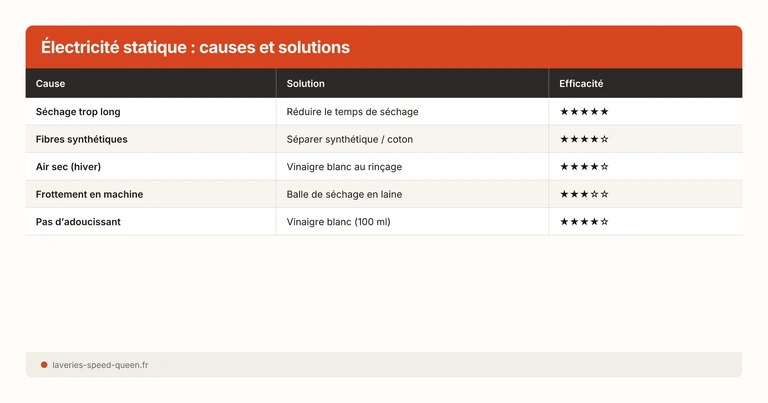
In short: static electricity in laundry is caused by friction between synthetic fibres in dry air — exactly the conditions inside a tumble dryer. The solutions: sort by fibre (separate synthetics from cotton), wool dryer balls (maintain moisture and separate laundry), white vinegar in the rinse (removes insulating residues), and above all do not over-dry. Professional dryers at the laundromat, with their automatic stop sensor, produce less static.
At a glance
Synthetics = static — polyester and nylon are the main culprits. Cotton and linen dissipate charges.
Over-drying = worst enemy — already dry laundry that keeps tumbling accumulates maximum charge.
Wool dryer balls — maintain moisture in the drum and separate laundry layers.
White vinegar in the rinse — 50 ml in the softener compartment. Removes insulating residues.
Quick misting — a water spray on a static garment discharges it instantly.
Why laundry becomes static
Static electricity in laundry is not mysterious — it is a well-understood physical phenomenon called the triboelectric effect (from the Greek tribos: friction). When two different materials rub together, electrons migrate from the surface of one to the other. One material becomes positively charged (it has lost electrons), the other negatively (it has gained some).
The three conditions of the static cocktail
1. Friction. In a tumble dryer, clothes rotate for 30 to 60 minutes in a drum, rubbing against each other thousands of times. Each contact is an opportunity for electron transfer.
2. Synthetic fibres. Not all fibres charge the same way. The triboelectric series ranks materials by their tendency to give up or capture electrons:
| Fibre | Tendency | Typical charge |
|---|---|---|
| Nylon | Gives up electrons | Charges + (positive) |
| Wool | Gives up electrons | Charges + (positive) |
| Cotton | Near neutral | Low charge |
| Linen | Near neutral | Low charge |
| Polyester | Captures electrons | Charges - (negative) |
| Acrylic | Captures strongly | Charges — (very negative) |
When nylon (positive) and polyester (negative) rub together, the potential difference is at its peak — the garments stick to each other like magnets. Cotton and linen are near neutral in the triboelectric series, which is why a cotton sheet never clings coming out of the dryer.
3. Dry air. Air humidity is a natural conductor that dissipates static charges. In a tumble dryer, hot air extracts all moisture from the laundry and drum — the air inside is extremely dry (5-10% relative humidity). Without moisture to dissipate them, charges accumulate.
Solution 1 — Sort by fibre for drying
The source of the problem is friction between different fibres, especially synthetics. The most effective solution is sorting.
- Load 1: cotton and linen (sheets, towels, cotton t-shirts, jeans). These natural fibres generate little static charge and tolerate high drying temperatures. See our drying guide for optimal times.
- Load 2: synthetics only (polyester, nylon, acrylic, elastane). Dry at low temperature and remove while slightly damp.
- Load 3: wool and delicates — generally should not go in the dryer. Flat drying.
This sorting eliminates nylon-polyester contact (the most charged combination) and reduces static charge by 60-80%.
Solution 2 — Do not over-dry
Over-drying is the primary cause of excessive static electricity. Already-dry laundry that continues to tumble accumulates charge without residual moisture to dissipate it.
- Remove laundry slightly damp (5-10% residual moisture). It should feel dry but not crispy to the touch.
- Use the humidity sensor if your dryer has one. Professional dryers (like those in laundromats) have sensors that stop the cycle when laundry reaches the programmed dryness level — not after.
- Avoid the “extra dry” programme for synthetics — it guarantees maximum static charge.
Solution 3 — Dryer balls
Dryer balls↗ are the most effective anti-static accessory. They act on all three causes simultaneously.
Wool balls (the best)
Wool is hygroscopic — it absorbs air moisture and releases it. In the dryer, wool balls maintain a slightly more humid microclimate around the laundry, helping dissipate charges. They also separate laundry layers, reducing fibre-to-fibre contact. 3-6 balls per load.
Rubber balls
Separate laundry and improve air circulation, speeding up drying and reducing drum time. No hygroscopic effect (rubber does not absorb water). Less effective than wool against static, but more durable and noisier.
Tennis balls (emergency)
Work like rubber balls — mechanical separation and improved air flow. Tennis ball felt absorbs a little moisture (moderate effect). Downside: new tennis balls may bleed colour (yellow). Use used balls.
Solution 4 — White vinegar in the rinse
White vinegar is an effective natural anti-static agent when added to the final rinse.
Why it works
Detergent and limescale residues that accumulate on fibres over time create an insulating layer. This layer prevents static charges from naturally dissipating through conduction. The acetic acid in white vinegar↗ (8%) dissolves limescale deposits (calcium carbonate) and removes surfactant residues. Clean fibres conduct moisture better and dissipate charges more effectively.
The protocol
- Pour 50 ml of white vinegar into the softener compartment of the washing machine.
- The vinegar will be dispensed during the final rinse.
- No need for softener in addition — vinegar softens by removing limescale.
- The vinegar smell disappears completely during drying.
At the laundromat: why less static
Professional dryers in laundromats generate less static electricity than domestic dryers. Three reasons explain this difference.
Larger drum
A professional dryer drum (110-200 litres) gives laundry more space than a domestic drum (60-90 litres). Garments rub less intensely because they have room to fall freely instead of piling on top of each other. Less friction = fewer electron transfers.
Automatic stop sensor
Speed Queen professional dryers are equipped with humidity sensors that measure laundry residual moisture in real time. The cycle stops when laundry reaches the programmed dryness level. No over-drying = no excessive charge accumulation. This is the main reason for the difference in static. See our drying guide for optimising your cycles.
Optimised air circulation
Professional dryers have a higher air flow than domestic models. Air circulates more efficiently through the laundry, reducing total drying time and therefore friction time. A 25-minute professional dry can replace 45 minutes in a domestic unit — almost half the friction.
Mistakes to avoid
- Over-drying synthetics — the primary cause of static charge. Remove laundry at 5-10% residual moisture.
- Mixing nylon and polyester in the dryer — these two fibres are at opposite extremes of the triboelectric series. Together, they generate maximum charge.
- Believing softener is the only solution — softener reduces static but clogs fibres and reduces towel absorbency. White vinegar is an alternative without side effects.
- Ignoring the humidity sensor — if your dryer has an automatic programme with a sensor, use it instead of the manual timer. It stops the cycle at the right moment.
- Ironing a static garment — the dry heat of the iron makes the problem worse. Mist first, then iron.
En tant que Partenaire Amazon, nous percevons une petite commission sur les achats effectués via les liens partenaires de cet article — sans surcoût pour vous. Cela nous aide à maintenir ce site et à produire des guides gratuits.
The professional dryers at our laundromats in Blagnac, Croix-Daurade and Montaudran are equipped with humidity sensors that stop the cycle at the right moment — no over-drying, less static. Their large-capacity drums reduce fibre-to-fibre friction. Payment CB sans contact ou espèces. See our prices.