In short: sorting your laundry prevents colour bleeding, shrinkage and premature wear. Sort in 3 steps: first by colour (white / light / dark / black), then by fabric (cotton, synthetic, delicate), and finally by temperature according to the care label. At a laundromat, where each machine costs money, sorting at home beforehand is essential to optimise every cycle.
At a glance
3 sorting criteria — colour, fabric, temperature. In that order.
Whites separate — a single garment that bleeds is enough to turn an entire white load grey.
Delicates apart — wool, silk and lace need a gentle cycle and reduced spin.
Label = law — the temperature shown is a maximum, never a minimum.
Prepare beforehand — pockets emptied, zips closed, jeans turned inside out, bags for delicates.
Why sort your laundry
Sorting laundry before washing is not an obsessive quirk — it is a technical necessity. Each textile has different physical and chemical properties: temperature tolerance, mechanical resistance, tendency to bleed. Mixing everything in the same machine means accepting four concrete risks.
Colour bleeding
A new red garment washed with white shirts can release enough dye to tint the entire load pink. Textile dyes, especially reactive dyes used on cotton, migrate into the wash water. Hot water accelerates this phenomenon: at 60 °C, a bleeding fabric releases 2 to 3 times more pigment than at 30 °C. The guide to rescuing colour-run laundry details the solutions, but prevention through sorting remains the best strategy.
Shrinkage
Wool and silk are protein fibres sensitive to heat. A wool jumper washed at 40 °C instead of 30 °C can lose an entire size in a single cycle — this is felting, an irreversible process. Cotton also shrinks, but less dramatically (3-5% on the first hot wash). By sorting by fabric, you can adapt the programme and temperature to each category.
Premature wear
Metal zips scratch delicate fabrics. Snap buttons snag wool knits. Terry fibres deposit on synthetic clothes. The mechanical action of the machine is violent — you need to avoid putting together textiles that damage each other. This is why household linen (towels, sheets) is separated from clothing.
Insufficient hygiene
Underwear, socks and face towels accumulate bacteria (staphylococci, E. coli). To eliminate them, you need a wash at 60 °C minimum. If these items are mixed with wool jumpers that only tolerate 30 °C, you have to choose: either the jumper shrinks, or the bacteria survive. Sorting solves this dilemma by allowing each category to be washed at its optimal temperature.
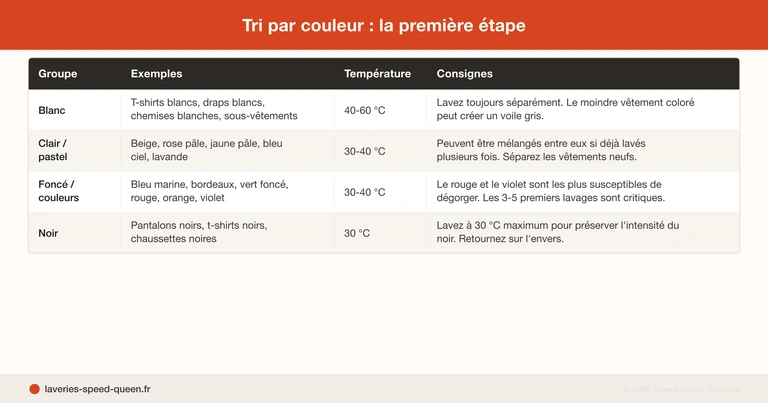
Sorting by colour: the first step
Sorting by colour is the best known and most important step. It prevents dye transfer between garments.
| Group | Examples | Temperature | Guidelines |
|---|---|---|---|
| White | White t-shirts, white sheets, white shirts, white underwear | 40-60 °C | Always wash separately. The slightest coloured garment can create a grey veil. |
| Light / pastel | Beige, pale pink, pale yellow, sky blue, lavender | 30-40 °C | Can be mixed together if already washed several times. Separate new garments. |
| Dark / vivid colours | Navy blue, burgundy, dark green, red, orange, purple | 30-40 °C | Red and purple are the most likely to bleed. The first 3-5 washes are critical. |
| Black | Black trousers, black t-shirts, black socks | 30 °C | Wash at 30 °C maximum to preserve the depth of black. Turn inside out. |
The white cloth test
To check if a new garment bleeds: dampen a white cloth, rub it for 30 seconds on an inner seam of the garment. If the cloth picks up colour, the garment should be washed alone or with similar colours for the first 3-5 washes. This precaution mainly applies to red, navy blue, purple and black.
Tip: fix colours from the first wash
For new brightly coloured garments, add 100 ml of white vinegar to the softener compartment during the first wash. The acetic acid helps fix reactive dyes on cotton fibres. This is not a foolproof treatment, but it significantly reduces bleeding in subsequent washes. White vinegar has many uses in laundry.
Sorting by fabric: the second step
Within each colour group, you still need to separate fabrics. Each textile fibre has a different mechanical and thermal resistance, which dictates the programme, temperature and spin speed.
| Fabric | Programme | Max temperature | Max spin | Notes |
|---|---|---|---|---|
| Cotton | Cotton / Normal | 60 °C (whites), 40 °C (colours) | 1200-1400 rpm | Resilient fibre. Withstands long, intensive cycles. Can shrink 3-5% on the first hot wash. |
| Linen | Cotton / Delicate | 40 °C (60 °C if white) | 800-1000 rpm | Resilient but creases easily. Moderate spin to limit wrinkles. Air dry. |
| Synthetic (polyester, nylon, acrylic) | Synthetics | 40 °C | 800-1000 rpm | Dries quickly, does not shrink. Can retain odours: add white vinegar during the rinse. |
| Wool | Wool / Delicate | 30 °C | 400-600 rpm | Felts under heat and agitation. Laundry bag required. No fabric softener. |
| Silk | Delicate / Hand wash | 30 °C | 400 rpm max | Very fragile protein fibre. pH-neutral detergent. No drum spin if possible. |
| Denim / jeans | Cotton / Jeans | 30-40 °C | 800-1000 rpm | Wash turned inside out. Indigo bleeds for the first 5-10 washes. Complete jeans guide. |
| Viscose / rayon | Delicate | 30 °C | 600-800 rpm | Shrinks easily. Very sensitive to mechanical agitation. Dry flat. |
How to identify a fabric
The exact composition is always shown on the care label. In the absence of a label, touch gives clues:
- Cotton: soft, matte, absorbs water immediately
- Polyester: slightly shiny, slippery, water beads on the surface
- Wool: stretchy, grainy texture, warm to the touch
- Silk: very smooth, shiny, cool to the touch
- Linen: stiff, visible texture, creases easily
Sorting by temperature: the third step
The washing temperature is dictated by the garment label and the level of hygiene required. The number on the tub symbol indicates the maximum temperature — you can always wash below it, never above.
| Temperature | Type of laundry | Objective | Notes |
|---|---|---|---|
| Cold / 20 °C | Silk, wool, fragile garments, vivid colours | Preserve fibres and colours | Enzyme detergents are effective from 15 °C. Sufficient for lightly soiled laundry. |
| 30 °C | Synthetics, colours, lightly soiled everyday laundry | Eco-friendly everyday cleaning | The most commonly used programme. Good compromise between effectiveness and savings. Washing at 30 °C uses 60% less energy than at 60 °C. |
| 40 °C | Coloured cotton, dirty everyday laundry, children’s clothes | Effective cleaning of everyday stains | The standard temperature for coloured cotton. Detergent enzymes are fully active. |
| 60 °C | Sheets, towels, underwear, baby linen, tea towels | Hygiene (kills most bacteria and dust mites) | Essential for bedding and linen in contact with the body. Sheets guide. |
| 90 °C | Very dirty tea towels, post-illness linen, machine maintenance | Complete disinfection | Reserved for resilient white cotton. One empty cycle per month to maintain the machine. |
Sorting by soil level
Beyond colour, fabric and temperature, the degree of soiling influences the programme to choose. Mixing very dirty laundry with lightly soiled laundry is counterproductive: dirt from the former redeposits on the latter.
Lightly soiled
Clothes worn once at the office, indoors. No visible stain, neutral smell. A short or eco programme at 30 °C is enough. This laundry does not need a pre-wash.
Normally soiled
Laundry worn for a full day with normal activity. Slight perspiration odour. Standard programme at 30-40 °C with the usual detergent dose.
Dirty
Sportswear, children's clothes after outdoor play, kitchen towels. Normal programme at 40-60 °C. Slightly increase the detergent dosage.
Very dirty / stained
Workwear, heavily stained laundry, mop cloths. Intensive programme with pre-wash. Treat stains before washing. Temperature according to the fabric.
Basket system: organising your laundry room
The most efficient way to sort is to do it as you go, not the day before laundry day. Set up a system of baskets or bags that matches your sorting categories.
The 3-basket system (recommended minimum)
For a 1-2 person household, three baskets are enough:
- White / light at 40-60 °C: sheets, towels, white t-shirts, white underwear. This is the basket that fills up fastest.
- Colours at 30-40 °C: all coloured everyday garments. The bulk of daily laundry.
- Delicate / wool at 30 °C: wool jumpers, silk, lace, fine lingerie. This basket fills slowly — you will run this wash less often.
The 4-5 basket system (household of 3+ people)
For families, add:
- Dark / black at 30 °C: jeans, black trousers, dark t-shirts. Separating blacks preserves their intensity.
- Very dirty laundry: sportswear, gardening outfits, kitchen aprons. This batch needs a longer cycle or a pre-wash.
Practical tips
- Label the baskets if several people sort laundry in the household
- Use breathable fabric bags (not sealed plastic — damp laundry goes mouldy in them)
- Run a machine as soon as a basket is full — don’t let it overflow
- Sorting takes 5-10 seconds per garment — it is an investment that pays for itself in clothes that last longer
At a laundromat: sorting matters even more
At a self-service laundromat, each wash cycle has a direct cost. Poor sorting can force you to re-wash an entire batch — double expense, double time. Our prices are designed to be accessible, but efficient sorting lets you optimise every euro spent.
Prepare your bags at home
Before heading to a laundromat, sort your laundry at home into separate bags:
- Bag 1: whites and lights (40-60 °C, cotton programme)
- Bag 2: colours (30-40 °C, synthetics or short cotton programme)
- Bag 3: delicates (30 °C, delicate programme if available)
- Bag 4 (optional): bulky items — duvet, pillows, curtains
Choose the right machine capacity
Sorting also lets you choose the machine suited to each category’s volume. There is no point paying for an 18 kg machine if you only have 5 kg of delicates. See our guide on laundry weight in the machine to estimate the load.
One sorting category = one optimised machine
At a laundromat, the golden rule is: one sorting category = one machine. Don’t give in to the temptation of grouping everything to “do just one load”. A poorly sorted batch washes poorly (the programme doesn’t suit everything) and risks damaging some items. If you’re visiting our laundromats for the first time, our guide walks you through step by step.
Decision flowchart: the 4 sorting questions
For each garment, ask yourself these 4 questions in order:
Question 1: what colour?
- White -> white basket
- Light / pastel -> light basket (or white if colourfast and not new)
- Dark / vivid -> dark basket
- Black -> black basket (or dark if no dedicated basket)
Question 2: what fabric?
- Cotton, linen -> resilient category
- Synthetic -> standard category
- Wool, silk, viscose, lace -> delicate category (separate)
- Denim -> with resilient darks, turned inside out
Question 3: what temperature?
- Check the label: group garments by compatible temperature
- When in doubt, choose the lowest temperature in the batch
- The care symbols guide you
Question 4: what soil level?
- Lightly soiled + normally soiled -> same batch, standard programme
- Very dirty / stained -> separate batch, pre-wash or intensive cycle
- Specific stains -> treat before washing (stain removal guide)
Sorting mistakes that cost you
- Washing whites with colours — a single red garment that bleeds is enough to turn a white load grey or pink. The problem gets worse at higher temperatures.
- Mixing wool and cotton — the cotton cycle (40 °C, 1200 rpm spin) felts the wool. The wool cycle (30 °C, 400 rpm) doesn't clean cotton properly.
- Overloading the machine to avoid a second batch — the laundry doesn't tumble freely, the detergent doesn't circulate, and everything comes out poorly washed and creased. Respect the stated capacity.
- Ignoring the labels — a single wash at the wrong temperature can shrink a jumper by a size or discolour a garment irreversibly.
- Forgetting to empty pockets — a tissue disintegrates and covers all the laundry in white fluff. A leaking pen can permanently stain an entire load.
- Washing terry towels with clothes — terry fibres deposit on synthetics and dark garments, creating a fluffy appearance impossible to remove by brushing.
- Not turning jeans inside out — direct friction of the right side against the drum accelerates fading and fabric wear. Turn them inside out every time.
Special cases
Baby linen
Baby linen should be washed separately: 60 °C for cotton bodysuits and pyjamas, hypoallergenic detergent↗ without fragrance, extra rinse. Do not mix with adult laundry (which may contain residues of scented detergent or fabric softener).
Sportswear
Technical fabrics (polyester, elastane) are washed at 30 °C, synthetics programme, without fabric softener (which clogs breathable pores). Do not mix them with cotton: cotton fibres deposit on synthetic knits.
Bulky household linen
Duvets, pillows and blankets form a category of their own. They need a large-capacity machine (minimum 10 kg, ideally 14-18 kg at a laundromat). Do not mix them with other items — the duvet needs room to be properly tumbled and rinsed.
Workwear
Uniforms, lab coats and stained work clothes (grease, paint, chemicals) form a separate batch. Treat grease stains and paint stains before washing. Use an intensive programme at the maximum temperature allowed by the fabric.
Sorting: a worthwhile investment
Sorting your laundry takes 2-3 minutes per wash. The benefits are tangible:
- Clothes that last longer: less mechanical wear, less colour fading
- Better wash results: each batch receives the programme, temperature and spin suited to it
- Energy savings: lightly soiled laundry doesn’t need an intensive 60 °C cycle
- Less ironing: similar fabrics crease similarly, making drying and ironing easier
A study by ADEME (France’s Environment and Energy Management Agency) shows that washing at 30 °C instead of 60 °C reduces the electricity consumption of a cycle by 50 to 60%. Sorting lets you reserve high temperatures only for the textiles that need them.
As an Amazon Associate, we earn a small commission on purchases made via the affiliate links in this article — at no extra cost to you. This helps us maintain this site and produce free guides.
Our laundromats in Blagnac, Croix-Daurade and Montaudran offer machines from 8 to 18 kg to suit every category of laundry. Sort at home, wash at the laundromat — it is the most efficient combination. Payment CB sans contact ou espèces. See our prices.
Sources and references
- Washing temperature guide by fabric
- Textile care symbols: complete guide
- Laundry weight in the machine: chart by item
- Detergent dosage: guide by machine type
- Washing jeans without damaging them
- White vinegar and laundry: uses and limits
- Preventing shrinkage in the wash
- Colour-run laundry: prevention and rescue
- ADEME — Guide “Reducing your electricity bill”, data on consumption by cycle temperature
- GINETEX — Standard ISO 3758, textile care symbols