In short: tea stains because of its tannins — the same polyphenols found in red wine and coffee. Black tea stains far more than green tea (oxidised tannins vs colourless catechins). On a fresh stain, white vinegar or lemon juice is enough (15-20 min contact time). On a dried stain, glycerine softens the tannins before a percarbonate soak. For stained cups, baking soda paste lifts the deposits without scratching.
At a glance
Blot, do not rub — rubbing spreads the tannins and pushes them into the fibres.
White vinegar or lemon — acid breaks down tannins through hydrolysis. 15-20 min on a fresh stain.
Glycerine for dried stains — softens dried tannins before acid treatment or percarbonate.
Tea with milk = double treatment — cold water (milk protein) then acid (tannins).
Cups: baking soda paste — scrub with a sponge, gentle and effective abrasive.
No tumble dryer — never dry a garment whose stain has not fully disappeared.
Why tea stains
Tea contains tannins — plant polyphenols from the same chemical family as those in red wine and coffee. These molecules form hydrogen bonds with textile fibres (cellulose in cotton and linen, proteins in wool and silk). The longer the tea is steeped, the more tannins are dissolved — and the more intense the stain.
But not all teas stain the same way. The key lies in the manufacturing process: black tea undergoes a full enzymatic oxidation that transforms its catechins (almost colourless polyphenols) into theaflavins (orange) and thearubigins (dark red-brown). It is these oxidised pigments that give black tea its deep amber colour — and that make its stains so stubborn.
Green tea, on the other hand, is heated quickly after harvest to block oxidation. Its catechins remain intact and very low in colour. This is why green tea barely stains, while an English Breakfast leaves a visible brown mark in seconds.
Black tea vs green tea vs tea with milk: adapting the treatment
The composition of the tea you drink directly determines the difficulty of removal and the protocol to follow.
Black tea (Earl Grey, Assam, English Breakfast)
The most staining. High concentration of theaflavins and thearubigins (~13-15 % oxidised tannins). The stain is brown-orange, intense and penetrates fibres quickly. Treatment: white vinegar or lemon on fresh stains, glycerine + percarbonate on dried stains.
Green tea (Sencha, Matcha, Gunpowder)
Low staining. The non-oxidised catechins are nearly colourless. A simple cold water rinse is enough in most cases. Matcha (powder) stains more due to the green particles in suspension — treat with Marseille soap if needed.
White tea and herbal infusions
Very low staining. White tea is even less oxidised than green. Herbal infusions (lime blossom, verbena, chamomile) do not contain tea plant tannins — they stain very little except hibiscus-based infusions (bright red, acidic) or turmeric (stubbornly yellow).
Tea with milk / chai
Composite stain: tea tannins + milk proteins (casein). The order of treatment is crucial: cold water first to remove the protein (it coagulates on heating), then acid treatment for the tannins. Same principle as for coffee with milk.
Black tea: more staining than coffee
Contrary to popular belief, black tea contains more coloured tannins than coffee. The thearubigins of tea are more stable and more adherent pigments than the melanoidins of coffee. If you have to choose between treating a coffee stain and a black tea stain, deal with the tea first — it is more likely to set permanently.
Fresh stain vs dried stain: the window of action
The speed of intervention largely determines the outcome. Tea tannins behave differently depending on the time since contact.
Fresh stain (less than 30 minutes)
The tannins are still in solution in the tea water. They are just beginning to form hydrogen bonds with the fibres. A simple acid treatment (white vinegar↗ or lemon) is enough to break these nascent bonds and remove the pigments.
Estimated success rate: 95 % if you intervene in the first 5 minutes, 85-90 % within the half hour.
Partially dried stain (30 min to 24 h)
The water has evaporated, concentrating the tannins on the fibre surface. The hydrogen bonds have multiplied and strengthened. You first need to rehydrate the tannins with glycerine↗ (which penetrates fibres and softens the pigments), then attack with acid.
Estimated success rate: 70-80 % with the correct protocol.
Old stain (more than 24 h) or dryer-set
The tannins have oxidised in the air and formed stable complexes with the fibres. Dryer heat may have polymerised these complexes, making them almost insoluble. A powerful agent (sodium percarbonate↗) and a prolonged soak are needed.
Estimated success rate: 40-60 %. Prevention remains the best strategy.
Fresh stain: the immediate method
If you intervene within minutes, the stain will come out in the vast majority of cases.
Blot the excess — dab with a clean cloth or paper towel. Do not rub.
Rinse from the reverse — run the stain under a trickle of cold water from the back of the fabric to push the pigments outwards.
Apply lemon juice or white vinegar — soak the area. Citric or acetic acid breaks down tannins through hydrolysis. Leave for 15-20 minutes.
Rub and rinse — gently rub the fabric against itself, then rinse thoroughly with cold water.
Why lemon is often preferred over vinegar for tea: lemon juice contains citric acid↗, a tricarboxylic acid that forms stable complexes with tannins (chelation). It is slightly more effective than the acetic acid in vinegar on the thearubigins of black tea. However, test on an inside seam first on dark fabrics — lemon can lighten locally.
Sparkling water is also useful as first aid: the dissolved CO2 creates a slight effervescence that helps dislodge surface pigments. It is not a complete treatment, but a practical emergency measure (at a restaurant, at the office) while waiting to apply lemon or vinegar.
Dried stain: glycerine first
A dried tea stain has formed a more resistant tannin-fibre complex. The oxidised thearubigins are particularly stubborn. You must first soften the tannins before attacking them chemically.
- Apply pure vegetable glycerine to the stain. Glycerine is a gentle solvent that penetrates fibres and rehydrates dried tannins.
- Leave for 30 minutes to 1 hour.
- Rub gently, then rinse with warm water.
- Apply white vinegar or lemon juice to the softened area. Leave for 15 minutes.
- If a trace persists, soak in a sodium percarbonate solution (2 tbsp per 2 L of warm water) for 2-4 hours. Sodium percarbonate releases active oxygen that oxidises the residual chromophores.
- Machine wash at 30-40 °C.
For very old stains (several weeks), combine glycerine + lemon as a paste: mix in equal parts, apply to the stain and leave for 1 hour before rinsing and moving to percarbonate.
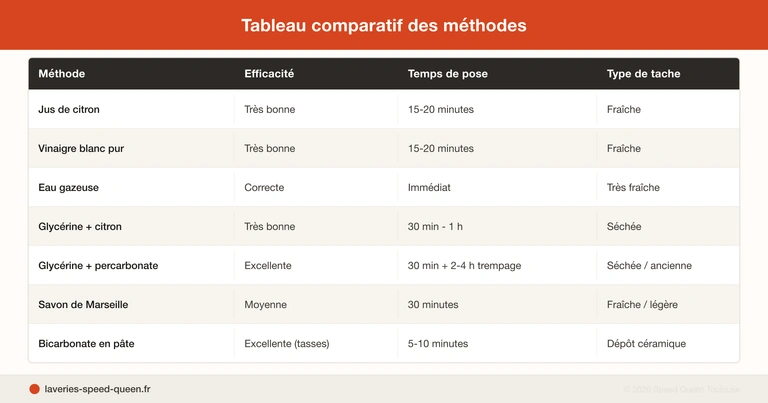
Comparison table of methods
| Method | Effectiveness | Contact time | Stain type | Suitable fabrics |
|---|---|---|---|---|
| Lemon juice | Very good | 15-20 minutes | Fresh | Light fabrics (cotton, linen) |
| Pure white vinegar | Very good | 15-20 minutes | Fresh | Cotton, linen, synthetic |
| Sparkling water | Fair | Immediate | Very fresh | All (first aid) |
| Glycerine + lemon | Very good | 30 min - 1 h | Dried | Cotton, linen, synthetic |
| Glycerine + percarbonate | Excellent | 30 min + 2-4 h soak | Dried / old | White and colourfast |
| Marseille soap | Moderate | 30 minutes | Fresh / light | All (emergency) |
| Baking soda paste | Excellent (cups) | 5-10 minutes | Ceramic deposit | Cups, teapots, crockery |
By fabric: adapting the method
Each fibre reacts differently to tannins and treatment products. Here are the protocols adapted by fabric type.
White cotton
The easiest to treat. Lemon or white vinegar as first treatment, then percarbonate if needed. A final wash at 60 °C is possible. Sunlight acts as a natural whitener on residual traces — see our guide to whitening yellowed laundry.
Coloured cotton
White vinegar without issue. Avoid pure lemon on dark colours (slight lightening effect). Percarbonate is usable on colourfast fabrics, but test on an inside seam first.
Linen
Linen is a cellulosic fibre like cotton — it responds well to white vinegar and lemon. Its more open structure absorbs tea quickly, but also releases tannins more easily when rinsed. For a stained linen tablecloth, soak the area in diluted lemon (half water, half lemon) for 20 minutes.
Silk
Delicate protein fibre. Dab with cold water only. No concentrated vinegar, no percarbonate. Pure glycerine (without rubbing) is tolerated. If the stain persists, take to a dry cleaner.
Wool
Sensitive protein fibre. Use diluted vinegar (50/50 water-vinegar) or pure glycerine. No percarbonate, no rubbing (risk of felting). Dab gently.
Synthetic (polyester, nylon)
Tannins adhere less to polyester than to natural fibres — the fibre is non-polar, so hydrogen bonds are weaker. A quick rinse is often enough. White vinegar if needed. Wash at 30 °C.
The stained tablecloth: a common case
Cotton or linen tablecloths are the classic victims of spilt tea. The fabric absorbs the liquid immediately over a wide area, complicating treatment. Here is the adapted method.
- Blot immediately — place a clean tea towel or paper towel on the stain and press to absorb maximum liquid. Do not rub.
- Sprinkle with salt — salt absorbs residual liquid and limits tannin penetration into the fibres. This is a first-aid measure, not a permanent treatment.
- Pour lemon — squeeze a lemon directly onto the stained area. Citric acid attacks the tannins while the salt continues to absorb.
- Leave for 20 minutes, then scrape off the salt and rinse thoroughly with cold water.
- Soak in percarbonate — for a white tablecloth, prepare a basin with 2 tablespoons of percarbonate per litre of water at 40 °C. Immerse the tablecloth and soak for 2 hours.
- Machine wash according to the label (generally 40-60 °C for cotton).
For fragile linen tablecloths or embroidered tablecloths, replace percarbonate with glycerine and limit washing to 30 °C.
Tea with milk and chai: the double treatment
As with coffee with milk, tea with milk combines tannins and milk proteins. Casein coagulates on heating — so the order of treatment is crucial.
- Cold water — Rinse thoroughly with cold water to dissolve and remove the casein. If the protein coagulates, it will form a yellowish film that traps the tannins.
- Dish soap (optional) — If the tea contained whole milk or cream (chai latte), apply a drop of dish soap to emulsify the fat.
- White vinegar or lemon — Once the protein is removed, treat the residual tannins.
- Machine wash — At 30-40 °C, normal cycle.
Chai tea sometimes contains turmeric (for the golden colour) and spices. Turmeric leaves a very stubborn yellow stain that does not respond to the same treatments as tannins. If your chai contains turmeric, apply vegetable oil to the yellow stain (curcumin is fat-soluble), then treat the tannins with vinegar.
Stained cups and teapots: baking soda
The brown deposits in cups are not dirt — they are tannins that have bonded to the ceramic surface through adsorption. The hot water of daily washing-up is not enough to dislodge them because the tannins form a very adherent film.
Baking soda method (the simplest)
- Sprinkle a tablespoon of baking soda into the dry cup.
- Add a few drops of water to form a slightly abrasive paste.
- Scrub with a sponge (soft side) in circular motions.
- Rinse. The marks should have gone.
Baking soda works in two ways: its gentle abrasive power (hardness 2.5 on the Mohs scale, versus 6-7 for ceramic) mechanically scrubs the tannins without scratching, and its alkaline pH (~8.5) helps dissolve the pigments.
Percarbonate method (old stains)
For heavily stained cups (months of deposits), fill the cup with hot water (70-80 °C), add a tablespoon of sodium percarbonate and soak overnight. The released active oxygen lifts the polymerised tannins. A simple rinse the next day is enough.
Porcelain or cast iron teapots
Porcelain teapots are cleaned like cups (baking soda paste). Enamelled cast iron teapots are rinsed with hot water without detergent — the inner enamel can be damaged by abrasive products. Unglazed clay teapots (Yixing type) are never washed with detergent: they are deliberately “seasoned” by tannins, which enrich the tea’s flavour over time.
Shop-bought products: which ones work?
Beyond home remedies, some shop-bought products are effective on tea stains:
- Oxygen-based stain remover (OxiClean, Vanish Oxi Action type): formulations based on sodium percarbonate. Effective on dried stains. Follow the dosages on the packaging.
- Pre-wash stain spray: practical for quick intervention. Contains surfactants and sometimes enzymes. Spray, leave, wash as soon as possible.
- Ox gall soap stain bar: bile acids emulsify fats and partially break down tannins. Particularly effective on tea with milk (greasy component).
Avoid chlorine-based products (bleach) on tea stains: bleach can yellow tannins instead of removing them, especially on cotton.
Mistakes to avoid
- Rubbing a fresh stain — you spread the tannins over a wider area and push them into the fibres. Always blot.
- Using hot water first — on tea with milk, hot water cooks the casein and sets the stain. Always start with cold water.
- Applying bleach — bleach can yellow oxidised tannins instead of whitening them, creating an even more visible stain.
- Tumble drying without checking — the heat (60-80 °C) polymerises the tannins and sets them almost irreversibly in the fibre.
- Waiting several days — the longer tannins dry and oxidise in the air, the more stable and harder to break the tannin-fibre complex becomes.
- Using concentrated vinegar on silk — the acid attacks silk proteins. Dab with cold water and glycerine only.
- Mixing vinegar and percarbonate together — the acid neutralises the base. Use them separately, at different stages of treatment.
Summary: 4 common scenarios
Scenario 1 — Black tea spilt on a white shirt: Blot, rinse from the reverse with cold water, apply lemon juice for 15-20 min, rinse, wash at 40 °C. Result: stain gone in 95 % of cases.
Scenario 2 — Dried tea with milk stain on a t-shirt: Rinse with cold water (protein), apply glycerine for 30 min, rinse, treat with white vinegar for 15 min, wash at 30 °C. If a trace remains, percarbonate for 2 h.
Scenario 3 — Black tea spilt on a white linen tablecloth: Blot, sprinkle with salt, pour lemon, leave 20 min. Scrape the salt, rinse. Soak in percarbonate 2 h. Wash at 40-60 °C.
Scenario 4 — Stained cups and teapot: Baking soda paste, scrub with a soft sponge, rinse. For old deposits: percarbonate + hot water overnight.
As an Amazon Partner, we earn a small commission on purchases made via the affiliate links in this article — at no extra cost to you. This helps us maintain this site and produce free guides.
Our laundromats in Blagnac, Croix-Daurade and Montaudran have professional machines with detergent included. The higher water volume (50-60 litres) helps dilute and extract tannins better than a domestic machine. Payment CB sans contact ou espèces. See our prices.
Sources and references
- Removing a coffee stain (same tannin family)
- Removing a red wine stain
- Sodium percarbonate: usage guide
- White vinegar and laundry: uses and limits
- Washing temperature guide
- Whitening yellowed laundry naturally
- Caring for delicate fabrics
- Chemistry of tea polyphenols — oxidation of catechins to theaflavins and thearubigins
- Tea Research Association — chemical composition of black, green and white tea