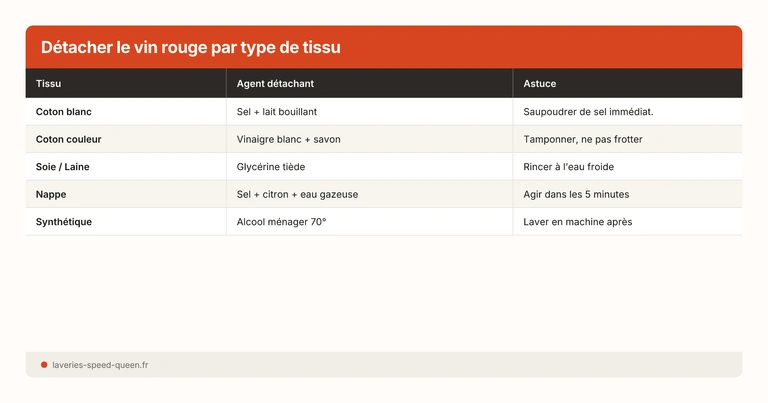
In short: to remove a red wine stain, speed is your best ally. Blot immediately with paper towels, absorb with flour or talc (not salt — it fixes tannins), rinse with cold water (never hot) and use Marseille soap. For a dried stain, sodium percarbonate or warm milk are the most effective solutions for dislodging embedded tannins.
At a glance
Act immediately -- absorb the liquid without rubbing to avoid spreading pigments.
Cold water is essential -- heat polymerises tannins and permanently sets the stain.
Salt is controversial -- it absorbs but may fix tannins. Prefer flour or talc.
Percarbonate for dried stains -- active oxygen that oxidises pigments without fading.
Heavy rinsing -- the 50-60 L water volume of professional machines is ideal for extracting tannins.
The chemistry of red wine: why it is so stubborn
Red wine is not just a coloured liquid; it is a complex chemical cocktail that aggressively interacts with textile fibres. Two components are mainly responsible for the damage. For a general approach to stain removal, see our tough stains guide which also covers blood and other organic stains:
- Anthocyanins: these are natural pigments (flavonoids) from the grape skin. They are highly water-soluble but have a strong affinity for natural fibres like cotton or linen.
- Tannins (polyphenols): they act as fixing agents. In winemaking, they structure the wine; on a tablecloth, they “mordant” the fibre, creating a solid chemical bond between pigment and textile. Red wine tannins belong to the same family as those in coffee and tea, but at a much higher concentration.
The danger of heat: when you apply hot water or iron a stained garment, you cause polymerisation of tannins. They then form long insoluble molecular chains that trap the pigments. The stain becomes an integral part of the fabric structure.
Why salt is controversial (and what to use instead)
You often hear you should “throw salt” on a wine stain. It is widespread advice — but textile chemists advise against it.
The problem with salt
Salt (sodium chloride) is hydrophilic: it attracts water by osmosis. If you pour salt on a wine puddle, it will indeed absorb the coloured liquid. So far, the reasoning is correct.
But salt is also a mordant — a colour fixative used for centuries in textile dyeing. Sodium and chloride ions interact with tannins and anthocyanins, strengthening bonds between pigments and fibres. By letting salt dry on the stain, you risk turning a recoverable stain into a permanent one.
Salt: a false friend for stain removal
Salt absorbs moisture but fixes pigments. In traditional textile dyeing, salt is used as a mordant to make colours more wash-resistant. That is exactly the opposite of what you are trying to do on a wine stain. Prefer flour, talc or fuller’s earth — these powders absorb without fixing pigments.
Alternatives to salt
- Flour: absorbs liquid by capillarity, with no chemical interaction with tannins. Available in any kitchen. Sprinkle generously, leave 5 minutes, shake off.
- Talc: same absorbent power, even more chemically neutral. Ideal if you have some on hand.
- Fuller’s earth: the best option — absorbing power over 80 % of its weight. See our grease stain guide for more on this underrated product.
- Paper towels: in the absence of powder, dab with white paper towels. Simple and risk-free.
Sparkling water: why it works
Sparkling water is a very effective first-aid measure on fresh red wine stains. Here is why:
The CO2 mechanism
Sparkling water contains dissolved carbon dioxide (CO2) under pressure. When you pour it on the stain, the CO2 is released as microbubbles. These bubbles create mechanical agitation at the fibre level, helping dislodge pigments that are starting to grip.
Additionally, dissolved CO2 makes the water slightly acidic (pH ~4-5), which has a moderate tannin-breaking effect through acid hydrolysis — the same mechanism as white vinegar, but milder.
How to use it
- Pour sparkling water directly on the stain, generously.
- Dab with a white cloth or paper towels — the bubbles help “lift” the pigments.
- Repeat 2-3 times if necessary.
- Rinse with cold water afterwards, then treat with Marseille soap↗.
Sparkling water is particularly useful at a restaurant or party, when you don’t have access to your usual stain removal products. It is a first-aid measure, not a complete treatment — wash the garment as soon as possible.
Fresh stain: the first 3 minutes
If you just spilled your glass, follow this strict protocol:
- Absorb: dab with white paper towels or sprinkle flour/talc. Never rub — you would only push pigments deeper into the fibre.
- Rinse with cold water: if possible, run water from the back of the fabric to “push” the stain outward.
- Marseille soap: apply a little pure Marseille soap to the still-damp area. Leave for 5 minutes.
- Emulsify: massage gently with your fingers and rinse again with cold water.
Check for residue before proceeding to drying.
If a shadow persists, keep the fabric damp until washing.
Dried stain: recovery
The stain has had time to dry? All is not lost, but you need to move to a stronger chemical method. Percarbonate↗ is also effective on other organic stains — discover how to whiten yellowed laundry with the same technique.
Sodium percarbonate (active oxygen)
This is the ultimate weapon against organic stains. Percarbonate releases active oxygen that oxidises the wine’s chromophores without fading fabrics (except very delicate textiles).
- Method: dissolve 1 tablespoon of percarbonate in 1 litre of 40 °C water.
- Action: submerge the textile and soak for 30-60 minutes.
- Wash: machine wash immediately afterwards.
For very old stains (several weeks), increase soaking time to 2-4 hours and concentration to 2 tablespoons per litre.
The warm milk technique
This is a grandmother’s trick validated by science. Casein (milk protein) has a chemical affinity with tannins superior to that of textile fibres. It is the same principle used in winemaking to “fine” (clarify) wine.
- Method: heat milk (without boiling) and soak the stain.
- Action: leave for 1 hour. The milk will literally “pump” tannins out of the fabric.
- Wash: rinse thoroughly with clean water before washing normally.
Vinegar + rubbing alcohol for very old stains
For red wine stains that have been dry for several days, a more aggressive combination may be needed:
- Mix 1 part white vinegar↗ + 1 part rubbing alcohol + 2 parts cold water.
- Apply to the stain with a cotton pad or cloth.
- Dab (do not rub), leave for 15 minutes.
- Rinse with cold water, then machine wash.
Vinegar breaks down tannins by acid hydrolysis, alcohol dissolves residual organic pigments. This is a last-resort method before percarbonate.
Percarbonate
Ideal for white cotton and sturdy tablecloths. Powerful oxidising action. The reference treatment for dried stains.
Warm milk
Perfect for wool, silk and delicate fibres where percarbonate is risky. Tannin capture mechanism via casein.
Vinegar + alcohol
Last resort for very old stains (>48 h). Combination of acid hydrolysis + pigment dissolution.
Black soap
Effective on mixed greasy stains (wine + sauce). Good complement to Marseille soap.
Red wine vs rose vs white wine: the differences
Not all wines stain the same way. Colour and tannin concentration vary considerably.
Red wine
The hardest to treat. Contains the highest concentration of anthocyanins (150-800 mg/L) and tannins (1-4 g/L). Full-bodied wines (Malbec, Syrah, Cabernet Sauvignon) stain more than light wines (Pinot Noir, Gamay) because they contain more pigments and tannins.
Rose wine
Halfway between red and white. Rose contains anthocyanins (20-100 mg/L) and tannins, but at much lower concentrations than red. Treat it as a “light” red wine stain — the same methods work but with a higher success rate. Cold water + Marseille soap often suffices.
White wine
The stain is nearly invisible at first but can yellow with time or ironing. This yellowing is due to caramelisation of residual sugars under heat (Maillard reaction). White wine contains very few anthocyanins but acids and sugars.
- Fresh stain: a plain water rinse is enough.
- Yellowed stain (ironed or sun-dried): treat like a classic yellow stain — percarbonate soak.
Myth: white wine on red wine
Pouring white wine on a red wine stain is a classic mistake. If it seems to “erase” the stain, it is only by dilution. You replace a complex stain with another stain (white wine) loaded with sugar. Simply use plain water or sparkling water for a healthier result.
Salt on red wine: the debate settled
To summarise the salt debate, here is what textile chemists say:
| Product | Absorbent power | Fixing risk | Recommended? |
|---|---|---|---|
| Fine salt | Good | High (tannin mordant) | No — risk of fixing the stain |
| Flour | Good | None | Yes — neutral absorbent |
| Talc | Very good | None | Yes — fine neutral absorbent |
| Fuller’s earth | Excellent | None | Yes — the best natural absorbent |
| Paper towels | Medium | None | Yes — always available |
By textile
Each fibre reacts differently to cleaning agents. Adapt your method to avoid damaging the material. For care symbols, always refer to the label.
Cotton tablecloth
Handles percarbonate and 60 °C washes well. The easiest textile to recover.
Linen tablecloth
Hollow fibre that absorbs quickly. Prefer a long percarbonate soak but avoid rubbing which breaks the fibre.
Silk
Very fragile. Use only cold water or the warm milk technique. Never percarbonate. See a dry cleaner if needed.
Wool
Sensitive to alkaline pH. Warm milk is your best option. Avoid thermal shocks (hot/cold water shifts). See our delicate textiles guide.
Synthetic
Polyester retains pigments less. A quick wash with soap pre-treatment is often enough.
Carpet / Rug
Use sparkling water to lift pigments by effervescence, then absorb with a sponge. See our rug washing guide.
Stain removal methods summary
| Stain type | Recommended method | Action time | Recommended wash |
|---|---|---|---|
| Fresh (still damp) | Flour/talc + Marseille soap + cold water | Immediate | Normal cycle (30-40 °C) |
| Fresh (first aid) | Sparkling water + dabbing | Immediate | Wash as soon as possible |
| Dried on cotton/linen | Percarbonate soak | 30-60 min | Cotton cycle (60 °C) |
| Dried on wool/silk | Warm milk soak | 1 hour | Delicate cycle (30 °C) |
| Old (>48 h) | Vinegar + alcohol then percarbonate | 15 min + 2 h soak | Cotton cycle (60 °C) |
| Set (tumble dried) | Concentrated percarbonate (long soak) | 4-8 hours | Professional cycle (intensive wash) |
Common scenarios and solutions
Scenario 1 — Red wine spilled on a white cotton tablecloth during dinner: dab with paper towels, sprinkle flour, rinse with cold water, Marseille soap. Wash at 40 °C. If a residual trace remains, percarbonate 30 min. Success rate: 95 %.
Scenario 2 — Dried red wine stain on a silk dress: warm milk (not boiling) soaking for 1 hour. Cold water rinse. If the stain persists, dry cleaning. No percarbonate, no rubbing.
Scenario 3 — Old red wine stain (1 week) on a white shirt: white vinegar + rubbing alcohol (50/50) dabbing for 15 min, then percarbonate (2 tbsp/L) soaking 2-4 h. Wash at 60 °C. Likely but not guaranteed result.
Scenario 4 — Rose wine on a coloured cotton t-shirt: cold water + Marseille soap is enough in most cases. If a trace remains, light percarbonate (1 tbsp/L, test on hem first). Wash at 30 °C.
Mistakes to avoid
- Hot water on fresh stain -- it instantly fixes tannins through polymerisation.
- Salt -- it absorbs but risks fixing pigments like a dye mordant. Use flour or talc.
- Vigorous rubbing -- you break fibres and embed pigment in the fabric core.
- Using bleach on colours -- you will create an irreversible white spot.
- The white wine myth -- do not add sugar and acid needlessly to your laundry.
- Ironing a poorly cleaned garment -- the iron's heat seals the stain forever.
- Waiting until tomorrow -- every hour strengthens the tannin-fibre bonds. Treat immediately or keep the fabric damp.
Why the laundromat is the ultimate solution
For large tablecloths or heavily stained items, domestic machines often lack “rinsing power”. A standard machine uses around 10-15 litres of water per phase.
In a professional laundromat, our machines use 50-60 litres of water per cycle. This massive volume allows much greater dilution of tannins and mechanical agitation that dislodges particles without damaging fibres. Additionally, our pre-dosed professional detergent contains highly concentrated surfactants designed for the hospitality industry. For more on the advantages of laundromats, see our comparison laundromat vs home machine.
As an Amazon Partner, we receive a small commission on purchases made via affiliate links in this article — at no extra cost to you. This helps us maintain this site and produce free guides.
A stubborn red wine stain? Our professional machines use 50-60 litres of water per cycle — this higher volume dilutes and extracts tannins better than a domestic machine. Laundromats in Blagnac, Croix-Daurade and Montaudran, detergent included, payment CB sans contact ou espèces. See our prices.
Sources and references
- Tough stains guide and pre-treatment
- Remove a coffee stain (same tannin family)
- Remove a blood stain
- Washing temperature guide
- Sodium percarbonate and laundry
- White vinegar and laundry: uses and limits
- Laundromat vs home machine
- How to wash curtains
- Thermal polymerisation of wine polyphenols — tannin fixation mechanisms on cellulosic fibres (Textile Research Journal)
- AISE: Detergent chemistry and surfactants (lien externe) (oxidising action of sodium percarbonate)
- Wine fining with casein — industrial winemaking process, applied to textile stain removal
- Salt as a mordant in textile dyeing — fixation of natural dyes by chloride and sodium ions