In short: mould is not just an aesthetic problem — it is a living organism that releases spores and mycotoxins. To remove it from fabric: brush the spores off dry outdoors, pre-treat according to the textile (percarbonate, white vinegar or Marseille soap), then wash at 60 °C minimum. Complete drying is essential to prevent any recurrence.
At a glance
Always brush dry outdoors first — mould spores disperse in the air; never release them indoors.
Pre-treat before washing — a 40 °C cycle alone will not remove the pigment. Sodium percarbonate is the most effective product on white cotton.
Wash at 60 °C minimum — this is the temperature that kills mould spores. 90 °C for heavily contaminated household linen.
Dry completely — in the tumble dryer or in the sun. A still-damp textile stored away means guaranteed mould.
Discard if heavily contaminated — a textile that still smells musty after 2-3 complete treatments is irredeemably contaminated.
Mould: why it is a health concern
Moulds are microscopic fungi that develop on organic matter in the presence of moisture. On textiles, they find an ideal environment: natural fibres (cotton cellulose, wool keratin), sweat residue, detergent remains — all this constitutes a nutritive substrate.
The issue goes beyond a simple stain. Moulds release two types of potentially harmful substances:
- Spores — microscopic particles that disperse into the air at the slightest movement of the textile. Inhaled, they trigger allergic reactions: rhinitis, sneezing, irritated eyes. In sensitive individuals, they can trigger or worsen asthma.
- Mycotoxins — secondary metabolites produced by certain species (Aspergillus, Stachybotrys). Prolonged skin contact with a contaminated textile can cause irritation, dermatitis, or more marked reactions in immunocompromised individuals.
A real risk, not an emergency
Wearing a slightly mouldy garment once will not cause a serious illness. However, prolonged or repeated exposure (mouldy sheets, regularly worn untreated garments) can sustain chronic allergic symptoms. Infants, asthmatic individuals and immunocompromised people are the most vulnerable.
This is why merely “masking” the stain is not enough: you must kill the fungus, eliminate the spores and remove the odour — three distinct objectives that each require a specific action.
Black vs white vs green mould
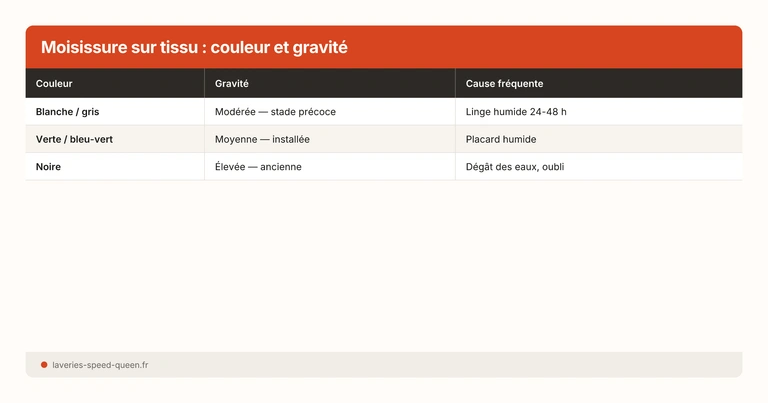
Not all moulds are equal. The colour gives an indication of the type of fungus and the severity of the contamination.
| Colour | Common fungus | Severity | Common cause |
|---|---|---|---|
| White / light grey | Mucor, Penicillium | Moderate — early stage | Laundry left damp 24-48 h (basket, drum) |
| Green / blue-green | Aspergillus, Cladosporium | Medium — established contamination | Textile stored in a damp wardrobe, cellar, garage |
| Black | Stachybotrys, Alternaria | High — old, deep | Water damage, textile forgotten for weeks/months |
White mould is the easiest to treat: the fungus is on the surface and has not yet deeply pigmented the fibres. A simple percarbonate↗ soak followed by a 60 °C wash is often sufficient.
Black mould is the most stubborn. The pigment (fungal melanin) penetrates deep into the fibres and resists standard treatments. It often takes 2-3 pre-treatment cycles. If the textile still smells musty after the third pass, it is probably beyond saving.
Stain removal protocol
Mould treatment always follows the same order, regardless of the textile. Each step has a specific objective — do not skip any.
1. Brush the spores off dry
Objective: remove as much fungal matter as possible before contact with water.
Take the textile outside (balcony, garden). Use a soft-bristle brush (clothes brush, old toothbrush for small areas) and brush the stain. The spores fly off — this is precisely why you must never do this step indoors. If you are allergy-prone, wear a mask.
2. Pre-treat according to the fabric
Objective: dissolve the fungal pigment and kill the filaments (mycelium) embedded in the fibres.
This is the decisive step. The product and method depend on the textile — see the detailed table in the next section. The general rule:
- White cotton: sodium percarbonate (the most effective)
- Colours: white vinegar + baking soda
- Delicates: Marseille soap↗
3. Machine wash at 60 °C minimum
Objective: kill remaining spores and flush treatment residue.
Moulds die from 60 °C. A wash at 30-40 °C is not enough — it removes dirt but leaves viable spores that will recolonise the fabric as soon as it is damp. For heavily contaminated household linen (sheets, towels), go up to 90 °C if the care label permits.
Add a glass of white vinegar↗ to the softener compartment: it neutralises residual odours and prevents limescale deposits that encourage recontamination.
4. Dry completely
Objective: eliminate all residual moisture — the number-one factor in recurrence.
The tumble dryer is ideal: it ensures uniform drying right to the core of the fibres. If you air-dry, favour direct sunlight — UV has a natural antifungal effect and helps bleach residual marks on whites.
5. Inspect and repeat if necessary
Check the stain after complete drying (a damp stain always looks lighter than it truly is). If the pigment remains, repeat steps 2 to 4. An old black mould stain may require 2-3 complete cycles.
Method by fabric type
| Textile | Pre-treatment | Wash temperature | Precautions |
|---|---|---|---|
| White cotton | Sodium percarbonate: 1 tbsp per litre of water at 40 °C, soak 1 h | 60-90 °C | The easiest to treat. Percarbonate releases active oxygen that destroys the pigment and disinfects. |
| Coloured cotton | Pure white vinegar dabbed on the stain, 15 min. Then sprinkle with baking soda. | 60 °C | Test vinegar on a hem first. Avoid percarbonate which may lighten colours. |
| Synthetic (polyester, nylon) | White vinegar soak (1 glass per litre of water, 30 min) | 40-60 °C according to label | Synthetics hold less surface pigment. Vinegar is often sufficient. |
| Silk / wool | Marseille soap rubbed on the damp stain, leave for 30 min | 30 °C max, wool cycle | No percarbonate, no pure vinegar (too acidic). If the stain remains, consult a dry cleaner. |
| Household linen (sheets, towels, tea towels) | Sodium percarbonate: soak 2 h in a basin at 40 °C | 90 °C | Cotton household linen handles the most aggressive treatments. Do not hesitate to go to 90 °C. |
| Outdoor textiles (awning, tarpaulin, garden cushion) | Brush then scrub with diluted black soap. Rinse with a hose. | Hand wash or 40 °C if size permits | Outdoor canvas is thick: insist on initial brushing. Professional laundromat machines (18-27 kg capacity) accept bulky items. |
For white cotton, sodium percarbonate is the reference product. When dissolved, it releases hydrogen peroxide and sodium carbonate — a duo that destroys the fungal pigment (bleaching action) while creating an alkaline environment hostile to moulds. Unlike bleach, it is biodegradable and does not weaken fibres.
For colours, white vinegar is the best compromise: its acidity (pH ~2.5) inhibits fungal growth without risk of discolouration. Baking soda sprinkled on top creates an effervescent reaction that helps dislodge the pigment from the fibres.
Removing the musty smell
The musty smell is often more stubborn than the stain itself. It comes from volatile organic compounds (VOCs) produced by the moulds’ metabolism — mainly geosmin and 1-octen-3-ol. These molecules embed in the fibres and resist standard washing.
Three-step treatment:
- Baking soda soak — 2 tablespoons per litre of warm water, for 2 hours. Baking soda neutralises the acidic VOCs responsible for the smell.
- 60 °C wash + white vinegar — a glass of white vinegar in the softener compartment. It neutralises odours that the baking soda did not capture and removes limescale residue.
- Sun drying — UV rays degrade residual odour molecules. A few hours of direct exposure often make the difference between a textile that is “almost” and “completely” deodorised.
Professional tumble dryer against odour
At the laundromat, the professional tumble dryer heats to 60-80 °C for 20-30 minutes. This prolonged heat destroys the last odour molecules and eliminates all residual moisture.
Drying indoors without a dehumidifier
often leaves enough moisture for the smell to return.
If the smell persists after this complete protocol, the textile is probably deeply contaminated — the mycelium has penetrated to the core of the fibres and continues producing VOCs even after washing.
When to discard the textile
There comes a point where treatment is no longer worthwhile. Here are the cases where it is better to part with the textile:
- Persistent odour after 2-3 complete treatments (brushing + pre-treatment + 60 °C wash + drying). If the mustiness returns every time, the mycelium is too deeply established.
- Extensive black stains covering more than 20-30% of the surface — the cost in time and product exceeds the textile’s value.
- Visibly damaged fibres — mould digests cotton cellulose and wool keratin. If the fabric tears easily where the mould was, the structure is compromised.
- Textile intended for an infant or immunocompromised person — in these cases, the benefit of the doubt does not go to the textile. Discard and replace.
- Do not donate a mouldy textile — neither as a gift nor for textile recycling. The spores will contaminate other garments on contact.
- Bag before discarding — place the textile in a sealed bin bag to avoid dispersing spores in the bin or waste room.
Machine washing: 60 °C minimum
After pre-treatment, machine washing is essential. But not just any way.
Temperature is the decisive factor. Mould spores resist lukewarm washes: at 30 °C, most survive. At 40 °C, some die but many persist. At 60 °C, virtually all spores and mycelium are destroyed. At 90 °C, sterilisation is near complete.
At the laundromat, professional Speed Queen machines offer several advantages for mould treatment:
- True 60-90 °C temperature — unlike some domestic machines that do not always reach the displayed temperature, professional machines genuinely heat to the selected temperature.
- Higher water volume (50-60 litres) — better rinsing flushes more spores and treatment residue.
- Powerful spin (1,000-1,200 rpm) — extracts more residual water, shortening drying time and reducing the window for recontamination.
- Tumble dryer immediately available — no laundry sitting damp on the airer for hours.
The direct transfer from washing machine to tumble dryer is the best guarantee against recurrence: the textile never remains in a damp state conducive to recolonisation.
Prevention
Mould on laundry is almost always a problem of residual moisture. The fungus needs three conditions to develop: humidity above 65%, temperature between 15 and 30 °C, and organic matter (the textile fibres themselves). Remove the moisture and mould cannot take hold.
Remove laundry immediately after washing — a damp, closed drum is the perfect incubator. At the laundromat, this habit is natural: you wait for the cycle to finish on site.
Never put damp laundry in the dirty laundry basket — a wet towel contaminates the entire basket in 24 h. Let it dry before putting it in the basket.
Dry completely before storing — the slightest residual moisture is enough. When in doubt, 10 extra minutes in the tumble dryer are worth more than a mould problem to treat.
Ventilate the drying room — if you dry indoors, open a window or use a dehumidifier. Ambient humidity should stay below 60%.
Clean the seal and drum of your machine — the rubber seal is a mould reservoir that recontaminates laundry every cycle. Clean it regularly with white vinegar.
Store in a dry, ventilated place — avoid closed cupboards in damp rooms (bathroom, cellar, garage). Leave space between stacks of laundry for air circulation.
Watch out for seasonal textiles: winter duvets stored in spring, curtains stored during holidays, ski clothes put away in April. These textiles spend months in a cupboard and are often stored with enough residual moisture to trigger fungal colonisation. Wash and dry completely before any long-term storage.
En tant que Partenaire Amazon, nous percevons une petite commission sur les achats effectués via les liens partenaires de cet article — sans surcoût pour vous. Cela nous aide à maintenir ce site et à produire des guides gratuits.
Our laundromats in Blagnac, Croix-Daurade and Montaudran have professional machines with 60-90 °C programmes and industrial tumble dryers for complete drying. Ideal for eliminating mould and preventing recurrence. Payment CB sans contact ou espèces. See our prices.