In short: engine grease and tar are fatty substances that are insoluble in water. The most effective method is grease-on-grease: apply butter or vegetable oil to dissolve the tar, then dish soap to degrease, and finally a machine wash at 30-40 °C. Never rub the stain dry — you will spread it.
At a glance
Do not rub dry — engine grease and tar spread. Scrape the excess with a flat object.
Grease on grease — butter, margarine or vegetable oil dissolves tar by chemical affinity (15-30 min).
Dish soap — emulsifies the grease + tar mixture to make it water-soluble.
Machine 30-40 °C — check the stain has gone BEFORE tumble drying.
Old stain = solvent — turpentine (cotton/linen) or WD-40 (synthetics) as a last resort.
Understanding engine grease and tar
Engine grease and tar are chemically similar substances — both are heavy, viscous, black hydrocarbons. Understanding their composition explains why standard methods (water + detergent) fail and why the grease-on-grease method works.
Engine grease
Engine grease is a mixture of used mechanical lubricant, microscopic metal particles and combustion residue. It is found on bicycle chains, car gears, machine tools and automatic gates. Its black colour comes from carbon and iron oxide particles suspended in the grease.
Engine grease penetrates textile fibres quickly thanks to its viscosity — it “flows” into the gaps like honey into fabric. The more open the weave (fleece, knitted fabric), the faster and deeper the penetration.
Tar (bitumen)
Tar is a heavy hydrocarbon from petroleum distillation (road bitumen) or coal pyrolysis (coal tar). It is found on freshly tarred roads, roofs, terraces and car parks in summer. Heat makes it more fluid — which is why you walk on soft tar in summer and it sticks to soles and trouser hems.
Why water alone does not work
Water is a polar molecule. Engine grease and tar are non-polar molecules. In chemistry, polar and non-polar molecules do not mix — it is the same principle as oil and water not mixing in a glass. Water slides off the grease stain without penetrating it.
That is why the strategy works in two stages: first dissolve the tar with another fat (non-polar to non-polar), then emulsify the whole mix with a surfactant (dish soap) that makes it water-soluble.
Step 1 — Scrape the excess (without rubbing)
The first instinct is often to rub the stain with a cloth or paper towel. That is the worst thing to do: rubbing spreads the grease over a larger area and pushes it into the fibres.
The right approach:
- Take a flat, rigid object: the back of a knife, an expired bank card, a plastic spatula.
- Scrape from the edge towards the centre of the stain to lift the excess material.
- Place the residue on paper towel (not in the sink — tar clogs drains).
- If the stain is fresh and thick, place paper towel above and below and press gently to absorb the maximum.
For tar in summer (soft and sticky), 30 minutes in the freezer solidifies the tar and makes scraping easier. Place the garment in a plastic bag and put it in the freezer. Cold tar cracks and comes off in pieces.
The cold trick for soft tar
Tar softened by summer heat is almost impossible to scrape. Cold solidifies it in minutes. If you have no freezer (outdoors, camping), apply an ice cube or an ice pack wrapped in a cloth directly on the stain for 5 minutes. The tar hardens and scrapes off easily.
Step 2 — The grease-on-grease method
This is the key to removing engine grease and tar. The chemical principle is simple: like dissolves like (similia similibus solvuntur). A liquid fat dissolves a solid fat by molecular affinity.
Which fats to use
Butter or margarine
The most accessible. Place a knob of butter directly on the stain and spread with your finger. Butter softens and dissolves tar in 15-30 minutes. Margarine works the same way. Advantage: the semi-solid consistency lets you target the stain precisely.
Vegetable oil (sunflower, olive, rapeseed)
More liquid than butter — penetrates fibres better but also spreads further. Apply with cotton or a brush to control the area. Effective on deep-set stains because liquid oil infiltrates in depth.
Coconut oil
Solid at room temperature, it melts on contact with skin. Ideal for small, precise stains — it does not run. Its medium-chain fatty acids dissolve heavy hydrocarbons very well.
Marseille soap (72% oil)
True Marseille soap contains 72% oil. Rub the block directly on the dampened stain. It combines the dissolving action of fat and the surfactant action of soap — two steps in one.
Application
- Apply generously — the layer of fat should cover the entire stained area and extend slightly beyond.
- Massage gently with your fingertip to work the fat into the fibres.
- Leave for 15 to 30 minutes. During this time, the fat molecules surround the tar molecules and detach them from the fibres.
- Rub with a clean cloth or paper towel. The tar mixes with the fat and lifts off. The cloth turns black — a sign the method is working.
- Repeat if needed. Thick stains may require 2-3 applications.
Step 3 — Degrease with dish soap
After the grease-on-grease step, the tar is dissolved but the fabric is now stained with fat (butter, oil). Dish soap is the ideal product for this step — it is specifically designed to emulsify fats.
- Apply neat dish soap (undiluted) directly on the treated area.
- Rub between your fingers or with a soft toothbrush. You will see a greyish lather form — this is the fat + tar mix being emulsified.
- Leave for 10 minutes.
- Rinse with warm water. Check whether the stain has gone. If residue remains, repeat the dish soap application.
Why dish soap and not laundry detergent
Dish soap contains a concentration of surfactants 3 to 5 times higher than laundry detergent. It is formulated to attack cooked fats and oils — exactly what is needed here. Machine detergent is diluted in 50 litres of water and never reaches this degreasing concentration on a localised stain.
Step 4 — Machine wash
After pre-treatment, the garment is ready for a standard machine wash.
- 30-40 °C with your usual detergent. Warm temperature helps finish dissolving residual fats.
- No fabric softener — it can fix residual fats into the fibres.
- Check the stain before tumble drying. The heat of the dryer polymerises hydrocarbon residue and makes the stain permanent.
For stubborn stains, a second wash cycle at 40 °C with added [sodium percarbonate](/blog/percarbonate↗-de-soude-linge/) (2 tablespoons in the drum) helps break down greasy residue through oxidation.
By fabric: adapting the treatment
Jeans / denim
The most tolerant fabric. The full method (butter → dish soap → machine) works perfectly. Denim also handles turpentine for old stains. Rub vigorously — the fabric is robust.
Polyester / nylon (sportswear)
The grease-on-grease method works well. Avoid turpentine which can attack synthetic fibres. For old stains, WD-40 is a better alternative on polyester. Wash at 30 °C, delicate cycle. See our sportswear care guide.
White cotton
Full method + sodium percarbonate soak after the dish soap step (2 tablespoons in 2 litres of warm water, 2 hours). Percarbonate releases active oxygen that whitens black residue. For whitening laundry after treatment.
Wool
Caution: wool is sensitive to rubbing and chemicals. Apply vegetable oil gently (cotton pad), leave for 30 min, then dab with very diluted dish soap. Hand wash at 20 °C. See our guide to washing wool without felting.
Leather
NEVER water or solvent. Dab with a cotton pad soaked in vegetable oil, rub gently in circles. Wipe with a dry cloth. If the grease has penetrated the leather pores, the dry cleaner is the only reliable option. See our leather and suede guide.
Upholstery / sofa
Grease-on-grease method with butter, then dab with diluted dish soap. Never soak a sofa — trapped moisture encourages mould. Dry with a hairdryer (cold air) after cleaning.
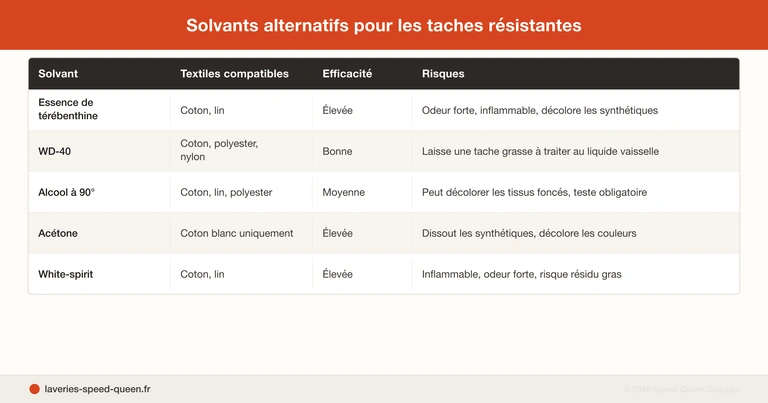
Alternative solvents for resistant stains
If the grease-on-grease method + dish soap is not enough (old stain, polymerised tar), stronger solvents are available. Use them with caution and always after testing on a hidden area.
| Solvent | Compatible fabrics | Effectiveness | Risks |
|---|---|---|---|
| Turpentine | Cotton, linen | High | Strong smell, flammable, discolours synthetics |
| WD-40 | Cotton, polyester, nylon | Good | Leaves a greasy stain to treat with dish soap |
| Rubbing alcohol (90°) | Cotton, linen, polyester | Moderate | Can discolour dark fabrics, testing mandatory |
| Acetone | White cotton only | High | Dissolves synthetics, discolours colours |
| White spirit | Cotton, linen | High | Flammable, strong smell, risk of greasy residue |
How to use turpentine
Turpentine (or substitute solvent) is the most effective solvent after the grease-on-grease method. It dissolves polymerised tar that butter can no longer reach.
- Place an absorbent cloth under the stain (to prevent dissolved tar from seeping through).
- Soak a cotton pad with turpentine.
- Dab the stain from the edge towards the centre. Do not rub — rubbing spreads it.
- Repeat with a clean cotton pad until it picks up no more colour.
- Apply dish soap to remove the smell and residue.
- Machine wash at 40 °C.
Work in a well-ventilated area — turpentine releases irritating vapours.
Old stain: the difficult case
An engine grease stain that has been washed and dried (especially tumble dried) is significantly harder to treat. The heat of drying has polymerised the hydrocarbons — they have gone from a semi-liquid state to a near-solid state, like varnish on the fibres.
The protocol for old stains:
- Soften the stain: apply vegetable oil and leave for 1 hour (not 15 minutes). The longer time allows the oil to penetrate the polymerised residue.
- Solvent: apply turpentine (cotton/linen) or WD-40 (synthetics). Leave for 30 minutes.
- Gentle brushing: scrub with a soft toothbrush to lift the softened residue.
- Dish soap: apply neat, rub, leave for 15 minutes.
- Machine wash: 40 °C with added sodium percarbonate.
- Check and repeat if needed. Old stains often require 2-3 complete cycles.
When to give up
If the stain persists after 3 complete treatment cycles (grease-on-grease + solvent + machine), it is probably permanent. The hydrocarbons have polymerised irreversibly into the fibres. For a valuable garment, professional dry cleaning with perchloroethylene remains the last option — dry cleaning dissolves petroleum residues very well.
Special case: tar on skin
After returning from a worksite or a bicycle repair, engine grease and tar also end up on hands and arms. The grease-on-grease principle works identically on skin.
- Cooking oil (sunflower, olive): pour on the stained area, massage in circles.
- Marseille soap: rub vigorously under warm water.
- Clay stone (if available): excellent for stubborn residue in skin folds and under nails.
Avoid white spirit and acetone on skin — they dry out the epidermis and cause irritation.
Prevention
For trades or hobbies exposed to engine grease and tar (mechanic, cyclist, roofer), a few measures reduce the risk of stains.
- Apron or overalls: work clothes are designed to resist mechanical stains. They protect civilian clothes underneath.
- Disposable or mechanic’s gloves: hands are the primary vector for transferring grease to clothes.
- Textile anti-stain spray: a fabric waterproofer reduces tar penetration into fibres. The stain stays on the surface and is removed more easily.
- Immediate treatment: fresh engine grease comes out much more easily than dried grease. Keep a tube of dish soap in your workshop or bike bag.
Mistakes to avoid
- Rubbing the stain dry — you spread the grease over a larger area and push it into the fibres.
- Washing directly in the machine without pre-treatment — standard detergent has no effect on hydrocarbons. The stain sets during the cycle.
- Tumble drying without checking — the heat polymerises the tar and makes the stain permanent.
- Using acetone on polyester — acetone dissolves synthetic fibres. The garment is destroyed.
- Pouring solvent directly onto the fabric — always apply with a cotton pad or swab. Pouring creates rings and the solvent seeps through to lower layers.
- Using hot water first — heat sets the tar. Always start with the fat treatment at room temperature.
As an Amazon Partner, we earn a small commission on purchases made through the affiliate links in this article — at no extra cost to you. This helps us maintain this site and produce free guides.
After pre-treating with butter and dish soap, wash your stained clothes in our laundromats in Blagnac, Croix-Daurade and Montaudran. The professional machines with built-in detergent offer superior agitation and rinsing compared to domestic machines for removing greasy residue. Payment CB sans contact ou espèces. Prices.