In short: To remove a grass stain, never rub it dry. Dab with pure white vinegar (15 minutes), rub with Marseille soap, then rinse with cold water. For old stains, rubbing alcohol (70%) or a sodium percarbonate soak are the most effective solutions. Always check that the stain has gone before tumble drying.
At a glance
No dry rubbing — chlorophyll becomes embedded in fibres if you rub without a dissolving agent.
White vinegar first — acetic acid dissolves chlorophyll without damaging most textiles.
Cold water mandatory — hot water sets plant pigments just as it sets wine tannins.
Never tumble dry before checking — the heat makes the stain permanent.
Water volume — professional machines (50-60 L) dilute and extract residue better than a home wash.
Why grass stains so much
Grass is not a simple dye: it is a mixture of organic pigments that chemically bond to textile fibres. Three components are responsible for the tenacity of these stains. For a full overview of stain removal, see our tough stain guide:
- Chlorophyll: the main green pigment in plants. Fat-soluble, it penetrates natural fibres (cotton, linen) by dissolving in the natural oils present on the fabric. It is what gives that characteristic intense green colour.
- Carotenoids: yellow-orange pigments present in smaller amounts. They are also fat-soluble and contribute to the yellowish tinge that grass stains take on as they dry.
- Plant proteins and xanthophylls: the sap and cell contents of crushed grass release proteins that coagulate on the fibre, trapping the pigments.
The dual chemical bond is what makes grass stains so stubborn. Chlorophyll is fat-soluble (it binds to the fabric’s oils) while also releasing water-soluble compounds (green degradation products). This mechanism creates a two-level anchor in the fibre. A simple water wash is not enough to break both types of bond. An acidic agent (vinegar) or a solvent (alcohol) is needed to break down the pigment’s molecular structure.
Chlorophyll and light
Chlorophyll exposed to sunlight degrades into pheophytin, a brown-olive compound even harder to extract than the original green pigment. This is why a grass stain dried in the sun on a washing line turns brown and becomes nearly impossible to remove without chemical treatment.
Fresh stain: the first 30 minutes
If the stain has just happened, speed is your best ally. The chlorophyll has not yet had time to polymerise in the fibre.
- Brush off residue: Remove grass blades and plant debris with a soft-bristle brush or the back of a knife. Do not rub the fabric itself.
- Dab with white vinegar↗: Soak a clean cloth (white if possible) in white vinegar and dab the stain from the outside in. Acetic acid dissolves the chlorophyll.
- Leave for 15 minutes: Do not rinse immediately. The vinegar needs time to attack the chemical bonds between pigment and fibre.
- Rub with Marseille soap↗: On the stain still soaked in vinegar, rub a bar of Marseille soap. The soap’s surfactants emulsify the dissolved pigments and lift them from the fibre.
- Rinse with cold water: Rinse thoroughly under a stream of cold water. Hot water would set the chlorophyll residue — the same principle as for red wine stains.
Check that the stain has gone before putting the garment in the machine.
If a green shadow remains, repeat the vinegar dabbing before washing.
Old or set-in stain
Has the stain dried, or even been through the tumble dryer? The pigments are polymerised in the fibre. You need stronger agents than vinegar alone.
Rubbing alcohol (70%)
Alcohol is a solvent that dissolves polymerised chlorophyll far more effectively than vinegar. It is the first option to try on old stains.
- Method: Apply rubbing alcohol (70%) to a cotton pad or white cloth. Dab the stain.
- Action: Leave for 10 minutes, then rub with Marseille soap.
- Precaution: Test on a hidden area (inside seam) for coloured fabrics. Alcohol can dull certain dyes.
Sodium percarbonate
For very set-in stains or white garments, [sodium percarbonate](/blog/percarbonate↗-de-soude-linge/) releases active oxygen that oxidises the green pigments.
- Method: Dissolve 1 tablespoon of percarbonate in 1 litre of warm water (40 °C).
- Action: Soak the garment for 1 hour.
- Wash: Machine wash immediately after soaking.
Glycerine
Vegetable glycerine softens dried chlorophyll residue and aids extraction. It is a gentle method, suited to delicate fabrics.
- Method: Apply a few drops of pure glycerine to the stain. Massage gently with your fingertips.
- Action: Leave for 30 minutes, then rinse with cold water.
- Follow-up: Continue with Marseille soap to remove remaining pigments before washing.
Rubbing alcohol
First choice for old stains on cotton and jeans. Dissolves polymerised chlorophyll.
Percarbonate
Ideal for whites and very set-in stains. Powerful oxidising action on pigments.
Glycerine
Gentle option for fragile fabrics (silk, fine wool). Softens dried residue.
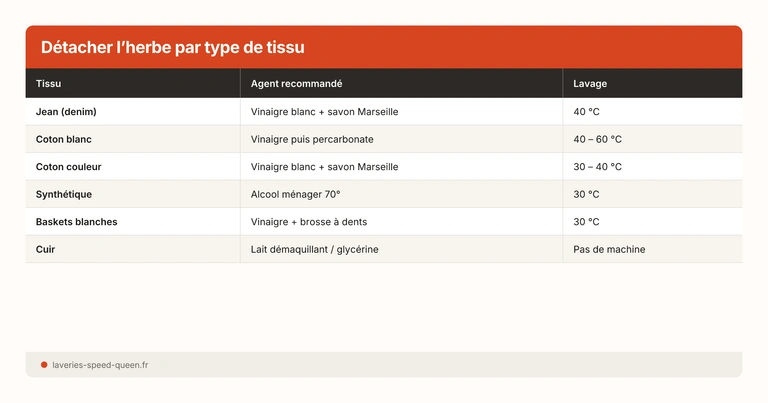
Method by fabric type
Each fabric reacts differently to stain removal agents. Adapt your approach to avoid damaging the garment. For questions about wash temperature, refer to the garment’s care label.
| Fabric | Recommended agent | Method | Wash |
|---|---|---|---|
| Jeans (denim) | White vinegar + Marseille soap | Dab 15 min, rub with soap | 40 °C, cotton cycle |
| White cotton | White vinegar then percarbonate | Dab, then soak 1 h if residue remains | 40-60 °C, cotton cycle |
| Coloured cotton | White vinegar + Marseille soap | Dab 15 min, rub with soap | 30-40 °C, colour cycle |
| Synthetic (polyester) | Rubbing alcohol 70% | Dab 10 min, rinse cold | 30 °C, synthetic cycle |
| White trainers | White vinegar + toothbrush | Brush the canvas, dab the sole | 30 °C in laundry bag or hand wash |
| Leather | Cleansing milk or glycerine | Dab gently, wipe with cloth | No machine — damp wipe |
Stained white trainers
Canvas trainers (Converse or Veja type) can handle a 30 °C machine wash in a laundry bag. Pre-treat the grass stain with white vinegar, then follow our shoe washing guide for the programme and drying. Always remove laces and insoles before washing.
Real-world cases
Sports kits (football, rugby)
Sports kits are the first victims of grass stains. The synthetic fibres (polyester) of modern kits hold less chlorophyll than cotton, but stains accumulate match after match.
- Protocol: Dab each stain with rubbing alcohol as soon as you return from the pitch. Group all kits for a collective wash.
- Laundromat advantage: For a team (15-20 shirts), large-capacity machines (18 kg) allow you to wash everything in a single cycle. See our guide to sportswear care for details.
- Temperature: 30 °C to preserve logos and lettering. Technical kits cannot handle hot washing.
Children’s trousers (school, playtime)
Trouser knees are the most affected area. Prolonged contact with damp grass produces deep stains, often reinforced by soil.
- Mixed grass + soil stain: Let the soil dry completely, brush it off, then treat the grass stain with white vinegar.
- Frequency: Children stain their clothes almost daily. A bottle of white vinegar in the laundry room allows quick pre-treatment the same evening.
- Children’s jeans: Denim handles vinegar and Marseille soap well. Wash at 40 °C without worry.
Gardening clothes
Gardening combines grass, soil, sap and sweat. Stains are often multiple and widespread.
- Batch pre-treatment: Treat all green stains with vinegar before putting everything in the machine.
- Sap stains: Tree sap (resin) requires a fatty solvent (butter, oil) before soap. Do not confuse sap with grass.
- Large loads: Gardening clothes are often bulky (overalls, thick trousers). Domestic machines of 7 kg may be insufficient. Laundromat machines (11 to 18 kg) easily handle this type of load.
Mistakes that set the stain
- Direct hot water — as with blood and wine, heat polymerises plant pigments and permanently sets them in the fibre.
- Chlorine bleach — on grass stains, bleach causes a chemical reaction that turns green into yellowish-brown. The result is a faded but still visible stain, and it is irreversible.
- Tumble drying before checking — the heat of the dryer (60-70 °C) bakes chlorophyll residue into the fibre. Always check when you take the laundry out of the washing machine.
- Dry rubbing — rubbing a dry grass stain without a dissolving agent only pushes the pigments deeper into the fibres.
- Toothpaste — often recommended online, toothpaste contains abrasives that damage fibres without dissolving chlorophyll. White vinegar is more effective and gentler.
Machine washing
After pre-treatment, machine washing removes pigment and stain removal agent residue. The choice of temperature is decisive.
Recommended settings
- Temperature: 40 °C for cotton and jeans (unless the care label says otherwise). 30 °C for synthetics and technical garments.
- Detergent: Standard liquid detergent. Avoid overdosing — extra detergent does not compensate for inadequate pre-treatment.
- Spin: 1,000-1,200 rpm for cotton, 800 rpm for synthetics.
Why a professional laundromat for large loads
When it comes to washing an entire rugby team’s kits, a weekend’s gardening outfits or three children’s trousers after a week of playtime, domestic machines reach their limits. The water volume is insufficient to properly dilute the extracted pigments.
Professional laundromat machines use 50 to 60 litres of water per cycle. This volume ensures complete dilution of chlorophyll residue and effective rinsing of stain removal agents. The pre-dosed professional detergent contains concentrated surfactants that complement the pre-treatment.
En tant que Partenaire Amazon, nous percevons une petite commission sur les achats effectués via les liens partenaires de cet article — sans surcoût pour vous. Cela nous aide à maintenir ce site et à produire des guides gratuits.
Team kits or a pile of grass-stained trousers? Our professional machines (11 to 18 kg) handle large loads in a single cycle with 50-60 litres of water and detergent included. Laundromats in Blagnac, Croix-Daurade and Montaudran, payment CB sans contact ou espèces. See our prices.
Prevention: limiting grass stains
Some simple habits reduce the frequency and severity of grass stains, especially for children who play outdoors daily.
Apply a textile waterproofing spray to the knees of children’s trousers at the start of the season. The treatment creates a barrier that prevents chlorophyll from penetrating the fibres. A shoe waterproofing spray↗ (available at most shops) works very well on denim and cotton. The application should be renewed every 3-4 washes.
For sports kits, choose polyester technical models rather than cotton. Polyester retains less chlorophyll because its surface is less porous. Stains come out more easily with white vinegar without prolonged treatment.
Finally, get into the habit of dabbing fresh stains as soon as possible. A bottle of white vinegar in the sports bag or in the club changing room allows immediate pre-treatment that makes all the difference between a stain that comes out in the next wash and one that becomes set in.
Sources and references
- Guide to tough stains and pre-treatment
- White vinegar and laundry: uses and limits
- Sodium percarbonate and laundry
- Wash temperature guide
- Washing shoes in the machine
- Sportswear care
- Chlorophyll and photochemical degradation — Journal of Photochemistry and Photobiology (chlorophyll / pheophytin conversion under UV)
- Solubility of leaf pigments — lipophilic properties of chlorophyll a and b documented in plant biochemistry