In short: coffee stains because of its tannins — plant polyphenols that bind to fibres. On a fresh stain, white vinegar or lemon juice is enough (15 min contact time). On a dried stain, glycerine softens the tannins before a sodium percarbonate soak. For coffee with milk, treat the milk protein with cold water first, then the tannins. Never tumble dry before confirming the stain has completely disappeared.
At a glance
Blot, don't rub — rubbing spreads the tannins into the fibres.
White vinegar or lemon — the acid breaks down tannins. 15 min contact on a fresh stain.
Glycerine for dried stains — softens set-in tannins before treatment.
Coffee with milk = double treatment — cold water (milk protein) then acid (tannins).
No tumble dryer — never dry a garment whose stain has not completely gone.
Why coffee stains
Coffee contains tannins — plant polyphenols from the same family as those in red wine or tea. These molecules form hydrogen bonds with textile fibres (cotton cellulose, wool proteins). The hotter the coffee at the moment of contact, the faster the tannins penetrate.
The good news: coffee tannins are less concentrated and less colouring than those in red wine. A fresh coffee stain treated correctly disappears in the vast majority of cases.
Tannins are not the only culprits. Coffee also contains melanoidins — brown pigments formed during roasting through the Maillard reaction (the same reaction that colours bread crust). These melanoidins contribute to the brown colour of the stain and are water-soluble, which explains why a simple rinse already removes a significant part of the discolouration.
Black coffee vs coffee with milk vs espresso: the difference for stain removal
Not all coffees stain in the same way. The composition of the beverage directly influences the stain removal protocol.
Black filter coffee
The simplest to treat. Contains mainly tannins and melanoidins dissolved in water. White vinegar or lemon suffices in most cases. This is the least concentrated coffee stain.
Espresso
More concentrated than filter coffee (about 2x more tannins per volume). The stain is darker and more stubborn. Same protocol as black coffee, but allow longer contact time (20-30 min instead of 15) or a second pass.
Coffee with milk / cappuccino
Combines tannins (coffee) + proteins (milk casein) + fat (milk lipids). This is a mixed stain that requires a double treatment: first cold water for the protein, then acid for the tannins.
Iced coffee with sugar
The added sugars create a sticky film that holds tannins against the fibres. Rinse thoroughly with cold water to dilute the sugar before treating the tannins. Sugar caramelised by the heat of the dryer is extremely difficult to remove.
Protein first, tannins second
For coffee with milk and cappuccino, the order of treatment is crucial. As with blood, milk casein coagulates with heat. Rinse first with cold water to remove the protein, then treat the tannins with white vinegar. If you start with hot water, the protein cooks and sets the stain — it will turn yellowish and become much more resistant.
Fresh stain vs dried stain: adapting the method
The success of stain removal depends largely on the time elapsed since contact. Here is why.
Fresh stain (less than 30 minutes)
The tannins are still in solution in the coffee’s water. They have not yet formed stable bonds with the fibres. A simple acid treatment is enough: white vinegar↗ or lemon breaks these nascent bonds.
Estimated success rate: 95% if you intervene within the first 5 minutes, 85% within the half hour.
Partially dried stain (30 min to 24h)
The water has evaporated, but the tannins have not yet been oxidised by air. They have formed stronger hydrogen bonds with the fibres. You first need to rehydrate the tannins (glycerine↗ or warm water), then attack them with acid.
Estimated success rate: 70-80% with the right protocol.
Old stain (more than 24h) or tumble-dried
The tannins have oxidised and formed stable complexes with the fibres. The heat of the dryer may have polymerised these complexes, making them virtually insoluble. A powerful agent (sodium percarbonate↗) and prolonged soaking are needed.
Estimated success rate: 40-60%. Prevention (checking before the dryer) remains the best strategy.
Fresh stain: the immediate method
If you intervene within minutes, the stain will come out 100% in most cases.
Blot the excess — dab with a clean cloth or paper towel. Do not rub.
Rinse from the reverse — run the stain under cold water from the back of the fabric to push the pigments out.
Apply pure white vinegar — soak the area. Acetic acid breaks down tannins through hydrolysis. Leave for 15 minutes.
Rub and rinse — gently rub the fabric against itself, then rinse thoroughly.
Alternative to vinegar: lemon juice works on the same principle (citric acid↗ vs acetic acid). It is slightly less effective but leaves a better smell. Sparkling water is also useful as first aid: the dissolved CO2 creates a gentle fizz that helps dislodge surface pigments.
Dried stain: glycerine first
A dried coffee stain has formed a more resistant tannin-fibre complex. You first need to soften the tannins before attacking them chemically.
- Apply pure vegetable glycerine to the stain. Glycerine is a gentle solvent that penetrates fibres and rehydrates dried tannins.
- Leave for 30 minutes to 1 hour.
- Rub gently, then rinse with warm water.
- If a trace persists, soak in a sodium percarbonate solution (2 tablespoons per 2 litres of warm water) for 2-4 hours. Sodium percarbonate releases active oxygen that oxidises residual chromophores.
- Machine wash at 30-40 °C.
For very old stains (several weeks), combine glycerine + white vinegar into a paste: mix in equal parts, apply to the stain and leave for 1 hour before rinsing and moving on to sodium percarbonate.
Comparison chart of methods
| Method | Effectiveness | Contact time | Stain type | Suitable fabrics |
|---|---|---|---|---|
| Pure white vinegar | Very good | 15 minutes | Fresh | Cotton, linen, synthetics |
| Lemon juice | Good | 15-20 minutes | Fresh | Light-coloured fabrics only |
| Sparkling water | Fair | Immediate | Very fresh | All (first aid) |
| Glycerine + vinegar | Very good | 30 min - 1h | Dried | Cotton, linen, synthetics |
| Glycerine + percarbonate | Excellent | 30 min + 2-4h soak | Dried / old | White and colourfast |
| Marseille soap | Moderate | 30 minutes | Fresh / light | All (emergency) |
| Warm milk (for ink) | Poor on coffee | 1-2 hours | Dried | Not recommended for coffee |
Tea stain: same family, same treatment
Tea also contains tannins — the chemistry is identical to that of coffee. The same treatment works (white vinegar or lemon on a fresh stain, glycerine on a dried stain). The only difference: black tea tannins are slightly more colouring than those in coffee, so act faster. Green tea stains much less.
Chai tea or tea with milk is treated like coffee with milk: cold water first (protein), then acid (tannins).
Coffee with milk: the detailed double treatment
Coffee with milk combines tannins (coffee) and proteins (milk casein). The order of treatment is crucial, and the presence of milk fat adds a third component:
- Cold water — Rinse thoroughly with cold water to dissolve and remove casein. Do not skip this step: if the protein coagulates from heat, it will form a yellowish film that traps the tannins.
- Dish soap (optional) — If the coffee contained whole milk or cream, apply a drop of dish soap to emulsify the fat. Dish soap is the best agent against lipids thanks to its surfactants.
- White vinegar — Once the protein and fat are removed, treat the residual tannins with white vinegar as you would for black coffee.
- Machine wash — At 30-40 °C, normal cycle.
By fabric: adapting the method in detail
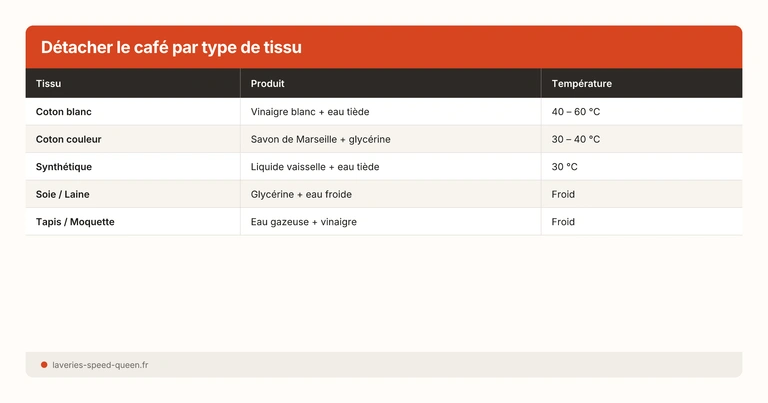
White cotton
The easiest. White vinegar or lemon as first treatment, then sodium percarbonate if needed. A final wash at 60 °C is possible. For very old stains, you can also whiten yellowed laundry with sodium percarbonate.
Coloured cotton
White vinegar without problem. Avoid pure lemon on dark colours (slight bleaching effect). Test on an inner hem. Sodium percarbonate is usable on colourfast fabrics, but do a preliminary test.
Silk
Dab with cold water only. Silk cannot withstand the strong acidity of vinegar or the alkalinity of percarbonate. If the stain persists, take it to a dry cleaner. Very diluted Marseille soap is tolerated as a last resort.
Wool
A protein fibre sensitive to strong acids. Use diluted white vinegar (50/50 water-vinegar) or pure glycerine. No sodium percarbonate. No rubbing — wool felts under pressure. See our delicate fabrics guide.
Synthetic (polyester)
Tannins adhere less to polyester than to cotton — the fibre is non-polar, so hydrogen bonds are weaker. A quick rinse is often enough. White vinegar if needed. Wash at 30 °C.
Tablecloth / table linen
Often white cotton — vinegar + percarbonate treatment. For delicate tablecloths, glycerine first. The wash temperature depends on the care label.
Jeans / denim
Denim is thick cotton — it absorbs a lot of coffee. Act quickly. Pure white vinegar, then wash at 40 °C. Caution: lemon can lighten a raw (unwashed) jean locally. See our guide to washing jeans.
Commercial products: which ones work?
Beyond home remedies, certain commercial products are effective on coffee stains:
- Active-oxygen stain remover (e.g. OxiClean, Vanish Oxi Action): these are sodium percarbonate-based formulations. Effective on dried stains, follow the dosage indicated on the packaging.
- Pre-wash stain spray: practical for quick intervention (at the office, at a restaurant). They contain surfactants and sometimes enzymes. Spray, leave, wash as soon as possible.
- Ox-gall stain soap: a natural stain removal classic. Ox gall (bile) contains bile acids that emulsify both fats and tannins. Effective on coffee with milk.
Avoid chlorine-based products (bleach): they can yellow tannins instead of removing them.
Mistakes to avoid
- Rubbing a fresh stain — you spread the tannins and push them into the fibres. Blot instead.
- Using bleach — bleach can yellow tannins instead of removing them, especially on cotton.
- Starting with hot water on coffee with milk — the milk casein coagulates and sets the stain.
- Tumble drying without checking — the heat turns a faint trace into a permanent stain.
- Waiting several days — the longer the tannins dry and oxidise, the more stable and harder to break the tannin-fibre complex becomes.
- Using salt alone — salt absorbs liquid but does not break down tannins. It is first aid, not a complete treatment.
- Mixing vinegar and percarbonate — the acid (vinegar) neutralises the base (percarbonate). Use them separately, at different stages of the treatment.
Summary: 3 common scenarios
Scenario 1 — Black coffee just spilled on a white shirt: Blot, rinse from the reverse with cold water, apply white vinegar for 15 min, rinse, wash at 40 °C. Result: stain gone in 95% of cases.
Scenario 2 — Dried coffee with milk stain on a coloured t-shirt: Rinse with cold water (protein), apply glycerine for 30 min, rinse, treat with white vinegar for 15 min, wash at 30 °C. If a trace remains, sodium percarbonate for 2h.
Scenario 3 — Old coffee stain on a white tablecloth that went through the dryer: Glycerine for 1h, rinse, overnight sodium percarbonate soak, wash at 60 °C. Uncertain result — next time, check before the dryer.
As an Amazon Partner, we earn a small commission on purchases made through the affiliate links in this article — at no extra cost to you. This helps us maintain this site and produce free guides.
Our laundromats in Blagnac, Croix-Daurade and Montaudran have professional machines with detergent included. The higher water volume (50-60 litres) helps dilute and extract tannins better than a domestic machine. Payment CB sans contact ou espèces. See our prices.
Sources and references
- Stain removal: solutions for all stains
- Remove a red wine stain (same tannin family)
- Wash temperature guide
- White vinegar and laundry: uses and limits
- Sodium percarbonate: usage guide
- Remove a grease stain (for greasy coffee with milk)
- Delicate fabrics care
- Coffee polyphenol chemistry — tannin/cellulose fibre interaction through hydrogen bonds
- Maillard reaction and melanoidins — brown pigments formed during coffee roasting