Chocolate is a composite stain: cocoa butter (fat), tannins (plant pigments) and, depending on the type, milk proteins that coagulate with heat. To remove it, you must treat these three components in the right order. Scrape the excess, rinse with cold water, apply Marseille soap, then wash at 30-40 °C. Never tumble dry before confirming the trace has completely disappeared.
At a glance
Scrape first — remove the surplus chocolate with the back of a spoon, without rubbing.
Cold water mandatory — hot water cooks the milk proteins and sets the tannins.
Marseille soap — its alkaline surfactants dissolve cocoa butter and sugars.
30-40 °C in the machine — check the stain has gone before any tumble drying.
Glycerine for old stains — softens set-in tannins before soaping.
Why chocolate stains so much
To remove stains effectively, you need to understand what you are dealing with. A chocolate stain is not a simple stain: it is a cocktail of three distinct chemical families, each requiring its own treatment.
Cocoa butter (fat component). Dark chocolate contains between 30 and 45% fat. This cocoa butter is a lipid that behaves exactly like a grease stain: it penetrates the fibres, binds by hydrophobic affinity and resists water alone. To dislodge it, you need surfactants — molecules capable of encapsulating the fat in micelles and flushing it out during rinsing.
Tannins (pigment component). Cocoa beans are rich in polyphenols, the same molecules that colour tea, red wine and coffee. Tannins have a formidable trait: they bind almost permanently to textile fibres when exposed to heat or an acidic environment. This is why a garment stained with chocolate and put straight into the tumble dryer often retains an indelible brown mark.
Sugar (water-soluble component). Good news: sugar dissolves in cold water. It is the easiest component to remove, but if it dries, it forms a sticky crust that traps the fat and tannins in the fibre.
Milk proteins (milk chocolate only). The milk powder in milk chocolate adds a fourth dimension to the problem. These proteins — casein and whey — coagulate above 40 °C, just like blood proteins. This is what makes milk chocolate harder to treat than pure dark chocolate.
The stain removal challenge is therefore threefold: dissolve the fat, neutralise the pigments and avoid cooking the proteins. Each mistake (hot water, rubbing, premature drying) irreversibly sets one of these components.
Dark, milk or white chocolate: the difference matters
Not all chocolates stain in the same way. Their composition determines the adapted treatment and difficulty level.
| Type | Dominant composition | Difficulty |
|---|---|---|
| Dark chocolate (≥ 70%) | Tannins +++, cocoa butter ++, little sugar, no milk proteins | Medium to high (stubborn pigments) |
| Milk chocolate | Cocoa butter ++, sugar ++, milk proteins +, tannins + | High (coagulation risk) |
| White chocolate | Cocoa butter +++, sugar +++, no tannins | Low (pure fat stain) |
Dark chocolate leaves a very visible dark brown trace, especially on light fabrics. The high concentration of tannins explains this intense colouration. However, the absence of milk proteins simplifies the treatment: no risk of protein coagulation.
Milk chocolate is paradoxically the most treacherous. Its stain is lighter, which tempts people to minimise the urgency. But the milk proteins add a strict constraint: the pre-treatment water must stay below 40 °C or the stain will be “cooked”.
White chocolate contains no cocoa solids — so no colouring tannins. Its stain is purely fatty and is treated like a classic oil stain: dish soap, warm water, wash at 40-60 °C.
Chocolate spread and chocolate sauce
Chocolate spread (Nutella type) contains palm oil in addition to cocoa butter, which doubles the fat component. Chocolate dessert sauces add starch and sometimes eggs. In both cases, apply neat dish soap before Marseille soap to handle the extra fat.
Fresh stain: the first 15 minutes
It is in the first minutes that the stain is most vulnerable. The chocolate has not yet dried, the sugar has not formed a crust, and the tannins have not bonded to the fibres. If you act quickly, success is virtually certain — even on white.
Step 1 — Remove the excess
Scrape the surface chocolate with the back of a spoon, a butter knife or the edge of a bank card. The goal is to lift the solid matter without spreading it. Never rub a fresh chocolate stain: you push the cocoa butter into the fibres and spread the tannins over a wider area.
If the chocolate is still soft (melted in a pocket, mousse stain), first place the garment in the freezer for 15 minutes. The chocolate will harden and peel off easily in one piece.
Step 2 — Rinse with cold water from the reverse
Turn the garment inside out and run the stained area under a strong stream of cold water. Cold water dissolves the sugar immediately and flushes surface pigments without cooking the proteins. Rinsing from the reverse pushes the residue outwards rather than through the fibre.
Step 3 — Marseille soap
Rub a block of Marseille soap↗ (genuine, without added perfume) directly on the damp stain. Marseille soap is an alkaline surfactant: it emulsifies cocoa butter by forming micelles (micro-bubbles of soap that trap the fat) and lifts tannins with its basic pH (pH 9-10). Leave for 15 minutes, forming a thick soap crust on the area.
Step 4 — Rub and rinse
Gently rub the fabric against itself under cold water. The stain should dissolve progressively. If a brown shadow persists, apply a few drops of concentrated dish soap (colourless preferably) to boost the degreasing action. Massage gently and rinse again.
Step 5 — Check before washing
Examine the area in natural light. If the stain has disappeared, you can run a normal wash cycle at 30-40 °C. If a trace remains, move to the next section before machine washing — washing over a still-visible stain risks setting it.
Old or set-in stain
A chocolate stain that has dried for several hours — or worse, has been through the machine without pre-treatment — requires a more aggressive approach. The tannins have bonded to the fibres, the cocoa butter has penetrated deep, and the sugar has formed a hard crust.
Glycerine: the anti-tannin weapon
Vegetable glycerine↗ is the most effective product for softening an old chocolate stain. It acts as a gentle solvent that penetrates the sugar/fat crust and rehydrates the fixed tannins, making them soluble again.
- Warm slightly the glycerine (lukewarm, not hot — in a bain-marie or 10 seconds in the microwave).
- Apply generously to the stain and massage with your fingertips to work it in.
- Leave for 30 minutes — glycerine needs time to soften set-in tannins.
- Soap with Marseille soap and rub gently.
- Rinse with cold water and assess the result.
Sodium percarbonate: active oxygen
If glycerine alone is not enough, [sodium percarbonate](/blog/percarbonate↗-de-soude-linge/) takes over. On contact with water, it releases hydrogen peroxide (oxygenated water) that oxidises remaining tannins and whitens brown traces.
- Dissolve 1 tablespoon of sodium percarbonate per litre of water at 40 °C.
- Immerse the garment and soak for 1 to 2 hours (up to 4 hours for very old stains).
- Rinse and machine wash at 30-40 °C.
Precaution with percarbonate
Sodium percarbonate is a whitening agent. It is safe on white cotton and colourfast fabrics, but can dull delicate colours or prints. On a fragile coloured garment, limit soaking to 30 minutes and test first on an inner hem.
The egg yolk method (delicate fabrics)
For silk, wool or cashmere, the previous treatments are too aggressive. A traditional technique involves mixing an egg yolk with a teaspoon of warm glycerine. This paste, applied to the stain for 30 minutes, uses the natural emulsifying properties of the egg yolk’s lecithin to dislodge fat and tannins without attacking the fibre. Rinse with cold water and hand wash with a gentle detergent.
Method adapted by fabric type
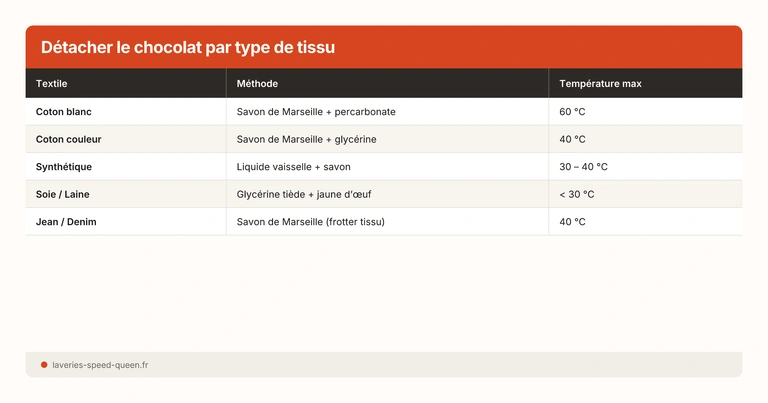
The fabric determines how much room for manoeuvre you have. White cotton tolerates vigorous treatments; silk demands the utmost delicacy.
| Fabric | Recommended method | Max temperature | Precautions |
|---|---|---|---|
| White cotton | Marseille soap + percarbonate (1-2h soak) | 60 °C | The most resilient. Sunlight bleaches residual traces on damp white cotton. |
| Coloured cotton | Marseille soap + glycerine | 40 °C | Percarbonate limited to 30 min. Test colour fastness. |
| Synthetic | Dish soap + Marseille soap | 30-40 °C | Polyester retains fat. Insist on degreasing before washing. |
| Silk / Wool | Warm glycerine + egg yolk or special soap | Cold (< 30 °C) | No rubbing, no percarbonate. Dab only. |
| Jeans / Denim | Marseille soap (rub fabric against fabric) | 40 °C | Denim is robust but can bleed. Wash alone. |
For delicate fabrics like silk or wool, always refer to the garment’s care label. The Ginetex symbols (circle, triangle, square) tell you precisely what the fibre tolerates. If in doubt about a valuable garment, take it to a professional dry cleaner.
Mistakes that set the stain
Certain instinctive reactions considerably worsen a chocolate stain. Here are the five most common mistakes — and why they are so harmful.
- Pouring hot water immediately — water above 40 °C cooks the milk proteins (milk chocolate) and accelerates tannin bonding to fibres. Always start cold.
- Rubbing the fresh stain vigorously — you spread the cocoa butter over a wider area and push it into the core of the fibre. Scrape, don't rub.
- Tumble drying without checking — dryer heat (60-80 °C) sets tannins almost irreversibly. Always check in natural light that the stain has completely gone.
- Using bleach on colours — bleach destroys tannins but also discolours the fabric. It is only viable on pure white cotton, and sodium percarbonate is a gentler and equally effective alternative.
- Ironing over the stain — the iron sole (150-200 °C) acts as a permanent heat setter. The result is a permanent brown imprint, impossible to remove.
Machine wash: temperature and programme
Once pre-treatment is done, the machine wash finalises the cleaning. But the machine settings make all the difference between a stain that disappears and one that sets.
What temperature to choose?
For milk or dark chocolate, stay between 30 and 40 °C for the first wash. This range is warm enough to fluidise residual cocoa butter and allow detergent surfactants to encapsulate it, without risking coagulation of remaining milk proteins.
For white chocolate (purely fatty stain, no tannins or proteins), you can go straight to 40-60 °C depending on the fabric label. See our wash temperature guide to adapt the programme to each fibre.
What programme?
A normal cotton cycle (or synthetics for technical garments) with thorough rinsing is ideal. Avoid eco or quick programmes that use less water: tannin residue needs generous rinsing to be completely flushed out.
The advantage of water volume
This is where the difference between a domestic machine and a professional laundromat machine becomes significant. A domestic washing machine uses on average 15 to 20 litres of water per cycle. That is enough for maintenance washing, but for stain removal, water volume plays an essential mechanical role: the more water there is, the more tannin and fat residues are diluted and carried away from the fibre.
The professional Speed Queen machines in our laundromats use between 50 and 60 litres of water per cycle, with a particularly long rinse phase. This higher volume, combined with pre-dosed professional detergent, offers a real advantage for stubborn stains like chocolate. The mechanical action of the drum (larger capacity = better agitation) also helps dislodge set-in residue.
Rinsing makes the difference
After pre-treatment with Marseille soap, a good rinse is as important as the wash itself. Soap residues left in the fibre can trap tannin pigments and create a yellowish ring on drying. A generous volume of water avoids this problem.
After the wash: the mandatory check
Remove the garment from the machine and examine the stained area in natural light (not under artificial lighting that masks nuances). If the stain has completely gone, you can dry normally. If a shadow persists, even slight, do not tumble dry. Restart the pre-treatment (glycerine + Marseille soap) and re-wash.
For white cotton, an extra tip: hang the garment still damp in full sunlight. UV rays act as a natural bleach on residual tannin traces — the same principle as natural bleaching of yellowed laundry.
As an Amazon Partner, we earn a small commission on purchases made through the affiliate links in this article — at no extra cost to you. This helps us maintain this site and produce free guides.
Chocolate stains often resist the limited water volume of domestic machines. Our laundromats in Blagnac, Croix-Daurade and Montaudran have professional machines with detergent included and high-performance rinsing (50-60 litres). Payment CB sans contact ou espèces. See our prices.