In short: To remove a blood stain, the golden rule is to use only cold water. Heat cooks the blood proteins and sets the stain permanently. For fresh stains, Marseille soap is enough; for dried stains, sodium percarbonate is your best ally. Never tumble dry before confirming the stain has completely disappeared.
At a glance
Cold water is essential — hot water (≥ 40 °C) sets the stain irreversibly.
Marseille soap — the ultimate weapon for fresh stains (leave for 30 min).
Percarbonate for dried stains — a long soak (4-8 h) to dislodge the fibres.
No tumble dryer — never dry a garment whose stain has not fully disappeared.
Why cold water is mandatory
The effectiveness of blood stain removal rests on a simple chemical explanation: the composition of haemoglobin. This protein, responsible for the red colour of blood, has a property of thermal coagulation.
As soon as the water temperature reaches 40 °C, blood proteins undergo denaturation. They unfold and form covalent bonds with the textile fibres (cotton, polyester or linen). This process is identical to cooking an egg: once the white has coagulated under heat, it is impossible to make it liquid again.
This is why any attempt to wash with hot water or iron over an untreated blood stain results in an indelible brown/yellow mark. Mechanical action combined with water between 10 and 20 °C is the only way to keep haemoglobin soluble so it can be flushed from the fabric. This is the same principle used in hospital cleaning protocols, where cold pre-washing is mandatory for blood-contaminated linen (source: CTIN recommendations, French Technical Committee for Nosocomial Infections).
Fresh vs dried blood: two different protocols
The distinction is fundamental because the state of the blood entirely determines the stain removal strategy. Fresh blood (less than 30 minutes old) is still soluble in cold water: the haemoglobin has not yet had time to bond covalently with the fibres. A vigorous rinse with cold water is often enough to remove 80-90 % of the stain.
Dried blood, on the other hand, has undergone polymerisation. The proteins have unfolded, entangled and bonded to the textile fibres through stable chemical bonds. You then need an agent capable of breaking these bonds: this is the role of sodium percarbonate↗ (active oxygen) or hydrogen peroxide, which oxidise the fixed haemoglobin residues.
Practical rule: if the stain is still damp and bright red, you are in the “fresh” protocol (next section). If it is brown, dry or cracked, go directly to the “dried” protocol.
Fresh stain: the immediate method
If you act within minutes of the incident, the stain can disappear 100 % without leaving a trace, even on white fabric.
Rinse from the reverse — hold the stain under a strong stream of cold water. By rinsing from the back of the fabric, you push the blood out of the fibre instead of through the garment.
Soap up — rub the area with a barely damp block of Marseille soap until a thick crust forms.
Wait — leave for 30 minutes. The alkaline Marseille soap will emulsify the organic residues.
Rub and rinse — gently rub the fabric against itself, then rinse thoroughly with cold water.
Dried stain: the long soak
A dried blood stain requires rehydrating the proteins and breaking their bonds with the fibres. Sodium percarbonate (active oxygen) is far more effective than baking soda here.
The percarbonate method
Sodium percarbonate comes as a white powder. On contact with water, it releases hydrogen peroxide (the same as in hydrogen peroxide solution) which attacks the blood pigments.
- Dissolve 2 tablespoons of percarbonate in 2 litres of warm water (to activate the product), then let the water cool or add ice.
- Fully immerse the stained garment or sheet.
- Leave to soak for 4 to 8 hours (overnight for sheets).
- Wash normally in the machine on cold (30 °C).
The salt water alternative
If you have no percarbonate, table salt creates an osmotic effect that “pulls” the blood out of the fibres. Mix 2 tablespoons of salt per litre of cold water and soak for 2 hours before soaping with Marseille soap.
| Method | Effectiveness | Contact time | Recommended use |
|---|---|---|---|
| Percarbonate | ⭐⭐⭐⭐⭐ | 4-8 hours | White and colourfast fabrics |
| Salt water | ⭐⭐⭐ | 2 hours | First aid / Delicate textiles |
| Aspirin / Tablet | ⭐⭐ | 1 hour | Emergency (dissolve 1 tablet in water) |
Stain that went through the dryer
This is the worst-case scenario: the garment has been washed (often on hot) then tumble dried. The stain is now an ingrained brown mark. Although success is no longer guaranteed, a rescue attempt is still possible.
The goal is to use a powerful enzyme-based stain remover or hydrogen peroxide at 3 % (10 volumes).
- Apply hydrogen peroxide locally. You will see effervescence (white foam): this is the chemical reaction with the remaining haemoglobin residues.
- Leave for 5 minutes, rinse and repeat.
- Finish with a 12-hour soak in sodium percarbonate.
Warning: Hydrogen peroxide is a bleaching agent. On a coloured garment, it may leave a lighter halo. Always test on an inside seam first.
The cold milk trick
For moderate blood stains (not a large amount), cold milk is a traditional technique that works thanks to casein — a milk protein that binds to haemoglobin and helps lift it from the fibres. Soak the stained area in cold milk for 1-2 hours, then gently rub and rinse. This method is gentle and suitable for delicate fabrics (silk, wool) where hydrogen peroxide would be too harsh.
By fabric: adapting the method
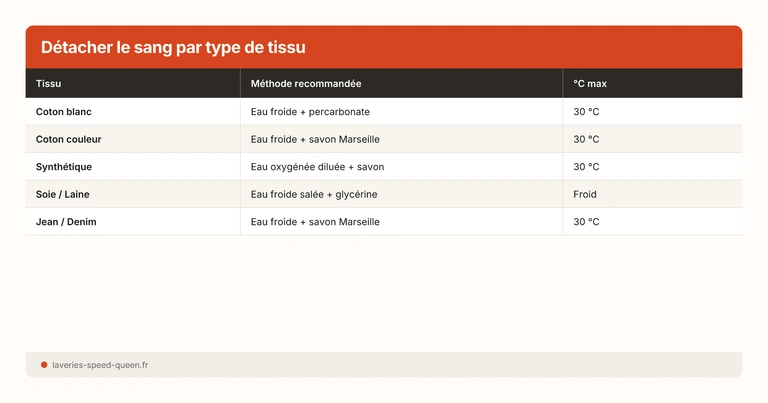
Not all fabrics react the same way to stain removal agents.
White cotton
The most resilient. You can use sodium percarbonate without worry. Once the stain has been cold-treated, a final wash at 60 °C is possible for hygiene.
Coloured cotton
Be careful with percarbonate, which can dull colours over time. Prefer Marseille soap and a quick wash after treatment.
Silk
Do not rub. Dab with a cloth soaked in cold salted water. Use only a special silk detergent.
Wool
Wool does not tolerate the alkalinity of percarbonate. Use pure Marseille soap, rub gently and rinse with cold water.
Synthetic
Polyester holds little blood on the surface, but once ingrained it is hard to remove. Act quickly with cold water.
Sheets and bedding
Volume matters. Soaking in a bathtub is ideal before running through a large-capacity machine (18 kg).
By fabric: detailed protocols
Each fabric reacts differently to stain removal agents. Here are the specific protocols for the most common cases.
White cotton (sheets, t-shirts, underwear)
White cotton is the most resistant fabric to stain removal treatments. You can use sodium percarbonate, hydrogen peroxide and even bleach (if the label allows it via the empty triangle symbol). For a fresh stain, Marseille soap↗ + cold water is highly effective. For a dried stain, a percarbonate soak for 4-8 hours is the most reliable method. Once the stain is fully removed, a final wash at 60 °C is possible for hygiene. White cotton is the only fabric where you have every option available.
Coloured cotton
Caution: sodium percarbonate can dull bright colours over time. Use Marseille soap as your first reflex — it is effective on fresh blood without risk of discolouration. For dried blood, opt for salt water (less aggressive than percarbonate) or a short soak (2 hours maximum) in percarbonate. Wash promptly after treatment to limit the product’s contact time with the dyes.
Jeans / denim
Denim is a dense and resilient fabric, but its indigo dye is sensitive. Fresh blood is easily removed with cold water as the dense fibres hold the blood on the surface. For dried blood, apply Marseille soap directly to the stain, rub gently and leave for 30 minutes. Avoid percarbonate on raw or dark jeans — it can create a lighter patch. Cold salt water (2 tbsp salt per litre, 2 hours soaking) is the safest alternative.
Mattress
A mattress cannot go in the machine: you must treat it locally. Dab immediately with a clean cloth soaked in cold water (do not rub — you would push the blood into the foam). Prepare a thick paste of baking soda↗ and cold water (2/3 – 1/3), apply to the stain and let dry completely (30 to 60 minutes). Vacuum the dry powder. For older stains, spray a 50/50 mix of cold water and hydrogen peroxide (3 %), dab with a clean cloth and let air dry. Protect the mattress with a waterproof mattress protector to prevent future accidents.
Silk and delicate fabrics
On silk, fine wool or lace, any aggressive mechanical action (rubbing, wringing) must be avoided. Gently dab with a cloth soaked in cold salted water — salt creates an osmotic effect that draws the blood out of the fibres without damaging the fabric. Do not use percarbonate (too alkaline for silk) or hydrogen peroxide (risk of localised bleaching). See our guide on delicate fabrics for more details. For a valuable item, professional dry cleaning remains the safest option.
Special cases
Menstrual blood: precautions by fabric
Menstrual blood contains more uterine mucosa than “ordinary” blood, making it more viscous and more adherent to fibres. The method remains the same (cold water is essential), but a few specifics apply:
- Cotton underwear: rinse immediately under a strong stream of cold water, then soap with Marseille soap. Cotton responds very well to this treatment.
- Period pants: rinse in cold water until the water runs clear, then machine wash at 30 °C. Do not use fabric softener — it blocks the absorption of the technical layers.
- Sheets (overnight stain): if the stain has dried overnight, soak in a percarbonate solution (2 tbsp per 2 litres of warm water) for 4-8 hours before washing in a large-capacity machine.
- Dark fabrics: prefer Marseille soap or salt water over percarbonate to avoid creating a lighter halo on the fabric.
Medical blood or nosebleed
Blood can sometimes be loaded with iron (medical treatments, iron supplements). If an orange trace remains after soap cleaning, it may be an iron residue rather than haemoglobin. A localised treatment with lemon juice (citric acid↗) or a textile rust remover can finish the job. Rinse thoroughly after application.
Baby clothes
For baby laundry, avoid harsh chemical stain removers. Marseille soap and sodium percarbonate are natural, biodegradable and fragrance-free solutions, ideal for sensitive skin. See our guide on washing baby clothes.
Mistakes to avoid
- Using hot water straight away — this is mistake number 1 that permanently sets the stain.
- Tumble drying too soon — the heat turns a treatable stain into a permanent mark.
- Rubbing with a dry cloth — you push the blood deep into the fibres instead of extracting it.
- Using bleach on blood — bleach yellows the blood proteins and weakens the fibres.
- Ironing a stained garment — the iron sole acts as a permanent heat fixer.
- Mixing vinegar and bleach — (safety reminder) this creates a dangerous toxic gas.
As an Amazon Partner, we earn a small commission on purchases made via the affiliate links in this article — at no extra cost to you. This helps us maintain this site and produce free guides.
Our laundromats in Blagnac, Croix-Daurade and Montaudran have professional machines with detergent included. The higher water volume (50-60 litres) helps remove blood residues better than a domestic machine. Payment CB sans contact ou espèces . See our prices.
Sources and references
- Stain removal: solutions for all stains
- Sodium percarbonate: usage guide
- Washing temperature guide
- Caring for delicate fabrics: silk and wool
- How to wash jeans without damage
- How often to wash your sheets
- Baking soda and laundry: uses and limits
- Ginetex: International guide to care labelling (lien externe)
- CTIN (French Technical Committee for Nosocomial Infections): cold pre-wash protocols for blood-contaminated linen