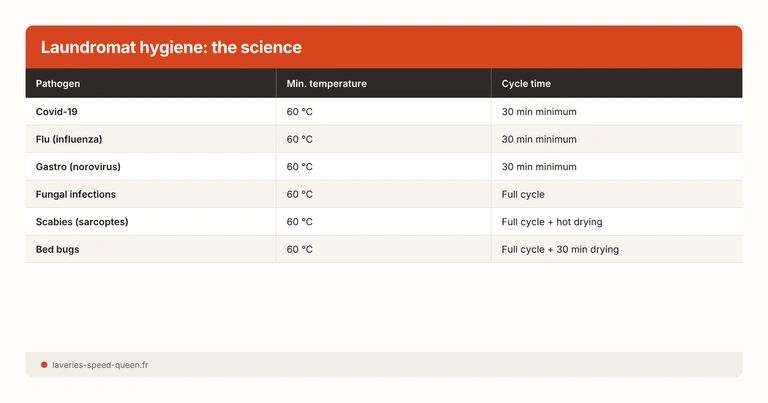
In a nutshell: At the laundromat, a 60 °C wash followed by tumble drying eliminates 99.99999 % of bacteria (7 log₁₀ reduction, hospital study PMC4229498). The water volume of professional machines (50-60 L per cycle) ensures deep rinsing of microbial residue.
Biofilm and Washing Machines: An Underestimated Phenomenon
In home washing machines, biofilms can reach up to 10^6 CFU/cm² on certain damp areas, especially after repeated cycles at 30-40 °C.
A biofilm is a community of micro-organisms (bacteria, yeasts) that aggregate on a surface by secreting a polysaccharide matrix. In a warm, moist environment, this matrix adheres to seals, the detergent drawer, and the drain filter of washing machines. It is this biological layer that is responsible for the characteristic “smelly machine” odour and some of the recontamination of clean laundry.
How Biofilm Forms in a Machine
Three conditions promote biofilm growth: residual moisture, moderate temperature (20-40 °C), and the presence of organic residue (fibres, sweat, unrinsed detergent). In a home machine, these conditions are frequently met:
- Low-temperature cycles: washes at 30 °C or “eco” cycles do not destroy bacteria; they redistribute them.
- Extended inactivity: between uses, the drum stays damp for hours, sometimes days.
- Limited water volume: modern compact machines use 35-45 litres per cycle, which can leave detergent residue that feeds the biofilm.
A study by Callewaert et al. published in Applied and Environmental Microbiology (2015) showed that home washing machines harbour specific bacterial communities in their door seal, with concentrations reaching 10⁶ CFU/cm².
Why Laundromat Machines Are Less Affected
In a self-service laundromat, several factors limit biofilm formation:
The table below compares operating conditions that directly influence bacterial risk.
| Factor | Home machine | Professional machine (laundromat) |
|---|---|---|
| Cycles per day | 1-2 | 8-15+ |
| Wet idle time | 12-48 h | 15-30 min between cycles |
| Water volume per cycle | 35-45 L | 50-60 L |
| Average cycle temperature | 30-40 °C | 40-60 °C (mixed usage) |
| Maintenance | Rare | Daily |
The near-continuous operation of laundromat machines reduces wet idle time — the main factor in bacterial colonisation. The higher water volume ensures better rinsing of organic residue. And daily maintenance (seal cleaning, filter checks) prevents organic matter build-up.
How to Prevent Biofilm at Home
For a complete home cleaning protocol, see our guide to cleaning your washing machine.
If you use a home machine between laundromat visits:
- Run an empty cycle at 90 °C once a month — the heat dissolves the biofilm matrix
- Leave the door and detergent drawer open after each cycle to ventilate the drum
- Clean the door seal with white vinegar↗ every two weeks
For more on recommended washing temperatures and causes of laundry odours.
At a Glance
94 micro-organisms identified in washing machine biofilms (PubMed study PMC4672060).
99.9 % of bacteria eliminated by Speed Queen tumble dryers (independent lab test, 3 major pathogens).
60 °C wash + tumble drying = 7 log₁₀ reduction — i.e. 99.99999 % of bacteria eliminated (hospital study PMC4229498).
The eco 30 °C cycle does not disinfect — bacteria survive below 40 °C (review PMC8231443).
440 G extraction force on Speed Queen machines — deeper rinsing that flushes more residue.
The Factors That Influence Washing Hygiene
The three decisive levers are temperature (40-60 °C), rinse volume (50-60 L in professional machines), and immediate tumble drying.
Three technical parameters determine the hygiene level of a wash cycle. They vary by machine type — this is where professional machines stand out.
Temperature: Factor #1
The most comprehensive scientific review on laundry hygiene, published in Applied and Environmental Microbiology (PMC8231443 (lien externe)), clearly establishes the impact of temperature:
| Temperature | Bacterial reduction | Effectiveness |
|---|---|---|
| 30 °C (eco cycle) | 1-2 log₁₀ | Removes visible dirt, freshens laundry |
| 40 °C | 3 log₁₀ (99.9 %) | Adequate hygiene for everyday laundry |
| 60 °C | 5 log₁₀ (99.999 %) | Recommended for bedding, towels, baby laundry |
| 60 °C + tumble drying | 7 log₁₀ (99.99999 %) | Hospital-grade level |
The eco cycle is designed to reduce energy consumption — and it does that very well. For an everyday t-shirt, it is perfect. For sheets, towels, baby laundry, or after an illness, a 60 °C wash makes a real difference.
Professional machines at the laundromat reach and maintain the displayed temperature throughout the entire cycle, which guarantees the hygienic effectiveness of the chosen program.
What “Clean” Means in Microbiology
In practice, a 40 °C wash achieves around 3 log₁₀, 60 °C around 5 log₁₀, and 60 °C + drying can reach 7 log₁₀.
When you take your laundry out of the machine and it smells fresh, you consider it clean. In microbiology, scientists measure washing effectiveness in “logarithmic reduction” — the number of decimal places of bacteria eliminated.
3 log₁₀ = 99.9 %
Out of 1,000,000 bacteria, 1,000 remain. This is the level achieved by a standard 40 °C wash without tumble drying. Sufficient for everyday laundry worn by healthy individuals.
5 log₁₀ = 99.999 %
Out of 1,000,000 bacteria, 10 remain. Level achieved by a 60 °C wash alone, or a 40 °C wash + professional tumble drying. Recommended for bedding and towels.
7 log₁₀ = 99.99999 %
Out of 10,000,000 bacteria, 1 remains. This is hospital-grade level, achieved by a 60 °C wash + complete tumble drying — exactly what a professional laundromat visit with drying provides.
The good news: reaching 5 to 7 log₁₀ requires no special product or complex protocol. Two things suffice: the right washing temperature and complete tumble drying.
A word of context
The data in this article come from scientific research. A 30-40 °C wash covers everyday needs. For maximum decontamination (5-7 log₁₀) — allergies, infants, convalescence, bulky laundry — professional laundromat washing at 60 °C followed by tumble drying offers a measurable additional level of protection.
Water Volume and Rinsing
Professional Speed Queen machines use 50 to 60 litres per cycle, versus 35 to 45 litres for a recent home machine. It is the rinsing that flushes bacteria detached from fibres by agitation and detergent. More water means more thorough rinsing.
Extraction force also plays a role: commercial Speed Queen machines extract at 440 G at 1,200 rpm. The higher the extraction force, the more residual water (and the micro-organisms it contains) is expelled before drying.
Biofilm: Why Continuous Use Is an Advantage
A study published in Frontiers in Microbiology (PMC4672060 (lien externe)) analysed the bacterial flora present in washing machines. The researchers identified 94 different micro-organisms in drum and water circuit biofilms.
What is a biofilm?
A biofilm is a community of micro-organisms that develops on damp surfaces — door seal, detergent drawer, internal pipes. It forms mainly when a machine stays damp and idle for several hours between uses. At a laundromat, the machines run regularly throughout the day: water circulates, the drum turns, residue is flushed out. This continuous operation significantly reduces the damp idle time that encourages biofilm development.
Drying: The Often Forgotten Hygiene Step
Tumble drying typically adds 3 to 4 log₁₀ of reduction after washing, turning a good clean into advanced decontamination.
This is probably the most interesting finding in this article. Tumble drying is not just a convenience — it is a genuine hygiene complement.
Hospital Data
A study conducted in a hospital setting (PMC4229498 (lien externe)) measured the impact of tumble drying after a 60 °C wash:
- Washing alone at 60 °C: 3 to 5 log₁₀ reduction
- Tumble drying: additional 3 to 4 log₁₀ reduction
- 60 °C wash + tumble drying: total reduction of 7 log₁₀
The researchers’ conclusion: “reducing the washing temperature from 70 °C to 60 °C does not affect decontamination effectiveness, provided the cycle is followed by tumble drying.”
Air drying has its limits
The same study showed that air-dried laundry can remain damp for hours, especially indoors or in poorly ventilated rooms. This prolonged dampness encourages bacterial multiplication, reducing some of the benefit of washing — and
contributes to indoor humidity
. Tumble drying eliminates this damp phase and completes the decontamination.
Speed Queen Data
The manufacturer Speed Queen had its tumble dryers tested by an independent laboratory on three bacterial strains:
- Staphylococcus aureus (skin infections)
- Pseudomonas aeruginosa (skin and pulmonary infections)
- Klebsiella pneumoniae (urinary and pulmonary infections)
Result: 99.9 % of all three strains eliminated on a 75-minute high-temperature cycle. (Source: Speed Queen (lien externe))
At the laundromat, drying is immediate after washing — no intermediate damp phase. This is exactly the protocol recommended by the hospital study.
What the Professional Laundromat Adds
Compared to home washing, the laundromat combines more water (50-60 L), 440 G extraction, and on-site drying — a more complete hygiene chain.
| Parameter | Home machine | Professional machine (laundromat) |
|---|---|---|
| Water volume per cycle | 35-45 litres | 50-60 litres |
| Extraction force | ~300-400 G | 440 G (1,200 rpm) |
| Actual temperature | May vary depending on eco mode | Maintained throughout the cycle |
| Immediate drying | Depends on equipment | Tumble dryer available on site |
| Detergent | Manual dosing | Professional automatic dosing |
| Capacity | 7-8 kg generally | 9, 11, or 18 kg |
5 Situations Where the Laundromat Makes a Difference
The most relevant uses are those requiring 60 °C and complete drying: bedding, baby laundry, post-illness, sportswear, and bath linen.
Bedding and allergies
Sheets, pillowcases, duvet covers: a 60 °C wash + complete tumble drying achieves 7 log₁₀ reduction — the recommended protocol against dust mites and pollen. The 18 kg laundromat machine handles a duvet + sheets in a single cycle. See our anti dust mite protocol and our anti-pollen protocol.
Baby laundry
Washing at 60 °C with tumble drying provides the maximum level of decontamination — without any additional chemical product. The professional detergent at the laundromat is automatically dosed: no risk of overdosing. See our baby laundry guide.
After an illness
Sheets, pyjamas, and towels used during a stomach bug or flu benefit from a wash at 60 °C minimum with complete drying. Study PMC8231443 shows that some viruses are more heat-resistant than bacteria — tumble drying effectively completes the decontamination.
Sportswear
Synthetic textiles trap odour-causing bacteria within their structure. The higher water volume of professional machines rinses these embedded bacteria more effectively. See our sportswear care guide.
Towels and bath linen
Damp towels are favourable ground for bacterial growth. A 60 °C wash eliminates accumulated bacteria, and tumble drying prevents them from re-establishing. See our towel guide.
For the environmental impact of washing synthetic textiles, see our study on microplastics and washing.
A Few Simple Habits at the Laundromat
The effective minimum protocol is: wash at the right temperature, transfer immediately to the tumble dryer, then dry until all damp spots are gone.
Choose the right temperature for the textile: 60 °C for bedding, towels, and baby laundry; 40 °C for everyday clothes. See our temperature guide for details by textile.
Dry immediately after washing: transfer the laundry to the tumble dryer as soon as the cycle ends, without waiting. It is during this damp window that bacteria can multiply.
Use complete drying: “almost dry” laundry loses some of its hygienic benefit. Areas still damp (seams, thick spots) remain favourable to bacteria. See our drying guide for durations by textile.
As an Amazon Partner, we earn a small commission on purchases made through affiliate links in this article — at no extra cost to you. This helps us maintain this site and produce free guides.
Professional machines that maximise your laundry hygiene: that is what the scientific studies show. Our laundromats in Blagnac and Croix-Daurade have Speed Queen machines with automatically dosed detergent and professional tumble dryers. Open 7j/7 de 7h à 22h, free parking. See our pricing. Questions about laundry hygiene? Contact us for personalised advice.
Methodology and Sources
- Microbiological data come from five publications indexed in PubMed (National Library of Medicine database, United States), all subject to scientific peer review.
- Tumble dryer performance is documented by the manufacturer Speed Queen based on tests conducted by an independent laboratory on three bacterial strains (S. aureus, P. aeruginosa, K. pneumoniae).
- Professional machine technical specifications (water volume, extraction force, rotation speed) come from Speed Queen Commercial (lien externe) product sheets.
- Data on domestic washing practices in France are based on the ADEME “Domestic Washing Usage” study (lien externe).
Sources and References
- Bacterial Exchange in Household Washing Machines (PMC4672060) (lien externe) — Frontiers in Microbiology, 2015
- Laundry Hygiene and Odor Control: State of the Science (PMC8231443) (lien externe) — Applied and Environmental Microbiology, 2021
- Level of decontamination after washing textiles at 60°C or 70°C followed by tumble drying (PMC4229498) (lien externe) — Infection Control & Hospital Epidemiology, 2014
- Quantifying pathogen infection risks from household laundry practices (PMC9290578) (lien externe) — Journal of Applied Microbiology, 2022
- Speed Queen Dryers Proven to Sanitize Loads (lien externe) — Speed Queen (manufacturer)
- Hardmount Washer-Extractor specifications (lien externe) — Speed Queen Commercial
- Domestic Washing Usage study (lien externe) — ADEME
- Anti dust mite protocol at the laundromat
- Anti-pollen protocol at the laundromat
- Washing temperature guide
- Laundromat drying guide