In a nutshell: to know if a duvet is truly machine washable, you need to cross-reference the care label, the filling, the drum volume and the drying capacity afterward. A duvet that “fits” in the machine isn’t necessarily one that washes well. If it’s compressed, old, made of delicate down or hard to dry properly, the risk increases fast.
Quick answer
1. Read the tub symbol — crossed-out tub = do not wash.
2. Check the filling — synthetic and down don't behave the same way.
3. Do the volume test — a door that closes isn't enough.
4. Think about drying — a poorly dried duvet is a failure even if the wash went well.
5. When in doubt — don't try an aggressive wash "to see what happens".
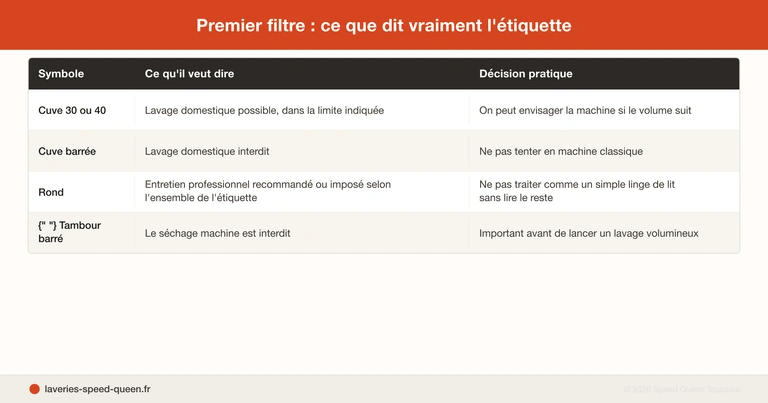
First filter: what the label actually says
The basis is the textile care standard. GINETEX states that the tub indicates whether domestic washing is possible, and the temperature printed inside the tub is a maximum limit not to be exceeded.
| Symbol | What it means | Practical decision |
|---|---|---|
| Domestic washing possible, within the indicated limit | Machine wash can be considered if the volume allows it |
| Domestic washing prohibited | Do not attempt in a standard machine |
| Professional care recommended or required depending on the full label | Do not treat as simple bedding without reading the rest |
 Crossed-out drum | Tumble drying is prohibited | Important to know before starting a bulky wash |
 Tub 30 or 40
 Crossed-out tub
 Circle
The point most guides miss
The label doesn’t just say if you can wash. It also tells you which is the most fragile part of the item. This is precisely what GINETEX reminds us: care information refers to the most sensitive element of the textile, not the “average” scenario.
The 5 things to check on the label
Before even talking about filling or volume, the label contains five decisive pieces of information. Here’s how to read them in order.
1. The tub symbol (washing)
This is the main pictogram. A tub filled with water, with or without a number. If the tub is crossed out, domestic washing is prohibited, full stop. If it’s present and not crossed out, note the number: it’s the maximum temperature. Most washable duvets display 30 or 40 °C.
2. The maximum temperature
The number inside the tub is a ceiling, not a suggestion. Washing below is always fine, washing above can damage the filling, the outer shell or the surface treatment. For most synthetic duvets, the ceiling is around 40 °C. For down, it’s generally 30 °C.
3. The filling type mentioned
The label states the filling composition: polyester, microfiber, goose down, duck feathers, bamboo, wool, etc. This detail changes everything for the washing and especially drying protocol. Don’t go by outer appearance: two duvets can have the same cotton shell but radically different fillings.
4. The size and weight
The dimensions (140x200, 200x200, 220x240) and the weight (expressed in g/m2) are direct indicators of how much space the duvet will take up in the drum. A 220x240 duvet at 400 g/m2 is much bulkier than a 140x200 at 200 g/m2. The weight also affects drying time.
5. The condition of the seams
This isn’t on the label, but it’s the fifth mandatory check. Inspect the seams, stitching and finishes. A duvet with weakened seams, filling that’s starting to migrate or a worn shell should not go in the machine: the tumbling and spinning could finish the job.
Second filter: the filling changes everything
A synthetic duvet and a down duvet don’t react the same way, even if the label allows washing. Synthetic tends to handle washes better, while natural down suffers more from compression and poor drying.
Synthetic (polyester, microfiber)
This is the easiest filling to maintain. Synthetic fibers resist water well, don’t clump easily and dry relatively quickly. Most synthetic duvets are machine washable at 40 °C if the drum volume allows it. Tumble drying is generally permitted at low temperature. At a laundromat, an 18 kg machine handles a synthetic double duvet with no difficulty. See our complete duvet washing guide for the detailed protocol.
Feathers and down (goose, duck)
Down is a premium but demanding filling. The plumules trap a lot of air, which gives the duvet its characteristic loft, but this same air makes them very bulky in the drum. Washing is possible if the label allows it, but it requires several strict conditions: gentle liquid detergent (never powder or softener), low temperature (30 °C max), moderate spin and above all complete drying with tennis balls to break up clumps. A poorly dried feather duvet smells musty within hours. For a dedicated protocol, see our feather duvet washing guide.
Bamboo and plant fibers
Bamboo fiber duvets are increasingly popular. They are generally machine washable at low temperature, but their washing behavior is closer to down than synthetic. Bamboo filling can clump if poorly tumbled, and drying must be thorough to prevent bad odors. Always check the label, as some bamboo duvets contain a fiber blend that alters the care instructions.
Wool
Wool is the most delicate filling for machine washing. Many wool duvets carry the crossed-out tub symbol or the “dry clean only” label. Heat, mechanical tumbling and water combined can felt wool irreversibly. If your wool duvet is labeled washable, follow the instructions strictly: wool program, cold water or 20 °C, minimal spin. When in doubt, go for another solution.
Synthetic
Generally more tolerant, simpler to wash and dry, as long as you respect the drum volume.
Feathers / down
Washable in some cases, but much more sensitive to clumping, agitation and especially incomplete drying.
Old or high-end duvet
The more you care about preserving the loft and filling structure, the more critical the volume test and drying protocol become.
Specially treated duvet
Anti-dust mite, coating or special technology = reading the label becomes even more important.
The real test: not “does it fit?” but “can it breathe?”
This is where many washes fail. A duvet can go into the machine, the door can close, and yet the wash turns out poorly because the filling is too compressed.
| Situation | Reading | Decision |
|---|---|---|
| The duvet fits and there’s space around it | Volume seems adequate | Washing is feasible if the label allows it |
| You have to push hard to close the door | Excessive compression | Do not start the cycle |
| The duvet fills nearly the entire drum | Water and detergent won’t circulate properly | Machine too small for a proper wash |
| You can’t ensure complete drying afterward | The problem will come after the wash | Better not to improvise |
The 5 checks before starting the machine
Before putting your duvet in the drum, go through these five points. If any one fails, don’t start the cycle.
1. The label allows washing — the tub symbol is present and not crossed out. Note the maximum temperature shown.
2. The seams are intact — no holes, no open seams, no very worn areas. Filling leaking into the drum is irrecoverable.
3. The duvet fits without forcing — it sits in the drum without excessive compression. If you have to push to close the door, the machine is too small.
4. There's space left in the drum — one-third of the volume should remain free for water to circulate and the filling to actually tumble.
5. You can dry it properly afterward — a large enough dryer, or space to dry flat for 24 to 48 hours. Without a reliable drying plan, don't wash.
Home, laundromat or another solution: how to decide properly
Between the small home machine and professional care, there’s sometimes a third option: the large laundromat machine. This is precisely what search results explain poorly: many brands wrongly pit “home machine” against “dry cleaning”, when the real criterion is often the usable volume.
Home — if the label allows washing, the filling isn't too delicate and the duvet has enough room in the drum.
Laundromat — if the duvet is washable but too bulky for a home machine. Use our laundry weight calculator to check the actual capacity you need.
Another solution — if the tub is crossed out, if tumble drying is prohibited and you can't dry properly, or if the piece is too delicate for an improvised attempt.
When the duvet is NOT washable: what to do
Sometimes the answer is clearly no. Here are the situations where machine washing is ruled out, and the alternatives to consider.
Crossed-out tub on the label
If the wash symbol is crossed out, it’s the most formal signal: the manufacturer declares that domestic washing is incompatible with the textile. This is common on wool duvets, high-end models with special treatments and certain memory foam fillings. In this case, respect the label.
Missing or unreadable label
This is a very common scenario with older duvets. If you can’t read the label, treat the duvet as fragile by default. Assess the filling (natural or synthetic?), the seam condition and the thickness. When in doubt, go to a professional.
Duvet too bulky for any accessible drum
Some king-size or very high-end duvets (weight above 500 g/m2 in 220x240 or 240x260) exceed even an 18 kg laundromat machine’s capacity. In that case, professional cleaning is the only safe option.
What to do when the machine is ruled out
- Professional cleaning (dry cleaning): the go-to solution when the label prohibits washing. Check that the cleaner uses a process suited to the filling (wet cleaning for down, gentle solvents for wool).
- Airing and preventive maintenance: between professional cleanings, air your duvet regularly outdoors. Natural sunlight helps reduce moisture and dust mite load. It’s not a substitute for washing, but a useful complement.
- Washable protective cover: investing in a machine-washable duvet cover protects the duvet from direct soiling and spaces out professional cleanings.
- Vacuuming and dust mites: for allergy sufferers, vacuuming the duvet with a textile nozzle reduces allergenic load between cleanings. See our anti-dust mite guide for adapted protocols.
Cases where it’s better not to risk it
- Missing label + expensive or old duvet — don't take a gamble based on guesswork.
- Very puffy down duvet in a small drum — the volume is already a warning sign.
- Tumble drying prohibited and you have no real plan for complete drying afterward.
- Already weakened duvet — weak seams, migrating filling, damaged shell.
If the answer is “yes, it’s washable”, what’s next?
Once the duvet is cleared for the machine, you still need to apply the right method: temperature, program, spin, drying and volume choice based on size.
The diagnosis doesn't replace the protocol
Once the duvet is deemed washable, move on to how to wash a duvet for the complete instructions. If you mainly want to understand the symbols themselves, also see our care label symbol decoder.
Methodology and sources
This article deliberately focuses on the decision before washing: reading the label, understanding the relevant symbols, assessing the filling, then testing the real volume situation. This is precisely what’s missing from much of the “how to wash a duvet” search results, which jump to the protocol without first securing the question “can my duvet actually go in the machine?”
- GINETEX, Care symbols, ISO 3758:2023 standard, consulted March 15, 2026
- DODO, Can you wash your duvet in the machine? All our tips, consulted March 15, 2026
- Internal references: how to wash a duvet, care symbols, how to wash a pillow
As an Amazon Partner, we earn a small commission on purchases made via the affiliate links in this article — at no extra cost to you. This helps us maintain this site and produce free guides.
If you’re now looking for the right machine, the right temperature and the right drying method, continue with
the complete guide to washing a duvet
. For the outer bedding, also see how to wash a duvet cover, and for the symbols themselves, our label decoder.