In a nutshell: every fabric has a precise ironing temperature — exceeding it damages the fibre, staying too low fails to remove creases. Cotton tolerates 200 °C with generous steam, linen goes up to 230 °C while still damp, while polyester and silk must not exceed 110 °C. The iron symbol on the label (1, 2 or 3 dots) remains the absolute reference. At a laundromat, the dryer anti-crease programme considerably reduces the need for ironing.
At a glance
Label first — the iron symbol (1, 2 or 3 dots) dictates the maximum temperature.
Cotton / linen = hot + steam — 180-230 °C, fabric still slightly damp.
Synthetics / silk = cool + dry — 110 °C max, on the reverse, no direct steam.
Wool = gentle + distance — 150 °C, steam at a distance or pressing cloth, never press hard.
Hang immediately — a garment left in a heap after ironing re-creases within minutes.
Why ironing temperature matters so much
Ironing works on a simple principle: heat and steam relax the hydrogen bonds between the polymer chains that make up textile fibres. Once the fibres are relaxed, the mechanical pressure of the iron realigns them flat. As they cool, the bonds reform in the new position — the fabric stays smooth.
The problem arises when the temperature exceeds the fibre’s tolerance. Overheated polyester partially melts, creating an irreversible shine. Burnt silk yellows. Under-heated cotton does not smooth out, no matter how many passes. The correct temperature is the single most important factor for the result.
The standardised care symbols (GINETEX / ISO 3758) codify this information in 3 simple levels: 1 dot (110 °C), 2 dots (150 °C), 3 dots (200 °C). A crossed-out iron means the fabric cannot tolerate any direct contact with heat. For a complete guide to all symbols, see our laundry label guide.
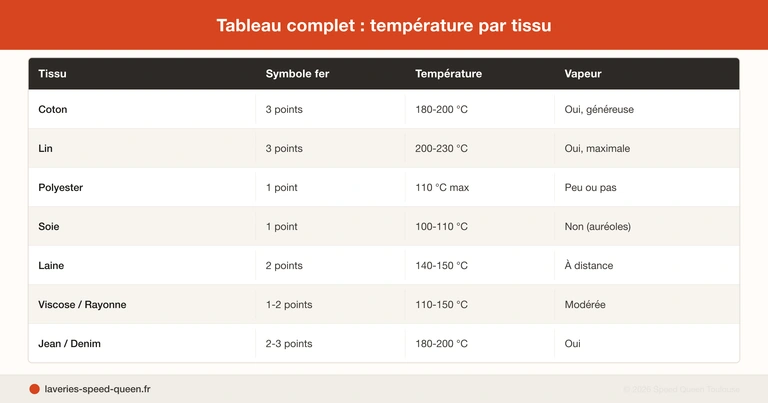
Complete chart: temperature by fabric
| Fabric | Iron symbol | Temperature | Steam | Key precaution |
|---|---|---|---|---|
| Cotton | 3 dots | 180-200 °C | Yes, generous | Iron while still slightly damp |
| Linen | 3 dots | 200-230 °C | Yes, maximum | On the reverse, damp. Accept residual creasing |
| Polyester | 1 dot | 110 °C max | Little or none | On the reverse, risk of shine and melting |
| Silk | 1 dot | 100-110 °C | No (water marks) | Pressing cloth mandatory or steamer at a distance |
| Wool | 2 dots | 140-150 °C | At a distance | No pressure — wool felts under the weight of the iron |
| Viscose / Rayon | 1-2 dots | 110-150 °C | Moderate | On the reverse, fabric shines easily |
| Denim / Jeans | 2-3 dots | 180-200 °C | Yes | On the reverse to preserve the indigo colour |
| Nylon / Polyamide | 1 dot | 110 °C max | No | Melts very easily — pressing cloth if ironing is needed |
Practical rule: when in doubt, always start at the lowest temperature and increase gradually. An under-heated fibre risks nothing — an overheated fibre is irreversibly damaged.
Fabric by fabric: the details that matter
Cotton (180-200 °C)
Cotton is the most common and simplest fabric to iron. Made of cellulose, it tolerates high temperatures without damage. Steam is your best ally: it penetrates the fibres and softens them in depth.
Optimal technique: spray the garment with water if it is already dry, or take it from the machine while still slightly damp. Iron with long strokes along the grain of the fabric. White cotton tolerates 200 °C without issue; for coloured cotton, stay at 180 °C to preserve the dye.
Cotton also benefits the most from good drying: a cotton shirt taken quickly from the dryer and hung on a hanger irons twice as fast as one left crumpled in a basket. See our drying guide to optimise this step.
Linen (200-230 °C)
Linen is a cellulose fibre like cotton, but its fibres are longer and stiffer. It tolerates the highest temperature of all common fabrics — up to 230 °C — but it has a particularity: it always retains a slight natural crease.
Optimal technique: iron linen on the reverse, still damp (spray generously if the fabric is dry). Use maximum steam. Do not try to achieve a perfectly smooth surface — linen is not made for that. Light creases are part of the fabric’s character.
Common trap: ironing dry linen at high temperature without steam shines the surface, creating irreversible glossy patches. Moisture is the key.
Polyester (110 °C max)
Polyester is a synthetic fibre derived from petroleum. Its melting point is around 250 °C, but the fabric starts to deform and shine well below that. At 110 °C, polyester smooths out correctly without risk.
Optimal technique: always iron on the reverse. Use little or no steam (polyester does not absorb water). Move quickly — polyester smooths out fast but shines just as fast if the iron stays still.
Good news: polyester creases far less than natural fibres. Proper drying (quick removal from dryer, hung on a hanger) is often enough to eliminate all creases. At a laundromat, the anti-crease programme is particularly effective on polyester.
Silk (100-110 °C)
Silk is an animal protein fibre (produced by the silkworm). It is sensitive to heat, water and friction. Ironing silk requires delicacy.
Optimal technique: set the iron to minimum (1 dot). Always iron on the reverse, with a fine cotton pressing cloth between the iron and the fabric. Never spray water directly on silk — drops leave visible marks. Keep the iron moving continuously, never stationary.
Recommended alternative: a garment steamer held 15-20 cm from the garment is safer than an iron for silk. The steam relaxes the fibres without direct contact and without risk of water marks. For very delicate silks, see our delicate textiles guide.
Wool (140-150 °C)
Wool is an animal protein fibre, like silk, but thicker and more resilient. Its enemy is not so much heat as pressure and hot water (which cause felting).
Optimal technique: use steam at a distance (hold the iron 2-3 cm from the fabric and send short steam bursts) or use a pressing cloth. Do not press the iron directly on wool with pressure — this crushes the fibres and can trigger surface felting. For more on washing wool, see our guide to washing a wool jumper.
Tip: hang the wool garment in the bathroom during a hot shower. The ambient steam is often enough to relax light creases without reaching for the iron.
Viscose / Rayon (110-150 °C)
Viscose is a semi-synthetic fibre made from wood cellulose. It has the softness of silk but the same fragility with the iron: it shines easily and can mark if the iron is too hot.
Optimal technique: iron on the reverse, at medium temperature (150 °C max). Use moderate steam. Move on without insisting on resistant areas — a second light pass is better than heavy pressure that shines the fabric.
Denim / Jeans (180-200 °C)
Denim is thick cotton, often dyed with indigo. It tolerates the same temperatures as regular cotton, but you need to protect the colour.
Optimal technique: turn the jeans inside out before ironing. Use steam to soften the thick fibres. Focus on the double seams (waist, pockets) which are the hardest areas to smooth. For washing jeans, see our jeans washing guide.
Nylon / Polyamide (110 °C max)
Nylon melts at an even lower temperature than polyester — around 220 °C. At 110 °C, it smooths out without risk, but you need to stay vigilant.
Optimal technique: use a pressing cloth systematically. No steam. Quick, light passes. Nylon creases little naturally — a garment steamer is often a better option than an iron.
Steam or no steam: the guide by fabric
Steam is not a universal bonus. It helps certain fabrics considerably and damages others.
Maximum steam
Cotton, linen, denim — cellulose fibres absorb water and relax under steam. The more steam, the fewer passes needed.
Moderate steam
Viscose, cotton-polyester blends — a little steam helps, but too much moisture can stain or deform the fabric.
Steam at a distance only
Wool — hold the iron 2-3 cm from the fabric and send short bursts. Direct contact with steam + pressure causes felting.
No steam
Silk, nylon, polyester — silk marks with water (water marks), synthetics do not absorb moisture. Iron dry with a pressing cloth if needed.
Ironing a shirt: the complete method
The shirt is the most frequently ironed garment and the one where technique matters most. The order of zones makes all the difference.
The reliable order: collar, cuffs, sleeves, shoulders, fronts, back. Start with the small zones to avoid re-folding a large surface you have already smoothed. For a detailed step-by-step guide, see our dedicated article on how to iron a shirt.
Key points:
- Collar: iron from the tips towards the centre (not the reverse) to avoid a ridge in the middle
- Cuffs: open them flat, iron the inside then the outside
- Sleeves: align the lower seam, iron one side then the other
- Button placket: iron from the reverse to go around the buttons without touching them
- Hang immediately on a hanger, top button fastened
Ironing trousers: centre crease and hems
Trousers require a different technique from shirts. The centre crease is an aesthetic choice — dress trousers have one, chinos and jeans do not.
Without centre crease (chinos, jeans, casual trousers)
Iron the trousers flat, one leg at a time. Start with the waistband and pockets (thick areas), then smooth each leg in long strokes from top to bottom. Turn over and do the other side.
With centre crease (suit trousers)
Align the inner and outer seams of the leg so the crease forms naturally in the right place. Place a pressing cloth on the crease and press firmly with steam. Hold for a few seconds at each position so the crease sets. Repeat along the full length of the leg.
Hems
Iron hems flat by unfolding them slightly, then reform the fold. A well-ironed hem gives a neat finish that makes all the difference.
Ironing a skirt: techniques by type
Straight skirt
Proceed as for trousers without a crease: waistband first, then the body of the skirt, turning gradually around the board. Iron darts on the reverse to avoid marks on the right side.
Pleated skirt
Pleated skirts are the most demanding. Hold each pleat in place with pins or clothes pegs on the edge of the board, and iron pleat by pleat with steam. It takes time, but it is the only reliable method.
Skirt in delicate fabric
For silk, viscose or satin skirts, apply the fabric’s precautions: low temperature, pressing cloth, ironing on the reverse. A garment steamer is often preferable for these materials.
Garment steamer vs iron
| Criterion | Iron | Garment steamer |
|---|---|---|
| Precision (collars, creases) | Excellent | Average |
| Light creases / touch-ups | Overkill | Excellent |
| Delicate textiles (silk, wool) | Risky without pressing cloth | Very suitable (no contact) |
| Speed (1 garment) | 5-10 min | 2-3 min |
| Result on thick cotton | Excellent | Insufficient alone |
| Footprint | Board required | Compact, no board |
| Entry price | 25-40 euros | 30-50 euros |
Verdict: the steamer is a complement, not a replacement. For dress shirts, creased trousers and thick cotton, the iron remains indispensable. For quick touch-ups, delicate fabrics and travel fixes, the steamer is superior.
Maintaining your iron
A dirty iron catches on fabric, leaves marks and spits limescale deposits. Regular maintenance extends the appliance’s lifespan and protects your clothes.
Descaling (every 1-2 months)
Fill the tank with a 50 % water / 50 % white vinegar mix. Heat the iron, send a few steam bursts over a sink, then rinse with clean water. Some irons have a self-cleaning function — use it.
Soleplate cleaning
On a warm (not hot) soleplate, gently rub with a damp cloth and a bicarbonate paste (2 tbsp bicarbonate + a little water). Wipe with a clean damp cloth. Never use an abrasive sponge.
Empty the tank after use
Standing water in the tank forms limescale. Empty the tank after each ironing session. Use demineralised water or a tap water / demineralised water mix (50/50).
Proper storage
Store the iron upright (on its heel), not flat. Do not wrap the cable too tightly around the appliance — this damages the wire over time. Let the iron cool completely before storing.
At the laundromat: anti-crease programme and optimised drying
Drying at a laundromat offers a major advantage for reducing ironing: commercial dryers have a larger capacity and higher airflow than domestic appliances, allowing more uniform drying and fewer creases.
The anti-crease programme
The anti-crease programme (or “cool down”) sends intermittent cool air after the hot drying cycle. This continuous movement prevents creases from setting in the fibres. On cotton-polyester shirts and “easy iron” garments, this programme can make ironing completely unnecessary.
The golden rule: remove quickly
Whatever the programme, the most important rule is to remove laundry as soon as the cycle ends. A garment that stays in the drum after drying cools in a creased position — and the creases set. Remove, shake, hang: those 30 seconds per garment will save you minutes at the iron.
For shirts in particular, see our complete article on how to iron a shirt which details the technique zone by zone.
Laundromat tip: shortened drying
Remove shirts and dress trousers from the dryer while still slightly damp (5 minutes before the end of the cycle) and hang them on a hanger. The weight of the damp fabric naturally smooths the fibres as it air-dries, and ironing becomes a simple quick touch-up.
Common ironing mistakes
- Ironing too hot out of habit — the leading cause of shine, melting and yellowing. Read the label systematically.
- Ironing a dirty garment — heat sets stains (sweat, food) and makes them permanent. Always iron clean laundry.
- Leaving the iron stationary — even a few seconds is enough to burn silk, shine polyester or mark viscose.
- Ignoring the pressing cloth — a simple cotton cloth between the iron and the garment protects all delicate fabrics.
- Ironing dry cotton — dry cotton and linen resist the iron. A mist of moisture changes everything.
- Forgetting to descale the iron — a limescale-clogged iron spits brown deposits on light fabric. Descale every 1-2 months.
- Leaving the garment in a heap after ironing — hang immediately on a hanger or fold neatly.
Special cases
Printed and screen-printed garments
Always iron on the reverse, at low temperature (110 °C max). Plastisol prints and heat-transfer motifs melt under the iron’s heat. If the garment has a heat-bonded motif, place greaseproof paper or a pressing cloth in between.
Embroidery
Place the garment embroidered side down on a folded terry towel. The towel absorbs the relief of the embroidery and the iron passes over the back without crushing the threads.
Garments with sequins or beads
Do not iron directly over them — sequins melt and beads come unstuck. Use a garment steamer at a distance, or iron only the non-decorated areas with a pressing cloth.
En tant que Partenaire Amazon, nous percevons une petite commission sur les achats effectués via les liens partenaires de cet article — sans surcoût pour vous. Cela nous aide à maintenir ce site et à produire des guides gratuits.
Our laundromats in Blagnac, Croix-Daurade and Montaudran have commercial dryers with an anti-crease programme. Well-managed drying considerably reduces the need for ironing. Payment CB sans contact ou espèces. Check our prices.
Sources and references
- GINETEX - Textile care symbols (ISO 3758:2023) (lien externe)
- Care symbols guide
- How to iron a shirt
- Drying guide
- Washing temperatures
- Washing a wool jumper without felting
- Washing jeans correctly
- Delicate textiles: care guide
- Thermal properties of textile fibres — cellulose (cotton, linen), protein (wool, silk), synthetic (polyester, nylon)
- Melting points of synthetic fibres: polyester ~250 °C, nylon ~220 °C, acrylic ~190 °C