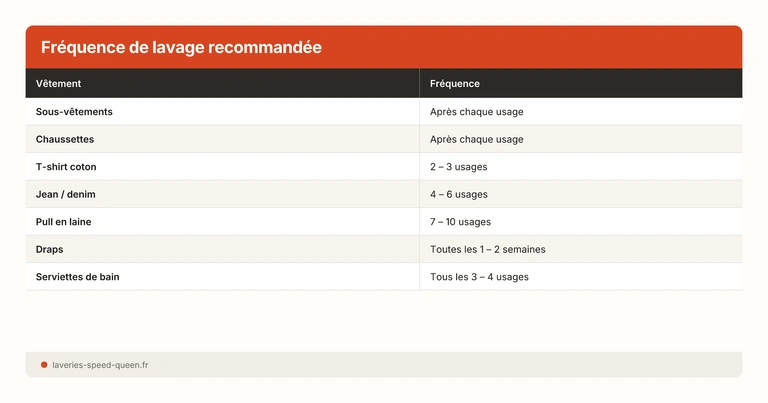
In a nutshell: not everything needs washing at the same frequency. Underwear and socks: after every use. T-shirts and shirts: 2-3 wears. Jeans and jumpers: 4-6 wears. Sheets: every 1-2 weeks. Washing at the right rhythm preserves hygiene without wearing out garments unnecessarily.
At a glance
After every use — underwear, socks, sportswear (direct contact, sweat).
Every 2-3 uses — t-shirts, polos, shirts, leggings (moderate skin contact).
Every 4-6 uses — jeans, trousers, jumpers, skirts (outer layer, little contact).
Every 1-2 weeks — sheets, towels, duvet cover.
For organising your dirty laundry between washes, a compartmented laundry bag↗ helps you sort by category (skin contact, outer layer, household linen) from the moment you take the garment off. For detergent, a gentle eco formula↗ preserves fibres in the long run — important when the goal is precisely to wash less often.
Complete chart by garment
| Garment | Recommended frequency | Why |
|---|---|---|
| Direct skin contact — after every use | ||
| Underwear (briefs, knickers, boxers) | After every use | Intimate area, bacteria, basic hygiene |
| Socks | After every use | Foot perspiration (~200 ml/day), bacteria, odours |
| Sports t-shirt / sports leggings | After every use | Heavy sweat, bacteria, synthetic fibres that retain odours |
| Swimsuit | After every use | Chlorine, salt, sand — rinse immediately |
| Moderate skin contact — 2-3 uses | ||
| Cotton t-shirt | 2-3 uses | Contact with underarm and chest sweat. 1 use in strong heat. |
| Polo, shirt | 2-3 uses | Same as t-shirt. Collars and cuffs concentrate sebum. |
| Pyjamas | 3-4 nights | Night sweating (0.3-0.5 L/night), but less movement than during the day |
| Bra | 3-4 uses | Little direct sweat, but fabric deforms if washed too often |
| Outer layer — 4-6 uses | ||
| Jeans / denim trousers | 4-6 uses | Dense fabric, little skin contact. Washing too often fades and wears denim. |
| Chinos / cotton trousers | 3-5 uses | Less dense than denim, but still an outer layer |
| Cotton jumper / sweatshirt | 4-5 uses | Worn over a t-shirt, indirect skin contact. Air between wears. |
| Wool jumper | 7-10 uses | Wool is naturally antibacterial and resists odours. Air for 24 h between wears. |
| Skirt, dress (not body-hugging) | 3-5 uses | Depends on fabric and lining. With lining: 5+ uses. |
| Outerwear — as needed | ||
| Jacket / blazer | 5-7 uses (or based on stain/odour) | Very little skin contact. Airing usually suffices. |
| Coat / puffer jacket | 1-2 times per season | Worn over other layers. Seasonal wash unless stained. Puffer jacket guide |
| Household linen | ||
| Sheets | Every 1-2 weeks | Night sweat, dead skin, dust mites. Detailed guide |
| Duvet cover | Every 2 weeks | Protects the duvet. Duvet cover guide |
| Bath towel | Every 3-4 uses | Constant moisture = rapid bacterial growth. Towel guide |
| Kitchen tea towel | Every 2-3 days | Contact with food and surfaces, cross-contamination risk |
| Additional garments | ||
| Dress shirt (office) | 1-2 uses | Collar and cuffs concentrate sebum; ironing needed after each wash |
| Hoodie | 4-6 uses | Worn over a t-shirt. Airing between uses extends the interval. |
| Gilet / cardigan | 5-7 uses | Intermediate layer, little direct skin contact |
| Shorts / bermudas | 2-3 uses | Thigh contact, summer sweat. 1 use in strong heat. |
| Bodycon dress / leggings | 1-2 uses | Full skin contact, synthetic fibres that retain odours |
| Scarf / pashmina | 5-10 uses | Little sweat. Airing suffices between uses. |
| Gloves (fabric) | Every 5-7 uses | Sweat and dirt accumulation. Wash at end of season at minimum. |
| Beanie | Every 5-7 uses | Contact with forehead (sebum), especially if worn during sport |
| Work wear (overalls, smock) | 1-2 work days | Professional soiling, sweat, contact with substances |
| Tie | Only if stained | No direct skin contact. Dry clean if needed. |
Why these frequencies
Skin contact determines frequency
The more a garment is in direct contact with skin, the more it absorbs sweat, sebum and dead skin — and the more often it needs washing. That is why underwear is washed after every use, but a coat only 1-2 times per season.
Over-washing wears out laundry
Each machine cycle subjects fibres to mechanical stress (friction) and chemical stress (detergent, water). Cotton loses about 0.5 to 1 % of its strength per cycle (source: Journal of the Textile Institute). Colours fade, elastane relaxes, denim fades.
Under-washing creates hygiene problems
Bacteria develop rapidly in warm, damp textiles. A t-shirt worn for 5 days without washing can harbour millions of bacteria. Odours, skin irritation and set-in stains are signs of too-infrequent washing.
Adjust for the situation
In strong heat
Halve the intervals. A t-shirt worn on a heatwave day should be washed after a single use. Excessive sweating accelerates bacterial growth.
After sport
Wash sportswear after every session, even a short one. Synthetic fibres retain the bacteria responsible for odours. Rinse at minimum if a full wash is not immediate.
Air to extend
Hang worn garments in the open air (not in the wardrobe) for 12-24 h. Residual moisture evaporates and bacteria slow down. This works especially well for jeans and wool jumpers.
The smell test
When in doubt: smell the armpits and collar. If the slightest odour is detectable, it is time to wash. A clean garment smells of nothing — neither good nor bad.
Wool: a special case
Wool is naturally antibacterial thanks to residual lanolin and its fibre structure that limits bacterial colonisation. A wool jumper worn over a t-shirt can be worn 7 to 10 times before needing a wash. Air it for 24 h outdoors between wears and it will stay fresh much longer than cotton or synthetics.
By activity: adjust frequency to your daily life
The general chart gives benchmarks, but your lifestyle changes everything. Two people wearing the same t-shirt will have very different washing needs depending on their activity.
| Activity | Adjustment | Why |
|---|---|---|
| Air-conditioned office | Standard chart frequency | Little sweat, controlled environment. Chart intervals apply as-is. |
| Working from home | Standard or slightly extended frequency | Less social contact, fewer commutes. Pyjama bottoms and hoodies get worn longer — but mind basic hygiene. |
| Physical work (site, warehouse) | Wash after every day for tops and underwear | Heavy sweating, dust, contact with soiling substances. Work trousers can last 2-3 days unless visibly dirty. |
| Sport (gym, running, cycling) | Wash after every session — everything worn | Synthetic fibres retain odour-causing bacteria. Even a quick rinse is better than nothing if a full wash is not immediate. See our sportswear guide. |
| Outdoor activities (hiking, gardening) | Wash after use for soiled garments | Soil, pollen, sweat, grass. Grass stains or mud set quickly — wash without delay. |
| Cooking / catering | Daily wash for aprons, tea towels, tops | Grease splashes, cooking smells, food hygiene. Grease stains become permanent if they dry. |
By season: summer vs winter
The season directly influences washing frequency because it changes sweat volume and the number of layers worn.
Summer: double frequency for tops
In summer, perspiration can reach 1 to 2 litres per day in strong heat. T-shirts, shirts and underwear are washed after every use. Shorts and skirts last 2 uses maximum. Bath towels (more frequent showers) are washed every 2-3 uses instead of 3-4.
Winter: layers protect
In winter, the layering system (t-shirt + jumper + coat) protects outer garments from sweat. A jumper worn over a clean t-shirt can last 5-7 days. Coats and jackets are washed only 1-2 times per season. However, underwear and t-shirts remain after-every-use, whatever the season.
Mid-season (spring, autumn)
Intermediate period where perspiration is moderate. Standard chart frequencies apply. Watch for the season change: clothes stored for 6 months may have yellowed — a refreshing wash is recommended before wearing again.
Holidays and seasonal activities
When skiing, base layers are washed after each day (trapped sweat). At the beach, rinse swimsuits and towels with clean water after every use (salt, chlorine, sand) before a machine wash. See our guide to washing ski gear.
The 5 signs it is time to wash
When in doubt, rely on these objective indicators rather than the calendar. The number of days worn is only a benchmark: the real measure is the garment’s condition. Here is how to assess a garment without counting the days.
Odour — smell the critical zones (armpits, collar, crotch). A clean garment smells of nothing, neither good nor bad. The slightest odour, even mild, signals bacterial colonisation. Note: smelling the middle of the chest is not enough — bacteria concentrate in sweat zones.
Feel — run your hand over the collar, armpits and waistband. Fabric that has accumulated sebum feels greasy, slightly tacky or stiff. On white cotton, a rough feel at the collar is the earliest sign before the yellow stain becomes visible.
Visible stains — a coffee, food or sweat stain is an immediate wash signal. The longer you wait, the more the stain sets.
Stiffness or heaviness — a garment that becomes stiff, heavy or 'sticks' to the skin is loaded with sebum and mineral salts. This is particularly noticeable on cotton t-shirts.
2 consecutive days of wear — for tops in contact with skin, 2 full days of wear is the reasonable maximum under normal conditions (office, indoors). Beyond that, bacterial load increases exponentially.
Exposure to a particular environment — kitchen, crowded public transport, contact with a sick person, dusty or smoky environment: wash without delay, even if the garment looks visually clean.
A useful daily benchmark: if you hesitate between “still wearable” and “needs washing”, the garment probably needs washing. The hesitation itself is a reliable signal. Odour-causing bacteria grow exponentially — a garment that “still passes” in the morning may not pass by evening.
Common mistakes
- Washing everything after a single use — this wastes water, energy and detergent, and wears out laundry prematurely. Reserve after-every-use washing for underwear and sport.
- Smelling the garment in the chest area — odours concentrate at armpits and collar, not in the middle. Smell the right zones.
- Never washing jeans — some advice recommends 'never' washing jeans. That is excessive. Jeans worn 20+ times without washing accumulate bacteria and dirt. 4-6 uses is the right balance.
- Putting worn garments straight into the wardrobe — residual moisture and bacteria transfer to neighbouring clean clothes. Air first.
- Ignoring kitchen tea towels — damp towels in contact with food are a bacterial hotspot. Change them every 2-3 days, not weekly.
At the laundromat: organising big catch-ups
Day-to-day washing is managed at home, but certain situations call for a volume catch-up. Return from holiday with 3 suitcases of laundry, spring cleaning, or simply a week where the laundry fell behind: the laundromat lets you handle everything in a single session.
The trick is to sort laundry by temperature and urgency before arriving. Run underwear and towels (60 °C) in a first machine, everyday clothes (30-40 °C) in a second, and delicates in a third if needed. Three machines in parallel equals 6-8 hours of home laundry processed in 1 hour.
For families who follow a regular washing routine, a monthly laundromat visit for bulky items (duvets, curtains, rugs) effectively supplements the home machine. This avoids overloading the machine at home and ensures a proper wash for voluminous textiles that need an 18 kg drum.
Methodology and sources
Washing frequencies are consensus recommendations based on textile hygiene guidelines, dermatological publications and ADEME recommendations to reduce the environmental impact of laundry. Fibre resistance data comes from textile literature.
Special cases to know
Certain situations significantly alter the usual frequencies:
- After illness (flu, gastro): wash pyjamas, sheets and towels immediately at 60 °C minimum. See our laundry disinfection guide.
- Return from travel: wash the entire suitcase contents before storing, even unworn garments (bed bugs, transport moisture).
- Season change: clothes stored for 6 months deserve a wash before being worn again — dust, musty odour and dust mites accumulate even in a clean wardrobe. See our spring cleaning guide.
- Sportswear: after every session, without exception. Synthetic fibres trap bacteria far more than cotton. See our dedicated sportswear guide.
Sources and references
- ADEME, Entretien du linge : 10 conseils santé et environnement, consulted 15 March 2026
- Journal of the Textile Institute, data on fibre degradation in washing
- GHI (Good Housekeeping Institute), How often should you wash your clothes?, consulted 15 March 2026
- Laundry weight per garment
- How often to wash sheets
- Duvet at the laundromat: price, drying and frequency
- Washing temperatures
- Sportswear care
- Whitening yellowed laundry
- Detergent dosage
- Washing ski gear
- Spring cleaning: wash everything at once
En tant que Partenaire Amazon, nous percevons une petite commission sur les achats effectués via les liens partenaires de cet article — sans surcoût pour vous. Cela nous aide à maintenir ce site et à produire des guides gratuits.
The right washing rhythm preserves hygiene AND garment lifespan. When it is big laundry day, our Speed Queen laundromats let you wash and dry everything in ~1 h — detergent and softener included. See our laundry weight guide to estimate your loads accurately.