In a nutshell: Rough towels? The problem usually comes from too much fabric softener, which deposits a waxy layer on the terry loops. Solution: replace the softener with half a glass of white vinegar in the rinse compartment, wash at 60 °C and tumble dry at medium temperature. The loops are straightened by the mechanical tumbling action.
At a glance
Reduce fabric softener — it can leave a film on the fibres.
Thorough rinsing — fewer residues = more absorbency.
Tumble dryer (if allowed) — the tumbling restores volume.
Do not overload the machine — towels need space to rinse properly.
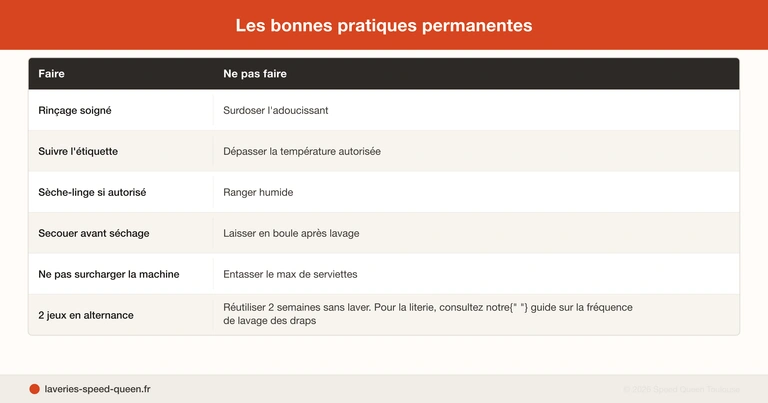
Permanent best practices
To keep towels soft over time, wash them at 60 °C with a full rinse and limit the load to about two thirds of the drum.
| Do | Don’t |
|---|---|
| Thorough rinsing | Overdose fabric softener |
| Follow the care label | Exceed the permitted temperature |
| Tumble dry if permitted | Store while still damp |
| Shake before drying | Leave in a ball after washing |
| Do not overload the machine | Cram in as many towels as possible |
| 2 sets in rotation | Reuse for 2 weeks without washing. For bedding, see our guide on how often to wash sheets |
Why towels become rough
In most cases, stiffness appears after several washes with overdosed softener and air-drying without mechanical tumbling.
Terry cloth works like a forest of micro-loops. As long as these loops stay open, water is drawn in by capillary action. When they flatten or stick together, the towel becomes both less absorbent and rougher.
| Textile parameter | Effect on fluffiness | Technical reference |
|---|---|---|
| Loop height and density | The freer the loops, the fluffier the towel | (Murphy & Macormac, Textile Research Journal, 1958; Cary & Sproles, 1979) |
| Capillarity | Ensures absorbency; drops if fibres are coated with deposits | (AATCC TM79; terry absorbance literature) |
| Cationic softener residues | Hydrophobic film, immediate soft feel but lasting loss of absorbency | (J. Surfactants & Detergents, 2015) |
Too much fabric softener
Fabric softener deposits a waxy layer on the terry cloth fibres. At first, it feels soft. But layer after layer, the deposit thickens, clogs the terry loops and creates a rigid, waterproof surface. The towels lose both their absorbency AND their softness.
Hard water limescale
Hard water (high in limescale) deposits minerals on the fibres. This deposit stiffens the fabric and gives a scratchy feel. The harder the water, the faster the effect.
Air drying
When a towel air-dries without movement, the terry loops stay flat and rigid. It is purely mechanical: the fibres dry in the position they are in. The tumble dryer, by tumbling, lifts and aerates each fibre.
Overloaded machine
Too many towels in the machine = insufficient rinsing = detergent and softener residues left in the fibres. Terry towels absorb a lot of water and take up a lot of space.
The method to restore softness
The most effective protocol combines a 60 °C cycle, 250 ml of white vinegar↗ in the rinse, then a tumble dry at medium temperature.
Step 1: careful washing
60 °C, full cycle, good rinse
Cotton terry towels handle 60 °C well (check the label). This temperature dissolves accumulated softener residues and ensures good hygiene. Use a full cycle with generous rinsing.
Dosing: less is more
Fabric softener: less is more. Softener manufacturers want you to use plenty — your towels do not.
Detergent: follow the dosage on the packaging (no more). Overdosing leaves residues that irritate the skin and stiffen fibres.
At the laundromat: detergent and softener are dispensed automatically at professional doses. The generous rinse (50-60 L of water) limits residues — that is the decisive advantage of automatic dosing.
Step 2: the tumble dryer
The real secret to hotel towels
The mechanical tumbling of the dryer lifts and aerates each loop of the terry cloth. It is the step that makes the biggest difference. Medium temperature, and remove the towels as soon as they are dry (over-drying stiffens the fibres). Add 2-3 wool dryer balls to amplify the effect. Find the details in our drying guide.
Recovery protocol: very rough towels
If your towels have become stiff and waterproof after months of softener overdosing:
White vinegar — pour 250 ml of white vinegar into the softener compartment (not into the drum). Run a cycle at 60 °C without detergent. The vinegar dissolves limescale and softener deposits built up in the fibres.
Second wash — run another normal cycle at 60 °C with your usual detergent (normal dose, no softener). This second pass cleans the now-freed fibres.
Full tumble dry — the mechanical tumbling reopens the terry loops. Medium temperature, with dryer balls. The result is noticeable from the very first time.
Hotel protocol (home-applicable version)
In practice at home, reproducing the hotel approach means eliminating softener, adding a light acidified rinse and stopping the dryer as soon as the laundry is dry.
Hotel laundries aim for three things: absorbency, consistent softness, and fast turnover. Their protocol is very different from the domestic habit of systematic softener use.
Little or no softener — to preserve the capillarity of the terry cloth (a widely documented practice in hotel laundries).
Light acidified rinse — in practice, neutralisation of alkaline residues; at home, moderately dosed white vinegar as a simplified equivalent.
Medium-temperature tumble dry — stop as soon as dry to avoid over-drying, which stiffens the loops.
Set rotation — alternating 2 to 3 sets of towels limits mechanical wear on each piece.
Recovery protocol by type of damage
When towels are stiff as cardboard, first run a 60 °C cycle with vinegar, then a second 60 °C cycle with detergent and no softener.
| Main problem | Visible sign | Recommended treatment |
|---|---|---|
| Limescale | Stiff, “cardboard-like” towel, mineral feel | Cycle at 60 °C with vinegar in the rinse, then rewash with normal detergent. |
| Excess softener | Waxy feel, poor absorbency | 2 cycles without softener (1 degreasing, 1 long rinse), moderate tumble dry. |
| Mechanical wear | Crushed or pulled loops, persistent loss of volume | Drying with textile balls + gradual replacement of the most worn pieces. |
Drying: air vs tumble dryer
At equal wash quality, the tumble dryer gives better fluffiness because 30 to 60 minutes of tumbling straightens the terry loops.
Tumble dryer (recommended)
The constant tumbling lifts the fibres and creates fluffiness. Follow the drying symbol on the label.
Air drying (if no other choice)
Shake the towels before and after hanging to retain volume. Hang in a ventilated area — [indoor drying generates a lot of humidity](/en/blog/indoor-drying-humidity/) if the room is poorly ventilated.
Towel washing frequency
To limit bacteria and odours, wash bath towels after 3 to 4 uses, hand towels every 2 to 3 days and face cloths after each use.
Bath towels
After 3-4 uses maximum. Even if the towel looks clean, residual moisture encourages bacterial growth. After 4-5 days without washing, that is what causes the characteristic musty smell.
Hand towels
Every 2-3 days. They are used by the whole household, several times a day, often without fully drying between uses.
Face cloths
After each use. The cloth stays damp and warm in the bathroom: the ideal environment for bacteria. A cloth used for 2 days already smells musty.
Let towels dry between uses (spread out, not balled up on the towel rail). A towel that dries quickly between uses stays fresh longer. If a smell persists despite this routine, also check the state of the drum, seal and dispenser with our guide to cleaning your washing machine.
The laundromat advantage
The practical combo
At the laundromat: wash then immediate drying, which limits residual moisture. Our laundromats in Blagnac and Croix-Daurade are open 7j/7.
Mistakes to avoid
- Adding more softener when towels are rough — it makes the problem worse; softener causes the stiffness
- Ignoring the care label — risk of damaging the fibres
- Overloading the machine — towels are not properly rinsed, residues remain
- Leaving towels in a damp ball — musty odours and bacterial growth
As an Amazon Associate, we earn a small commission on purchases made through the affiliate links in this article — at no extra cost to you. This helps us maintain this site and produce free guides.
Want hotel-fluffy towels? Our laundromats in Blagnac, Croix-Daurade and Montaudran offer washing and professional tumble drying. Detergent and softener included, automatic dosing, from EUR 4.90. See our prices.
Methodology and sources
- The mechanism of cationic surfactant-based softeners (adsorption onto the fibre, more hydrophobic layer, reduced absorbency) is described in textile chemistry, notably in Elucidation of Softening Mechanism in Rinse Cycle Fabric Softeners (J. Surfactants and Detergents) (lien externe).
- For terry textiles, interpretation of care instructions (temperature, rinsing, drying) follows the GINETEX / ISO 3758 (lien externe) standard.
The hotel secret: why their towels are better
Hotel towels always seem fluffier than the ones at home. It is not just a matter of brand — it is a matter of washing method.
The weight makes the difference
Hotels use terry cotton towels at 500-600 g/m². At home, most towels are 300-400 g/m². The higher the weight, the denser, more absorbent and fluffier the towel. Investing in 500 g/m² changes everything — and at the laundromat, the 9 kg machine washes them without compression.
Exact detergent dosing
The number-one problem with rough towels at home: detergent overdosing. Detergent residues build up in the terry loops, stiffen them and reduce absorbency. At the laundromat, detergent is dosed automatically — impossible to overdose.
Full drying at moderate temperature
Hotels dry in a professional tumble dryer at moderate temperature, never on high heat which breaks fibres. At the laundromat, the professional dryer dries a load of towels in 25-30 minutes. The drum movement restores loft to the terry loops.
In summary, hotel-quality is accessible to everyone: 500 g/m² towels (EUR 25-40 per pair), washing in a professional machine with automatic dosing, full tumble drying. That is exactly what the laundromat offers.
When to replace your towels (and how to recycle them)
Even the best towels have a limited lifespan. Here are the telltale signs — and what to do with the old ones.
Persistent odour
If your towel smells musty or stale despite washing at 60 °C, bacteria have settled deep in the fibres. One last try: wash at 90 °C (if the label permits). If the smell returns after 2-3 uses, replace it.
No longer absorbs water
A towel that slides over the skin instead of absorbing has lost its capacity. The terry loops are flattened or coated with detergent/softener residues. A wash without softener + white vinegar in the rinse compartment may save it. If not, it is done.
Rough even after tumble drying
If the towel stays stiff after a pass through a professional dryer (which normally restores loft), the fibres are permanently broken by washes that were too hot or repeated detergent overdosing.
Recycling old towels
Do not throw old towels in the bin. Options: cleaning cloths (cut into squares), bath mats for the garage/workshop, textile collection point (Le Relais, Eco-TLC bins) — even worn textiles are recycled into industrial insulation.
On average, replace your towels every 3-5 years if you care for them properly (60 °C wash, correct dosing, full drying). With professional laundromat washing and automatic dosing, you maximise this lifespan.
Why new towels are not fluffy
Many consumers are surprised: brand-new towels, supposedly high quality, are rough from the very first touch. It is not a manufacturing defect — it is intentional.
Industrial sizing: an invisible film
During manufacture, towels receive a sizing treatment — a chemical treatment based on silicones, starches or resins that temporarily stiffens the fibres. This sizing serves several logistical purposes: it protects the fabric during transport and warehouse storage, it gives a “new” and uniform appearance on the shelf, and it makes stacking easier (soft towels would slide off each other on pallets). The result for the consumer: a stiff, poorly absorbent towel that sometimes feels slightly shiny.
How to remove the sizing
A first wash at 60 °C with detergent (not just a water rinse) removes most of the sizing. Add 200 ml of white vinegar to the softener compartment to dissolve silicone residues. Some towels, particularly dense Egyptian cotton ones (500-600 g/m²), need two washes before revealing their true softness and full absorbency.
Do not be surprised if the towel feels slightly “scratchy” after the first wash but before drying. It is the tumble drying that makes the real difference: the mechanical tumbling lifts the terry loops freed from the sizing. Hotels that use new towels systematically run them through an industrial pre-wash cycle before putting them into service — a 90 °C wash followed by a full tumble dry in a professional dryer.
How to choose durable towels
No washing method in the world will save a poor quality towel. Here are the criteria to check when buying to maximise the lifespan and softness of your towels.
Weight is the first indicator: below 400 g/m², the towel will be light but will wear out in 1-2 years. Between 450 and 550 g/m², you are in the hotel range — the best balance of quality, softness and durability. Above 600 g/m², the towel is very thick but dries slowly and takes up a lot of space in the machine.
Material matters too: Egyptian cotton (extra-long fibres) and Turkish cotton (long fibres) produce towels that are naturally softer and more resilient than standard cotton. Avoid towels with a high percentage of polyester — they dry quickly but lose their absorbency fast.
Finally, prefer towels with double-twist yarn (yarn twisted twice), which is more resistant to repeated washing than single-ply yarn. This information sometimes appears on the label or product listing.