In a nutshell: fast fashion multiplies the environmental impact of laundry: more microplastics (500,000 to 6 million fibres per cycle), a reduced lifespan (10-30 washes vs 100+), and massive water consumption from production to washing. Solutions exist: buy less/better, wash less often, wash cold, use a microplastic filter bag, and choose second-hand. Commercial laundromat machines consume less water and energy per kg than domestic machines.
At a glance
500,000 to 6 million microfibres per cycle — synthetics pollute waterways with every wash.
10-30 washes vs 100+ — a fast fashion garment lasts 3 to 10 times less.
Washing cold reduces microfibres by 30-40 % — hot water weakens synthetics.
Commercial machines = more efficient per kg — less water and energy per kilo of laundry washed.
The problem: fast fashion worsens the impact of laundry
The textile industry is the second most polluting industry in the world. But the problem does not stop at production — every wash of a synthetic garment continues to pollute throughout its lifespan. And fast fashion worsens this cycle in three ways.
1. Microplastics: 500,000 fibres per cycle
Each wash cycle of synthetic textiles (polyester, nylon, acrylic) releases between 500,000 and 6,000,000 plastic microfibres into wastewater. These fibres measure between 10 and 100 µm — too small to be filtered by water treatment plants, they end up in rivers, oceans and the food chain.
The link to fast fashion: fast fashion garments are predominantly polyester (60 % of global fibre production is polyester). And new garments release significantly more microfibres during the first 5 to 10 washes, as poorly fixed fibres from rapid, cheap manufacturing detach in large quantities.
For complete microplastics data, see our dedicated article on microplastics and synthetic washing.
2. Reduced lifespan = more wasted cycles
A low-end fast fashion garment shows signs of wear after 10 to 30 washes: pilling, deformation, fading, seams giving way. A comparable quality garment in natural fibres or a quality blend can withstand 50 to 100+ washes without significant degradation.
What this means in practice:
- A 5 euro t-shirt worn 10 times and washed 10 times = 0.50 euro per wear.
- A 25 euro t-shirt worn 100 times and washed 50 times = 0.25 euro per wear.
- The “cheap” t-shirt costs twice as much per wear and uses double the wash cycles for the same number of days of use.
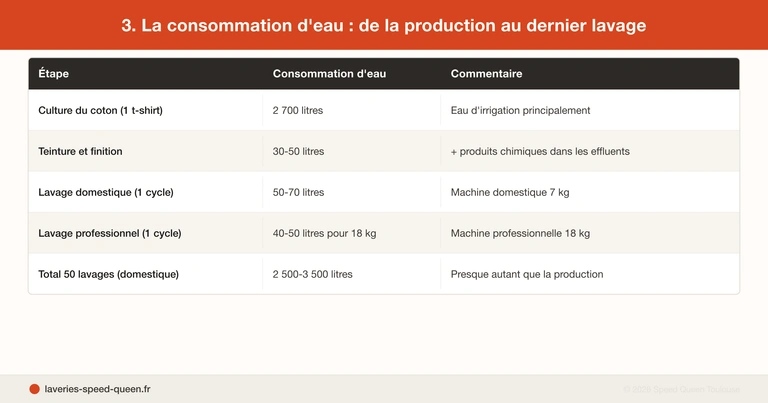
3. Water consumption: from production to the last wash
The water impact of a garment begins well before the first wash:
| Stage | Water consumption | Comment |
|---|---|---|
| Cotton farming (1 t-shirt) | 2,700 litres | Mainly irrigation water |
| Dyeing and finishing | 30-50 litres | + chemicals in effluent |
| Domestic wash (1 cycle) | 50-70 litres | 7 kg domestic machine |
| Commercial wash (1 cycle) | 40-50 litres for 18 kg | 18 kg commercial machine |
| Total 50 washes (domestic) | 2,500-3,500 litres | Almost as much as production |
The maths is simple: a fast fashion garment that lasts 15 washes “only” consumes 750-1,050 litres in washing. But it must be replaced 3 times to cover the same duration of use as a durable garment — that is 3 x 2,700 litres of production = 8,100 litres. The durable garment: 2,700 litres of production + 2,500 litres of washing = 5,200 litres total.
The real water cost
Frequent replacement of fast fashion garments consumes more water than all the washes of a durable garment. The impact is in repeated production, not in individual washing. Buying a quality garment and washing it correctly is more eco-friendly than buying three cheap garments even if you wash them less.
What you can do: practical solutions
The solutions are not complicated, but they require a change of habit. Here are the most effective, ranked by impact.
1. Buy less and better
This is the most powerful lever. A garment that is never produced consumes no water, energy or chemicals.
How to recognise quality:
- Seams: double, regular, no loose threads. Pull lightly — a seam that gapes is a seam that will give way.
- Fabric: sufficient density (fabric should not be see-through unless intended). A thin fabric = rapid wear.
- Composition: natural fibres (cotton, linen, wool) or natural-dominant blends last better than low-end 100 % polyester.
- Labels: Oeko-Tex Standard 100 (no harmful substances), GOTS (organic and ethical production chain).
2. Wash less often
Every wash cycle wears the garment, consumes water and energy, and releases microfibres. Reducing frequency is one of the most impactful actions.
Garments to wash after every wear: underwear, socks, t-shirts in direct contact with skin (especially in summer), sportswear after exercise.
Garments that can be worn multiple times:
- Jeans: 5 to 10 wears between washes. See our jeans washing guide.
- Jumpers: 3 to 5 wears if worn over a t-shirt.
- Jackets and coats: 10+ wears, unless stained.
- Pyjamas: 3 to 4 nights. See our guide on pyjama washing frequency.
For a complete guide, see our article on how often to wash clothes.
3. Wash cold and on delicate
Cold water (20-30 °C) reduces microfibre release by 30 to 40 % compared to washing at 40-60 °C. It also preserves colours, fibres and textile elasticity. Modern detergents are formulated to be effective at 20-30 °C on everyday laundry.
When to raise the temperature: sheets, towels, underwear, sick laundry (60 °C), heavily soiled or stained textiles. See our guide on washing at 30 or 40 degrees to know when low temperature is enough.
Wash cold (20-30 °C)
Reduces microfibres by 30-40 %, preserves colours and fibres. Sufficient for lightly soiled everyday laundry.
Delicate programme
Reduces mechanical agitation and spin speed. Less friction = fewer microfibres and less wear.
Liquid detergent
Slightly less abrasive than powder. Reduces friction that fragments synthetic fibres.
Fill to 80-90 %
A well-filled drum reduces item-against-item friction. Fewer impacts = fewer microfibres released.
4. Use a microplastic filter bag
For synthetic garments you already own, a Guppyfriend-type wash bag reduces microfibre discharge:
- Guppyfriend bag: retains 50 to 80 % of microfibres. Place synthetic garments inside before washing.
- External filter: installed on the machine drain hose, retains 80 to 90 % of microfibres.
These are not perfect solutions — some microfibres still get through — but they significantly reduce discharge. See our article on microplastics and washing for the detailed comparison.
5. Choose second-hand
A second-hand garment has virtually zero production impact — it already exists. And contrary to popular belief, quality second-hand garments often have an additional advantage: they have already passed the first 5 to 10 washes (the highest microplastic emitters), which reduces their future impact.
To properly prepare a second-hand garment before wearing it, see our guide on the first wash of new and second-hand clothes.
6. Repair instead of throwing away
A missing button, a loose seam, a stuck zip — these small defects do not justify throwing away a garment. Repair often costs less than replacement and extends the garment’s life by several years.
Labels to know
| Label | What it certifies | Level of rigour |
|---|---|---|
| Oeko-Tex Standard 100 | Absence of harmful substances in the finished product | Finished product only — does not cover production |
| GOTS (Global Organic Textile Standard) | Organic fibre + eco-friendly production + social conditions | Very demanding — entire chain |
| EU Ecolabel | Reduced environmental impact over the life cycle | Demanding — covers production and use |
| Bluesign | Responsible chemical management in production | Very technical — industry-oriented |
| BCI (Better Cotton Initiative) | More sustainable cotton production | Moderate — continuous improvement, not organic |
The best label is longevity
A label guarantees production standards, but the garment’s actual lifespan remains the best indicator of environmental impact. A label-free t-shirt that lasts 5 years is more eco-friendly than a GOTS-labelled t-shirt thrown away after 6 months. The label AND durability — that is the ideal.
Commercial machines: more efficient per kg
Commercial laundromat machines have an environmental advantage that is often overlooked: they consume less water and energy per kilogram of laundry than domestic machines.
Water
- 7 kg domestic machine: roughly 50-70 litres per cycle = 7 to 10 litres/kg
- 18 kg commercial machine: roughly 40-50 litres per cycle = 2.2 to 2.8 litres/kg
Efficiency is almost 3 times higher at a laundromat for the water/kg ratio. Even a fully loaded domestic machine cannot compete with the processing volume of an 18 kg machine.
Energy
Commercial Speed Queen machines are designed for maximum efficiency: optimised cycles, superior water extraction (reducing drying time), and a lifespan of 10,000+ cycles. Energy per kg of laundry is significantly lower than a standard domestic machine.
The bottom line
For large loads (duvets, complete bedding, pet laundry, holiday returns), the laundromat is objectively more efficient than domestic processing in several small successive loads. See our comparison of laundromat vs home machine for details.
What fast fashion changes in your laundry habits
- Low-end synthetic garments pill quickly — fibres that pill are microfibres in the process of detaching. Every pill is a sign of textile pollution.
- Fast fashion colours fade easily — cheap dye does not withstand repeated washes. Wash separately for the first cycles and use colour catcher sheets.
- Seams give way after a few washes — a poorly stitched garment cannot withstand the mechanical tumbling of the drum. The delicate programme delays the inevitable but does not solve the structural problem.
- Shrinkage is common — fast fashion garments are often cut to the tightest fit. The slightest shrinkage makes the garment unwearable.
What to do with fast fashion garments you already own
Throwing out your current synthetic clothes to buy organic is not the solution — it is actually worse for the environment. The best approach:
- Wear them as long as possible — every extra month of use reduces the impact per wear.
- Wash them properly — cold, on delicate, in a Guppyfriend bag.
- Repair them when possible.
- Donate them when you no longer want them — a garment worn by someone else is better than one in landfill.
- Replace them gradually with better-quality items as they reach the end of their life.
For caring for garments that pill, see our guide on pilling. To prevent colour bleed, see our article on colour bleed.
Where this page ends
This page covers the environmental impact of fast fashion on laundry. For detailed scientific data on microplastics, see our article on microplastics and synthetic washing. For energy savings in laundry, see our energy savings guide. For water and electricity consumption of your machine, see our complete guide.
Methodology and sources
- ADEME, Le revers de mon look, 2024, consulted 20 March 2026
- Napper & Thompson, Release of synthetic microplastic plastic fibres from domestic washing machines, Marine Pollution Bulletin, 2016
- De Falco et al., Evaluation of microplastic release caused by textile washing processes of synthetic fabrics, Environmental Pollution, 2018
- European Environment Agency, Textiles and the environment, 2022
- Ellen MacArthur Foundation, A New Textiles Economy, 2017
Sources and references
- ADEME - Le revers de mon look (lien externe)
- European Environment Agency - Textiles and the environment (lien externe)
- Ellen MacArthur Foundation - A New Textiles Economy (lien externe)
- Microplastics and synthetic washing
- Energy savings in laundry
- Water and electricity consumption of a washing machine
- Laundromat vs home machine
- How often to wash clothes
- Pilling: remove and prevent
- Colour bleed
- Washing at 30 or 40 degrees
- New and second-hand clothes
En tant que Partenaire Amazon, nous percevons une petite commission sur les achats effectués via les liens partenaires de cet article — sans surcoût pour vous. Cela nous aide à maintenir ce site et à produire des guides gratuits.
For your big laundry loads, our laundromats in Blagnac, Croix-Daurade and Montaudran offer commercial machines that consume less water and energy per kilo of laundry than domestic machines. A concrete step to reduce your laundry footprint. Payment CB sans contact ou espèces.