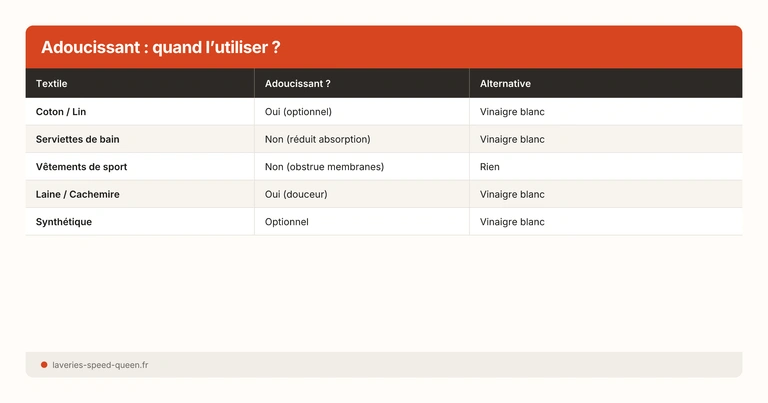
In short: fabric softener softens fibres by depositing cationic agents that smooth the textile surface. It is useful on cotton in hard water, useless in soft water, and counter-productive on technical textiles (sport, microfibre). Overdosing causes more problems than skipping softener altogether. White vinegar is a partial alternative (anti-limescale, not anti-static).
At a glance
Comfort, not cleaning -- fabric softener does not wash. It softens and adds fragrance.
Useful in hard water -- compensates for limescale stiffness on cotton, linen and sheets.
Avoid on sportswear -- the greasy film blocks breathable pores and traps odours.
Overdosing = problems -- greasy film, loss of absorption, skin irritation.
How fabric softener works: the chemistry explained
Fabric softener contains cationic surfactants — molecules with a positively charged end and a long fatty chain on the other. During the rinse, these molecules attach to textile fibres (negatively charged after washing) and deposit a lubricating film.
Result: fibres slide against each other, the textile feels softer, and static electricity is reduced (positive charges neutralise negative charges).
The mechanism in detail
To understand why softener works on some textiles and not others, you need to look at what happens at the fibre level:
- Wash phase: the detergent (anionic surfactants) removes dirt and grease. The fibres end up negatively charged on the surface.
- Rinse phase: the softener is released. The cationics — positively charged — are attracted to the negative fibres. They attach head-down, with the fatty chain facing outward.
- Drying: the greasy film remains on the fibre. This is what gives the “slippery” feel and reduces friction between fibres.
This greasy film is precisely the problem on certain textiles: it blocks micro-pores of technical fibres, repels water on towels, and can irritate sensitive skin if it contains synthetic fragrances.
Typical ingredients of a fabric softener
A standard fabric softener mainly contains:
- Quaternary ammonium salts (quats): the cationic agents that soften. They represent 3 to 8% of the product.
- Synthetic fragrances: responsible for the “clean laundry” smell. These are the primary cause of skin reactions (contact dermatitis).
- Preservatives: such as isothiazolinone, also irritating for sensitive skin.
- Water: the majority component (>90%).
The composition explains why fabric softener does not clean: it contains no anionic surfactants (the molecules that lift dirt). It is a comfort product, not a cleaning product.
The 5 cases where fabric softener is not recommended
Beyond the general overview, here are the situations where fabric softener causes more harm than good, with the scientific explanation for each case.
1. Bath towels
Fabric softener deposits a hydrophobic film (which repels water) on looped cotton fibres. After several washes with softener, towels feel pleasantly smooth but absorb noticeably less water. The paradox: the softer the towel feels, the less effectively it dries. To restore absorption, see our fluffy towels guide.
2. Sportswear and technical textiles
The synthetic fibres of sportswear (polyester, nylon, elastane) are designed with micro-pores that wick away sweat. Fabric softener blocks these pores with its greasy film. Consequences: breathability drops, sweat lingers, and the bacteria responsible for bad odours thrive. See our sportswear care guide for best practices.
3. Microfibre (cloths and wipes)
Microfibre cloths work thanks to their ultra-fine fibres that capture dust and grease mechanically. The cationic film of fabric softener neutralises this capturing ability. A microfibre cloth washed with softener loses most of its cleaning power and absorption.
4. Baby clothes and sensitive skin
The synthetic fragrances in fabric softener are the most frequent cause of contact dermatitis from laundry. Baby skin is more permeable than adult skin, which increases the risk of reaction. Dermatologists generally recommend avoiding fabric softener on laundry in direct contact with fragile skin. For more, read our article on detergent residue and sensitive skin and our guide to washing baby clothes.
5. Waterproof and water-repellent textiles
Gore-Tex jackets, down jackets with DWR (Durable Water Repellent) treatment and ski clothing lose their waterproofing on contact with fabric softener. The cationic film damages the surface water-repellent treatment. A single mistake can be enough to compromise the protection. See our down jacket washing guide or our article on washing ski gear.
When fabric softener is useful
Cotton and linen in hard water
In hard water (>25 °f), calcium ions deposit in fibres and stiffen them. Fabric softener compensates by lubricating the surface. This is its most justified use.
Sheets and household linen
Cotton sheets benefit from the added softness, especially in hard water. The comfort to the touch at bedtime is noticeable.
Reducing static electricity
Synthetic clothes that cling to the body in winter benefit from the anti-static effect. Occasional use is enough -- no need for every wash.
When to skip it
| Textile / situation | Why avoid | Alternative |
|---|---|---|
| Sportswear | The greasy film blocks micro-pores of technical fibres, reduces breathability and retains bacteria (odours) | Wash without softener, sport guide |
| Microfibre | Loses its absorption and cleaning capacity (the film repels water) | Water + detergent only |
| Towels (in excess) | Reduces absorption. The greasy film partially repels water. | Half dose or white vinegar |
| Sensitive skin / babies | Synthetic fragrances are the number one cause of skin reactions from laundry | Fragrance-free or white vinegar. Sensitive skin guide |
| Soft water (<15 °f) | Laundry is already naturally soft — softener is unnecessary | Nothing — the laundry does not need it |
| Waterproof textiles (Gore-Tex, DWR) | Damages the water-repellent treatment | Specialist technical detergent |
Alternatives to fabric softener
Several solutions can give you soft laundry without the downsides of chemical softener. None is perfect — each has its strengths and limitations.
White vinegar (the most common alternative)
White vinegar is often presented as a natural replacement for fabric softener. This is partially true:
What it does
Acetic acid dissolves limescale residue deposited in fibres during washing. The laundry is softer because mineral deposits are removed. Effective especially in hard water.
What it does not do
Vinegar has no anti-static effect (no cationic charges) and does not add fragrance to laundry. If you want soft AND anti-static laundry, vinegar alone is not enough.
Dosage: 50-100 ml of white vinegar↗ in the rinse tray (flower symbol). The vinegar smell disappears completely when the laundry dries.
Vinegar + softener together?
Pointless. Vinegar (acid) and softener (cationic at neutral-alkaline pH) partially counteract each other. Choose one or the other, not both in the same cycle.
Dryer balls
Dryer balls↗ made of wool or rubber work mechanically: they bounce between clothes in the tumble dryer, separate fibres, and prevent laundry from compressing into a dense mass. Practical results:
- Softer laundry without any chemicals.
- Reduced static electricity (especially wool balls, which absorb some moisture and reduce dry friction).
- Drying time reduced by 10 to 25% depending on the load, because air circulates better between items.
Dryer balls do not replace the anti-limescale effect of white vinegar: they do not act on mineral deposits in fibres. In very hard water, combining white vinegar in the rinse + dryer balls gives the best result without chemical softener.
Baking soda
Baking soda softens hard water by neutralising calcium ions. At a rate of 1 to 2 tablespoons in the drum, it improves detergent action and makes laundry softer. It is not a softener in the strict sense (no film on fibres, no anti-static effect), but a relevant complement in hard water areas.
Alternatives comparison
| Alternative | Softness | Anti-static | Anti-limescale | Fragrance | Cost |
|---|---|---|---|---|---|
| White vinegar | Good (hard water) | No | Yes | No | ~EUR 0.02/cycle |
| Dryer balls | Good | Partial | No | No | ~EUR 0.01/cycle (amortised) |
| Baking soda | Medium | No | Yes | No | ~EUR 0.05/cycle |
| Conventional softener | Very good | Yes | No | Yes | ~EUR 0.10-0.15/cycle |
Dosing: less is often better
Overdosing fabric softener is the most common mistake. Manufacturers themselves suggest doses often higher than necessary — their commercial interest is that you consume more product.
Why overdosing is counter-productive
- Greasy film build-up: with each wash using excess softener, an additional layer is deposited without being fully rinsed. After 5 to 10 washes, laundry becomes greasy to the touch, towels no longer absorb, and colours look dull.
- Residue in the machine: excess softener leaves deposits in the rinse tray, hoses and drum. This residue encourages the growth of bacteria and mould — hence the musty smell some machines develop. For machine maintenance, see our washing machine cleaning guide.
- Skin irritation: the more softener you use, the more fragrances and chemicals remain in contact with the skin. This is an aggravating factor for sensitive people.
The right dosage by water hardness
| Water hardness | Recommended dosage | Comment |
|---|---|---|
Soft water (<15 °f) | No softener needed | Laundry is naturally soft. Softener is unnecessary. |
Medium water (15-25 °f) | Half dose (half cap) | Enough to compensate for limescale without overloading fibres. |
Hard water (25-35 °f) | Three-quarter dose | Softener has a real benefit here. Dose just below the manufacturer’s recommendation. |
Very hard water (>35 °f) | Full dose | This is the only case where the manufacturer’s dose is justified. White vinegar as a supplement also helps. |
To find out your water hardness, check your water supplier’s website or your local council. In Toulouse, the water is fairly hard (around 25-30 °f depending on the area), which justifies moderate use of softener on cotton and linen.
At Speed Queen laundromats
Fabric softener is integrated into the cycle and dosed automatically at our Speed Queen laundromats in Toulouse and Blagnac. The professional dosing is calibrated for everyday laundry (cotton, blends) without excess — it avoids overdosing problems while providing softness.
The professional rinse uses a large volume of water (50-60 litres) that effectively removes detergent and softener residue. This is a concrete advantage over domestic machines, which rinse with less water and sometimes leave product traces on fibres — a common problem for sensitive skin.
For technical textiles (sport, Gore-Tex) or very sensitive skin, pre-treat your laundry at home (white vinegar soak) and benefit from the professional rinse at the laundromat to remove residue. This is the safest solution for combining washing efficiency with respect for delicate fibres.
Mistakes to avoid
- Systematically overdosing -- a full cap is often too much. The greasy film builds up wash after wash.
- Using on sportswear -- technical fibres lose their breathability and retain odours.
- Pouring into the main tray -- softener acts during the rinse, not during the wash. Wrong compartment = product rinsed out too early.
- Believing more = better -- beyond the recommended dose, softener leaves a visible greasy film and reduces textile absorption.
- Using on microfibre -- microfibre cloths lose all their cleaning and absorption ability.
As an Amazon Partner, we earn a small commission on purchases made via the affiliate links in this article — at no extra cost to you. This helps us maintain this site and produce free guides.
At Speed Queen laundromats, fabric softener is dosed automatically — suited to everyday laundry, without excess. Detergent + softener included, everything washed and dried in ~1h. Check our prices or
our guide to choosing your detergent
at home.
Sources and references
- ADEME, Basic ingredients for greener cleaning, accessed 23 March 2026
- UFC-Que Choisir, Fabric softeners: should you use them?, accessed 23 March 2026
- AISE (International Association for Soaps, Detergents and Maintenance Products), data on cationic surfactants, accessed 23 March 2026
- Which detergent to choose: liquid, powder or pods
- White vinegar and laundry: uses and limits
- Baking soda and laundry: the real uses
- Detergent residue: sensitive skin solutions
- Sportswear: causes of odours and solutions
- Rough towels: how to make them fluffy
- Washing baby clothes: complete guide
- Detergent dosage: practical guide