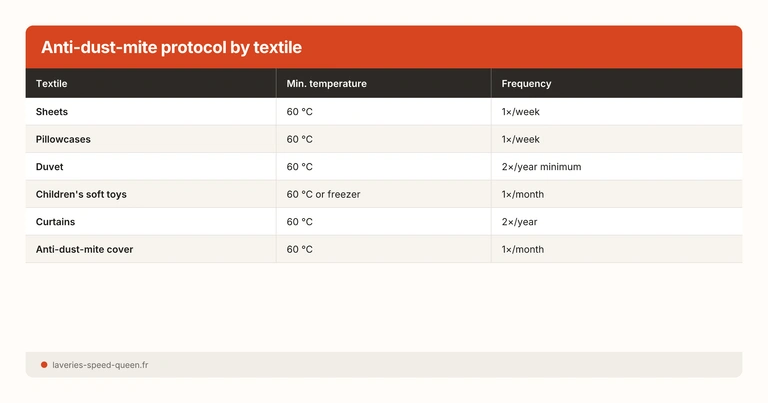
In a nutshell: To eliminate dust mites, wash sheets and covers at 60 °C minimum — dust mites survive below 55 °C. Tumble drying completes the elimination. For a double duvet, an 18 kg machine is essential: the 50-75 litre volume of a duvet cannot be effectively treated in a 7-8 kg home machine. Recommended frequency: sheets every week, duvets every 2-3 months.
At a Glance
60 °C minimum — that is the threshold that destroys mites, eggs, and allergens.
Sheets + pillowcases every week — dust mites reproduce in 2-3 weeks.
Pillows every month, duvet every quarter — these are major reservoirs.
100 % complete drying — a damp textile becomes a habitat again within hours.
Anti dust mite covers on mattress and pillows — an essential physical barrier.
Summary: The Anti Dust Mite Schedule
The effective minimum schedule combines weekly sheets at 60 °C, monthly pillows, and quarterly duvet, with full drying after each cycle.
| Textile | Frequency | Temperature | Laundromat machine |
|---|---|---|---|
| Sheets + pillowcases + duvet cover | Every week | 60 °C | 9 kg |
| Pillows (synthetic) | Every month | 60 °C | 9 kg (2 pillows) |
| Pillows (feather) | Every month | 40 °C delicate | 9 kg (2 pillows) |
| Duvet (synthetic) | Every quarter | 60 °C | 18 kg |
| Duvet (down) | Every quarter | 40 °C delicate | 18 kg |
| Anti dust mite covers | Every 2-3 months | As per label | 9 kg |
| Blankets / bedroom throws | Every month | 60 °C if possible | 9 or 18 kg depending on volume |
Dust Mites in Numbers
In a bedroom at 20-25 °C with humidity above 50 %, the dust mite population can double in about 3 weeks without a suitable washing routine.
What your bed contains
A mattress used for several years can harbour a large dust mite population. It is their droppings — not the mites themselves — that cause rhinitis, asthma, and eczema in sensitised individuals.
Conditions for proliferation
Temperature: 20-25 °C. Humidity: > 50 %. Food: skin cells shed naturally each night. Your bed ticks all three boxes. Without intervention, the dust mite population doubles roughly every 3 weeks.
Why 30 °C is not enough
A 30-40 °C wash removes surface allergens (droppings, debris) but living mites and their eggs survive. They recolonise the textile within days. At 60 °C, adult mites, larvae, and eggs are all destroyed. That is the difference between “rinsing” and “eradicating.” To also limit the bacterial risk on the machine side, see our
guide to cleaning your washing machine
.
The Complete Anti Dust Mite Protocol
To sustainably reduce allergen exposure, you need to treat sheets, pillows, and duvet simultaneously on a fixed schedule — not only when symptoms appear.
Sheets and Pillowcases: Every Week, 60 °C
The most important wash
Sheets, pillowcases, duvet cover: weekly wash at 60 °C, cotton cycle. No exceptions. A 2-week-old sheet already contains millions of mites and accumulated droppings. Washing at 60 °C eliminates the mites and significantly reduces allergen exposure. For more details on frequency and best practices, see our complete guide to washing sheets.
At the laundromat, run a 9 kg machine with all the week’s bed linen: 2 pillowcases + 1 fitted sheet + 1 duvet cover = about 3.5 kg. That fits easily, with enough room for good agitation and rinsing.
Pillows: Every Month, 60 °C
Pillows are in direct contact with the face — nose, eyes, mouth. This is the zone of maximum allergen exposure. A 2-year-old pillow contains 10 % of its weight in dead mites and droppings.
Synthetic pillow
60 °C, cotton cycle. 2 pillows per 9 kg machine. Synthetic handles heat well and dries quickly in the tumble dryer.
Feather / down pillow
40 °C maximum, delicate cycle. Natural down is more fragile, but allergens are mechanically removed by agitation and thorough rinsing. Full tumble drying on delicate cycle.
Detailed guide: how to wash a pillow.
Duvet: Every Quarter (Minimum), 18 kg Machine
The duvet accumulates night-time perspiration and skin cells for months. It is the largest dust mite reservoir in the bed — and the most neglected.
Synthetic duvet
60 °C, cotton cycle. The 18 kg machine is essential: a double duvet weighs 2-3 kg but takes up 50-75 litres of volume. In a 9 kg machine, it is compressed and poorly washed.
Down duvet
40 °C, delicate cycle. Down cannot handle 60 °C, but the water volume and agitation of an 18 kg professional machine compensate by mechanically removing allergens. Long tumble drying on delicate cycle.
Detailed guide: how to wash a duvet.
Why the duvet needs an 18 kg machine
A double duvet takes up 50-75 litres of volume: it needs an 18 kg machine to be washed and rinsed properly. At the laundromat, the 18 kg machine provides the volume needed for the duvet to move freely inside the drum.
Mattress Protectors and Waterproof Pads: The Forgotten Step
The mattress protector is the most neglected piece of bedding in anti dust mite protocols — yet it plays a critical barrier role. Placed between the fitted sheet and the mattress, it absorbs the night-time perspiration that passes through the sheet (about 200 ml per night for an adult) and prevents that moisture from reaching the mattress. Without it, the mattress directly absorbs sweat, sebum, and dead skin — an ideal environment for mites that cannot be machine washed.
The Three Types of Mattress Protector
Not all mattress protectors wash the same way. The material type determines the maximum temperature and drying method.
Terry cloth mattress protector: this is the most common model. Cotton terry is absorbent, durable, and handles frequent washing at 60 °C on a normal cycle very well. It is the most suitable choice for an anti dust mite protocol, because 60 °C destroys mites and eggs with every wash. Tumble drying is fine without restriction.
Flannelette mattress protector: softer to the touch than terry, flannelette (brushed cotton) generally handles 40 to 60 °C depending on the manufacturer. Check the label: some flannelette blends with synthetic fibres do not handle high temperatures well. For allergy sufferers, choose a model that accepts 60 °C.
Waterproof mattress protector (polyurethane membrane): this model has a PU membrane bonded or laminated onto the fabric. The membrane blocks liquids, making it essential for children’s beds or excessive perspiration. Warning: the PU membrane cannot handle more than 40 °C, and washing too hot can cause it to melt, peel, or crack. Wash at 40 °C maximum, on a delicate cycle. Never put a waterproof mattress protector in the tumble dryer: drum heat degrades the membrane. Air dry only, preferably flat.
Washing Frequency
For an adult without allergies, 1 wash per month is enough. The fitted sheet acts as a barrier between the skin and the protector, which slows down the build-up of dirt. But for someone allergic to dust mites, increase to 2 washes per month: the perspiration that passes through the sheet creates a warm, moist microclimate on the protector — exactly the conditions mites seek. If there is a visible stain (heavy perspiration, spilled liquid, night-time accident), wash immediately without waiting for the next scheduled date.
Baby mattress pads are a special case. Spit-up, nappy leaks, and frequent infant perspiration require systematic washing at 60 °C, at least once a week. For a baby, choose a terry pad that handles 60 °C rather than a waterproof model limited to 40 °C. See our guide to washing baby laundry for other items.
Protocol at the Laundromat
A standard mattress protector (140x190 or 160x200) weighs between 800 g and 1.5 kg depending on the model. It fits easily in a 9 kg machine, alone or with the week’s sheets. Run the cycle suited to the protector type: 60 °C for terry and compatible flannelette, 40 °C on delicate for waterproof models. For drying, terry and flannelette models go in the tumble dryer without issue. Waterproof models must be taken home and air dried.
The Most Common Mistake
The most common mistake is never washing the mattress protector. Many people change sheets every week but forget that the layer underneath accumulates perspiration, bacteria, and allergens month after month. The result: even with clean sheets, the sleep environment remains contaminated. If you haven’t washed your mattress protector in over two months, do it now — it is probably the source of that “stale” feeling you notice despite fresh sheets from the machine.
For washing frequencies of all bedding items, see our complete sheet washing chart.
Drying: As Important as Washing
Absolute rule: never damp
A textile stored damp — even slightly — becomes an ideal dust mite habitat again within hours. Residual moisture + room temperature = perfect conditions for proliferation. All your washing effort is cancelled. Dry to 100 % before storing or making the bed.
The professional tumble dryer at the laundromat is the most effective tool for this: it dries evenly, even bulky items like duvets and pillows, in 25-40 minutes. At home, a duvet takes 24-48 h to air dry — with a risk of mould developing at the core.
To understand in detail how temperature and drying eliminate pathogens, see our study on laundromat hygiene.
Anti Dust Mite Covers: The Physical Barrier
Effective anti dust mite covers use a weave finer than 10 microns, but still need to be washed every 2 to 3 months.
Anti dust mite covers are very tightly woven envelopes (pores < 10 microns) that prevent allergens from passing through.
What they do
They isolate the dust mites present in the mattress and pillow: allergens can no longer reach you. This is the most effective measure after regular washing. Choose certified covers (ECARF or equivalent). If you have sensitive skin, also see our guide on detergent residue and sensitive skin.
What they don't do
They do not protect against dust mites living on the sheets, pillowcases, and duvets above the cover. You still sleep in contact with these textiles. Weekly washing remains essential.
Care
Wash the covers every 2-3 months as per the manufacturer's recommendations. Temperature and cycle according to the cover's label (each brand has its own specifications).
Complementary Daily Habits
The most useful daily trio is simple: 15 minutes of airing, humidity kept below 50 %, and weekly vacuuming with a HEPA filter.
Washing eliminates dust mites. These daily habits prevent their return.
Air for 15 minutes a day
Open the bedroom windows each morning. Leave the duvet open for 30 minutes before making the bed: the night-time moisture (200-500 ml of perspiration per person) needs to evaporate. Dust mites cannot tolerate dry air.
Keep humidity below 50 %
Use a hygrometer (10 EUR in-store). If humidity regularly exceeds 50 %, a dehumidifier is a worthwhile investment. Never dry laundry in the bedroom — a drying rack releases 2 litres of water into the air (learn more).
Vacuum mattress and bed base every week
Vacuum (with HEPA filter) the mattress, bed base, and floor around the bed. This reduces the skin cells available to dust mites and removes airborne allergens.
Why the Laundromat Is More Effective for Allergy Sufferers
In practice, a professional machine with 50-60 litres of water and a dedicated tumble dryer reduces allergen residue better than a short domestic cycle.
Higher water volume and rinsing
Speed Queen professional machines use 50-60 litres per cycle. This water volume allows deep rinsing that removes allergens (droppings, debris) from fibres — even those the wash itself did not destroy.
18 kg machine for duvets and pillows
Bulky items need space to be properly washed. A double duvet takes up 50-75 litres of volume: it needs an 18 kg machine to move freely in the drum and benefit from effective agitation and rinsing.
Guaranteed complete drying
Professional 14-16 kg tumble dryers dry a duvet in 30-40 minutes. At home, a duvet takes 24-48 h to air dry. During those 48 hours, surviving mites resettle in the damp fibres.
Mistakes to Avoid
- Washing at 30-40 °C "to preserve the fabric" — dust mites survive; the wash only rinses surface allergens
- Spacing washes 2-3 weeks apart — the mite population has time to double; allergen exposure skyrockets
- Storing a textile still warm / damp — residual moisture = recolonisation within hours
- Relying solely on covers — they protect the mattress, not the sheets or duvet
- Washing the duvet in a machine that is too small — compressed, it is neither washed nor rinsed properly
- Forgetting the pillows — direct face contact = maximum exposure zone
As an Amazon Partner, we earn a small commission on purchases made through affiliate links in this article — at no extra cost to you. This helps us maintain this site and produce free guides.
Allergic to dust mites? The laundromat is your best ally: 18 kg machines for duvets, professional tumble dryers for guaranteed complete drying, detergent included. Laundromats in Blagnac and Croix-Daurade, open 7j/7 de 7h à 22h. See our pricing. Questions about the anti dust mite protocol? Contact us for personalised advice.
Anti-Pollen Protocol (March to July)
Pollen season in the Toulouse region runs from March to July, with a grass pollen peak in May-June. During this period, laundry becomes a major vector for transporting pollen indoors.
The Textile Avoidance Protocol
To limit symptoms, adopt these habits as soon as the first pollen appears:
- Immediate separation: Never place outdoor clothes on your bed or sofa. Set up a “textile airlock” at the entrance (a closed basket) to deposit your clothes as soon as you get home.
- Washing outdoor clothes: Wash textiles worn outside after each day with high pollen counts (RNSA index 4 or 5). A 40 °C wash is enough to mechanically dislodge pollen grains from the fibres.
- Enhanced bedding routine: Wash your sheets and especially your pillowcases every week at 60 °C. Pollen accumulated in your hair deposits on the pillowcase overnight, triggering reactions upon waking.
- Closed-circuit drying: This is the most critical point. You absolutely must not dry laundry outside during pollen season. Damp fibres act like pollen magnets. The laundromat tumble dryer is the only guarantee of allergen-free laundry.
- RNSA monitoring: Adjust your washing rhythm by checking the pollen bulletin for your area. If the index reaches 4 or 5, wash exposed clothes immediately.
Dust Mites and Seasons: Why Autumn Is the Critical Period
The dust mite population peaks in autumn (September-November): homes close up, heating comes back on, indoor humidity rises. This is when the washing protocol matters most.
Autumn: peak exposure
Dust mites multiplied all summer in the ambient heat. In autumn, when you close the windows and turn on the heating, the allergen concentration in bedding reaches its maximum. This is when symptoms are strongest: morning rhinitis, puffy eyes, night-time cough.
Winter: maintain the protocol
Heating keeps the bedroom at 20-22 °C — ideal temperature for dust mites. The humidity generated by night-time breathing (200-500 ml per person) feeds their habitat. Do not ease off the washing frequency just because it's winter.
Spring-summer: double exposure
In spring, dust mites coexist with tree and grass pollen. Multi-allergic individuals face a double burden. Regular laundry washing remains essential all year round, even when symptoms seem to come "from outside."
The most common mistake is only starting the protocol when symptoms appear. Dust mites reproduce continuously: regular washing all year round prevents build-up, instead of reacting when exposure is already critical.
Annual Budget for the Anti Dust Mite Protocol at the Laundromat
An anti dust mite protocol at the laundromat is a regular investment. Here is the realistic budget, calculated using Speed Queen Toulouse prices.
| Textile | Frequency | Machine | Unit cost | Annual cost |
|---|---|---|---|---|
| Sheets + pillowcases + cover | Every week (x52) | 9 kg: 4.90-5.50 EUR + drying ~3 EUR | ~8 EUR | ~415 EUR |
| Pillows (x2) | Every month (x12) | 9 kg: 4.90-5.50 EUR + drying ~4.50 EUR | ~10 EUR | ~120 EUR |
| Duvet | Every quarter (x4) | 18 kg: 9.80-10 EUR + drying ~6 EUR | ~16 EUR | ~65 EUR |
| Total | ~600 EUR | |||
| Total with loyalty card (-20 %) | ~480 EUR |
This budget may seem high, but it should be compared to the cost of untreated allergy: allergology consultations (25-50 EUR per visit), antihistamines (15-30 EUR/month), prescription nasal sprays, and above all the deterioration of sleep and quality of life. Regular laundromat washing is a preventive investment that reduces the allergen load at the source.
To reduce the budget, combine your washes: sheets + pillowcases + towels in the same 9 kg machine. Use the loyalty card from the start (20 EUR top-up = -20 % on everything). At the laundromat, each cycle includes detergent — no separate product to buy.
Methodology and Sources
- Health/allergen recommendations are based on ANSES institutional references on indoor air quality and domestic allergens.
- Temperatures and operational frequencies are then translated into a practical laundromat protocol (9 kg / 18 kg machine capacities, complete drying).
- Internal capacity/pricing figures are aligned with the site’s official pages (pricing and equipment) to remain consistent between article and local offer.