In a nutshell: the right dose depends on three factors — detergent format (liquid, powder, pod), laundry load and water hardness. Always follow the manufacturer’s instructions on the packaging. When in doubt, dose slightly below rather than above: overdosing is worse than underdosing (residues, machine buildup, irritation). At a Speed Queen laundromat, dosing is automatic — detergent and softener included.
At a glance
Reference = packaging — each detergent has its own concentration. This chart gives ballpark figures.
Three variables — format (liquid/powder/pod) x load (kg) x water hardness (°f).
Overdosing does not clean better — it leaves residues, clogs the machine and irritates the skin.
At SQ laundromat = automatic — calibrated dosing, detergent and softener included.
Indicative dosage chart
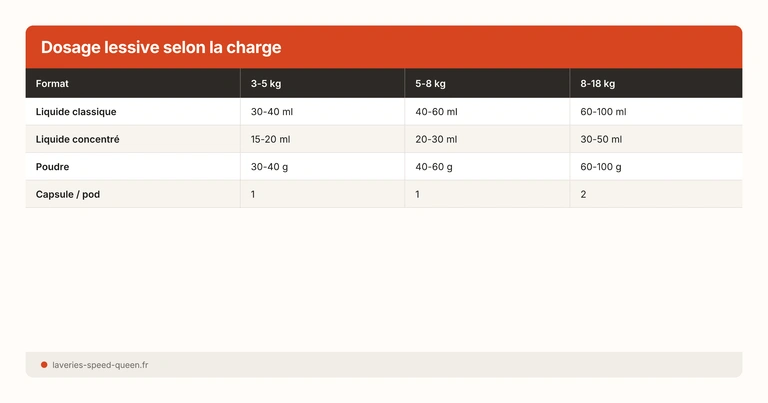
The doses below are ballpark figures based on average manufacturer recommendations. Always adjust according to your detergent’s concentration (standard vs concentrated) and the specific instructions on the packaging.
| Format | Load 3-5 kg | Load 5-8 kg | Load 8-18 kg (laundromat) | Hard water adjustment (>25 °f) |
|---|---|---|---|---|
| Standard liquid | 30-40 ml | 40-60 ml | 60-100 ml | +25% dose |
| Concentrated liquid | 15-20 ml | 20-30 ml | 30-50 ml | +25% dose |
| Powder | 30-40 g | 40-60 g | 60-100 g | +25-50% dose |
| Pod / capsule | 1 pod | 1 pod | 2 pods | Not adjustable |
Water hardness varies by region
Soft water in Brittany or the Massif Central (<15 °f), moderately hard in the South-West (15-25 °f), hard in Ile-de-France, the North or in Toulouse depending on the area (25-35 °f). Check your water bill or your local council’s website to find your hardness. It is the variable that changes the required dosage the most.
Why overdosing is worse than underdosing
Residues in the fibres
Excess detergent does not rinse out completely. The residues make laundry stiff, attract dust and can cause skin irritation (eczema, itching), especially on sensitive skin and baby clothes.
Machine buildup
Residues accumulate in the door seal, detergent dispenser, drain filter and pipes. The machine loses efficiency, develops odours and needs more frequent cleaning.
Excess foam
Too much foam prevents the correct mechanical tumbling of laundry in the drum. The laundry is less well washed despite more product — counterintuitive but well documented.
Environmental impact
According to AISE, 30-40% of consumers overdose. This excess represents thousands of tonnes of extra surfactants in wastewater every year in Europe.
Overdosing: the 5 real-world problems
Detergent overdosing is the most common and most underestimated mistake. According to AISE, 30-40% of European consumers put too much detergent in their machine. Here are the 5 real-world consequences.
1. Residues in the fibres and stiff laundry
Excess detergent does not rinse out fully, even with a complete rinse cycle. The remaining surfactants crystallise as they dry, making laundry stiff and scratchy. These residues also attract dust and dirt, which soils the laundry faster — a vicious cycle where you wash more often laundry that gets dirty more quickly.
2. Skin irritation and sensitive skin
Detergent residues in prolonged contact with the skin (underwear, sheets, pyjamas) cause reactions in sensitive people: eczema, itching, redness. It is the number-one cause of textile-related irritation identified by dermatologists. For baby clothes and sensitive skin, slight underdosing is always preferable to overdosing.
3. Excessive foam = less effective washing
It is counterintuitive, but more foam = less clean. Machine washing relies on mechanical action: the tumbling of laundry in the drum. Excess foam cushions this action and prevents the fabric-against-fabric friction that dislodges dirt. Modern machines detect excess foam and add extra rinses — lengthening the cycle and increasing water consumption.
4. Machine buildup
Detergent residues accumulate in the door seal, detergent dispenser, drain filter and pipes. This damp biofilm loaded with organic matter becomes a breeding ground for mould and bacteria. Result: a machine that smells bad and transfers its odours to the laundry. Machine cleaning then becomes necessary monthly instead of quarterly.
5. Environmental impact
Widespread overdosing represents thousands of tonnes of extra surfactants released into wastewater every year in Europe. Treatment plants do not filter out 100% of detergent chemicals. Correct dosing is a simple, immediate environmental action.
Hard water vs soft water: the impact on dosage
Water hardness is the variable that changes the required dosage the most. It is expressed in French degrees (°f) and measures the concentration of calcium and magnesium.
| Hardness | Value (°f) | Typical regions | Dosage adjustment | Effect on laundry |
|---|---|---|---|---|
| Soft water | <15 °f | Brittany, Massif Central, Vosges | Reduce by 25% | Detergent foams easily, easy rinsing |
| Moderately hard water | 15-25 °f | South-West, Loire, Rhone | Standard dose | Good balance between effectiveness and rinsing |
| Hard water | 25-35 °f | Ile-de-France, North, Toulouse (some areas) | Increase by 25% | Limescale neutralises some of the surfactants |
| Very hard water | >35 °f | Paris Basin, some limestone areas | Increase by 25-50% | Risk of limescale film on fibres, stiff laundry |
In hard water, the calcium in the water reacts with the detergent’s surfactants and partially neutralises them. You therefore need more detergent to achieve the same cleaning power. Adding a water softener (Calgon type) or white vinegar to the rinse compensates without increasing the detergent dose. White vinegar dissolves limescale deposits on fibres and in the machine.
In soft water, detergent foams much more easily. The standard dose is often excessive — reduce by 25% to avoid residues. If your laundry comes out stiff despite a reduced dose, the problem lies elsewhere (type of detergent, insufficient rinse programme).
How to check your water hardness
Water hardness is the variable that changes the required dosage the most. Three ways to find it:
- Water bill: most suppliers show the hardness in °f (French degrees) on the annual bill or on their website.
- Local council website: water quality is a public document. Search “[town name] water quality” on Google — you will find the ARS report with the hardness.
- Test strips: available at pharmacies or pet shops (~EUR 5 for 50 strips). Dip in tap water — the result shows in 30 seconds.
Benchmarks: soft water <15 °f (Brittany, Massif Central), moderately hard 15-25 °f (South-West, Loire), hard 25-35 °f (Ile-de-France, North, Toulouse depending on area), very hard >35 °f (some limestone areas of the Paris Basin).
Underdosing: when it is also a problem
Underdosing is less serious than overdosing, but it has real consequences for cleanliness and laundry lifespan:
- Greying laundry: insufficient surfactants do not remove all dirt. White laundry gradually turns grey, cycle after cycle. It is a cumulative problem: each insufficient wash leaves a thin layer of residual dirt that adds to previous ones.
- Limescale residues: in hard water, without enough sequestrants (anti-limescale agents in the detergent), the water’s limescale deposits directly into the fibres. Result: stiff laundry, scratchy towels and a yellowish film on whites (see our guide to whitening yellowed laundry).
- Persistent odours: bacteria not eliminated by insufficient washing produce malodorous volatile compounds, especially on synthetic textiles that naturally retain bacteria. If your laundry smells bad after washing, underdosing is a common cause.
- Stains not removed: without enough surfactants, greasy stains (sebum, cooking oil, sunscreen) are not emulsified and remain embedded in the fibres. They can set permanently after a pass through the tumble dryer.
The right approach: follow the manufacturer’s dose as a baseline, adjust ±25% according to the load and soil level. Never halve the dose “to save money” — the result will be poorly washed laundry that gets dirty faster and needs rewashing, cancelling any savings.
Special cases
Baby clothes
Dose slightly below the recommendation and add an extra rinse if possible. Detergent residues are the number-one cause of irritation on newborn skin.
Sportswear
Overdosing worsens odours on synthetic fibres — residues feed bacteria. Dose normally and wash at cold (30 °C).
Large loads (duvets, sheets)
In an 18 kg machine, the water volume is larger — increase the dose proportionally. At a Speed Queen laundromat, this is handled automatically.
Concentrated detergent
Caution: ultra-concentrated detergents require 2-3x less product. It is written on the packaging but often ignored. Read the recommended dose FOR THIS detergent, not a generic dose.
At a self-service laundromat: dosing is not an issue
At a Speed Queen laundromat, detergent and softener are dosed automatically by the machine. The system is calibrated for the drum size (9 kg or 18 kg) and the water volume used. The result:
- Zero waste: the exact amount of biodegradable professional detergent is dispensed each cycle.
- Zero overdosing: no residues, no stiff laundry, no machine buildup.
- Superior rinsing: professional machines use 50-60 litres of water per cycle, compared with 40-50 litres for a domestic machine. The rinse is more thorough, which removes residues even in hard water.
- Professional formulation: the detergents used in laundromats are formulated for high-volume machines and meet strict biodegradability standards.
This is one of the overlooked advantages of the laundromat compared to a domestic machine: dosing is no longer a source of error.
Mistakes to avoid
- Doubling the dose for very dirty laundry — increase by a quarter maximum. The surplus does not clean better and leaves residues.
- Using the cap without reading the markings — dosing caps have markings. Filling to the brim = often 2x the recommended dose.
- Keeping the same dose when switching detergent — each brand has its own concentration. Re-read the packaging with each change.
- Adding detergent mid-cycle — detergent added late does not have time to rinse out properly.
- Ignoring water hardness — in hard water, underdosing leaves a limescale film. In soft water, the normal dose is already too much.
Dosing in hard vs soft water: the regional chart
The most overlooked dosing factor is water hardness. In hard water (25+ °TH), some of the detergent is neutralised by calcium before it can act on the laundry. The manufacturer’s “soft water” dose then becomes insufficient.
In Toulouse and the surrounding area, water is moderately hard to hard (20-30 °TH depending on the area). Systematically use the “hard water” dose shown on your detergent — it is generally 25-50% higher than the soft water dose. If your detergent does not show a dose by hardness, increase by 30% over the standard dose.
At a Speed Queen laundromat, this problem is solved automatically: the professional detergent is dosed taking local water hardness into account. This is one of the overlooked advantages of automatic dosing at a laundromat, particularly useful in hard water areas like Toulouse.
As an Amazon Associate, we earn a small commission on purchases made through the affiliate links in this article — at no extra cost to you. This helps us maintain this site and produce free guides.
At a Speed Queen laundromat, dosing is fully automatic — biodegradable professional detergent and softener included, dosed to the gram according to the load. Zero guesswork, zero waste. Everything washed and dried in ~1h. See our prices or our guide to choosing a detergent at home.
Sources and references
- AISE (International Association for Soaps, Detergents and Maintenance Products), data on European consumer overdosing
- Which detergent to choose: liquid, powder or pods
- Detergent residues: solutions for sensitive skin
- Eco-friendly laundromat: professional machine impact
- Cleaning your washing machine
- Laundry weight per garment
- White vinegar and laundry: uses and limits
- Laundromat vs home machine: comparison
- Homemade detergent: recipe and limits
- Washing baby clothes safely