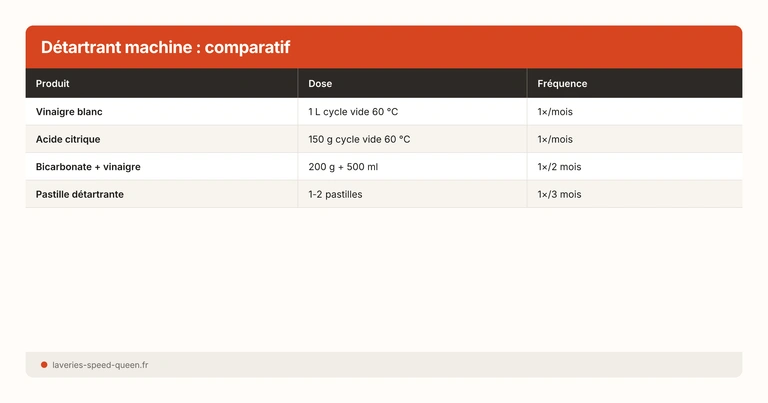
Limescale is the silent enemy of your washing machine: it builds up on the heating element, reduces heating efficiency, promotes odours and wears out seals prematurely. Citric acid (150 g, empty cycle at 60 °C) is the most effective way to remove it. White vinegar (1 litre) is a gentler but less powerful alternative. The frequency depends on water hardness: monthly in very hard water, every 2 months in moderately hard water, quarterly in soft water.
At a glance
Citric acid = method no. 1 — 150 g in the drum, 60 °C empty cycle, biodegradable and safe for the machine.
White vinegar = alternative — 1 litre in the drum, 60 °C. Less powerful; too-frequent use may wear certain seals.
Do not mix — vinegar + baking soda = mutual neutralisation, zero descaling power.
Adapted frequency — hard water = monthly, moderately hard = every 2 months, soft water = quarterly.
Complementary areas — door seal, detergent drawer, drain filter should be cleaned at the same time.
Why limescale is a problem
Limescale — chemically calcium carbonate (CaCO3) — is naturally present in tap water. When water heats up, dissolved CO2 escapes and calcium precipitates as scale, a white hard crust that deposits preferentially on hot surfaces: the electric heating element, the inner drum walls, and the water inlet and outlet circuits.
This build-up is more than cosmetic. It has tangible consequences for your machine and your laundry.
On the heating element. Limescale is a thermal insulator. A layer of just 2 mm forces the element to consume 15 to 20% more energy to reach the same temperature. Over time, the element overheats to compensate, reducing its lifespan and potentially causing a breakdown.
On seals and pipes. Scale accumulates in the rubber door seal and internal pipes. It creates micro-roughness where bacteria and mould take hold, generating the dreaded musty washing machine odours. Seals harden, crack and eventually leak.
On laundry. Very hard water reduces the effectiveness of detergent surfactants — the molecules that encapsulate dirt. The result: laundry comes out duller, rougher, sometimes greyish. Limescale residues also deposit directly on fibres, giving fabric a cardboard-like feel. This is particularly noticeable on towels and dark laundry.
On water consumption. A circuit partially blocked by scale reduces water flow. The machine compensates by extending fill phases, increasing both water consumption and cycle duration.
Water hardness: the determining factor
Not all tap water is equal when it comes to limescale. Water hardness measures the concentration of calcium and magnesium ions. The higher the figure, the more limescale-prone your water and the faster your machine will scale up.
| Hardness | mg/L CaCO3 | Characteristics | Descaling frequency |
|---|---|---|---|
| Soft water | 0 - 150 | Few deposits, soap lathers easily | Every 3 months |
| Moderately hard | 150 - 300 | Visible deposits on taps, film on glasses | Every 2 months |
| Hard water | 300 - 450 | Rapid scaling, rough laundry, vulnerable element | Every month |
| Very hard | > 450 | Accelerated scaling, noticeable energy overconsumption | Every 3 weeks |
Checking your local water
Your local water supplier publishes an annual water quality report. You can find the hardness figure on your municipality’s website or directly from the water company. You can also use test strips sold in pharmacies or aquarium shops.
Method no. 1: citric acid (the most effective)
Citric acid↗ (C6H8O7) is a natural organic acid found in citrus fruits. In solution, it reacts with calcium carbonate to form calcium citrate, a soluble salt that drains away with the rinse water. This reaction is more effective than vinegar, faster, and produces no strong odour.
Dosage and protocol
- Remove all laundry from the drum. Descaling must be done with an empty machine.
- Pour 150 g of citric acid directly into the drum (not the detergent drawer). For a heavily scaled or large-capacity machine (over 10 kg), increase to 200 g.
- Run a long cycle at 60 °C. Heat accelerates the chemical dissolution of limescale. A normal cotton programme without pre-wash will do. Skip heavy spinning — a low or medium spin is sufficient.
- Leave the door open after the cycle to let residual moisture evaporate.
Where to buy citric acid
Food-grade citric acid is available in organic shops, hardware stores, large supermarkets (eco cleaning aisle) or online. Expect about EUR 5-8 per kilo — that is less than EUR 1 per descale. Buy anhydrous citric acid (powder), not lemon juice which is far too dilute.
Why citric acid is superior to vinegar
Citric acid outperforms white vinegar↗ due to its concentration and chemistry. Citric acid is a triacid: each molecule releases three H+ protons, giving it roughly three times the limescale-dissolving power of acetic acid (vinegar) at the same concentration. Additionally, the calcium citrate formed is more soluble than calcium acetate, meaning dissolved limescale residues are better flushed during rinsing.
Citric acid is also odourless, unlike vinegar whose pungent smell can linger for several cycles. Finally, it is fully biodegradable and poses no risk to rubber seals, plastic pipes or metal parts at the recommended dosages.
Method no. 2: white vinegar (the accessible alternative)
White vinegar (8% acetic acid in France, sometimes 10-14% for household vinegar) is the all-purpose cleaning product par excellence. Its acidity dissolves limescale, but less effectively than citric acid.
Dosage and protocol
- Pour 1 litre of white vinegar (8%) directly into the empty drum.
- Run a cycle at 60 °C, long cotton programme.
- Ventilate the machine after the cycle — the vinegar smell dissipates within a few hours with the door open.
For more intensive descaling, you can use 14% household vinegar: 50 cL will suffice. This concentrated vinegar is available in hardware stores and supermarkets. Do not use higher concentrations (20%+ cleaning vinegar): the risk of attacking seals becomes real.
Limitations of vinegar
White vinegar has three objective drawbacks for descaling.
First, its descaling power is limited. Acetic acid is a weak monoacid: it releases a single proton per molecule, versus three for citric acid. At equal volume, it dissolves roughly three times less limescale.
Second, some washing machine manufacturers (Miele, Bosch) advise against frequent use of vinegar. Acetic acid, used regularly at high temperatures, can weaken certain rubber seals and parts over time. Citric acid does not pose this problem.
Third, the persistent smell of vinegar can impregnate the first wash after descaling. An additional empty rinse cycle eliminates this risk.
White vinegar remains an excellent product for many laundry-related uses — see our complete guide to white vinegar for laundry for its real advantages and limits.
Method no. 3: commercial descaling tablets
Descaling tablets sold in supermarkets (Calgon, Dr. Beckmann, HG, etc.) generally contain a mixture of citric acid, sulfamic acid or polycarboxylates, combined with dispersing agents that prevent dissolved limescale from redepositing.
Advantages
- Pre-calibrated dosage: one tablet per cycle, no weighing needed.
- Complementary agents: dispersants and surfactants also clean bacterial biofilm, not just limescale.
- Guaranteed compatibility: manufacturers test their products on common washing machine brands.
Disadvantages
- Much higher price: a tablet costs EUR 0.80-1.50, versus about EUR 0.75 for 150 g of bulk citric acid.
- Sometimes opaque composition: some products contain fragrances, dyes or bleaching agents that serve no descaling purpose.
- Variable effectiveness: polycarboxylate-based tablets are more preventive (they prevent deposits) than curative (they cannot eliminate heavy existing scale).
Citric acid
The most effective. 150 g, empty cycle at 60 °C. About EUR 0.75 per descale. Biodegradable, odourless, safe for seals.
White vinegar 8%
Accessible alternative. 1 litre, empty cycle at 60 °C. Less powerful, persistent smell. Not recommended for very frequent use.
Descaling tablets
Easy dosage, combined descaling + cleaning action. High price (EUR 0.80-1.50 per unit). More preventive than curative.
Sulfamic acid
Used in professional tablets. Very effective on thick scale, but more aggressive. Reserved for extreme cases.
Descaling mistakes to avoid
- Mixing vinegar and baking soda — the acid-base reaction produces sodium acetate (a neutral salt) and CO2 (the foam). The result is a liquid with zero descaling power. Use them in two separate cycles.
- Using bleach to descale — bleach (sodium hypochlorite) is an oxidising disinfectant, not an acid. It has no effect on limescale. It can also damage rubber seals and discolour plastic parts.
- Exceeding 90 °C with citric acid — above 80 °C, citric acid can form insoluble calcium citrate that redeposits instead of draining. 60 °C is the optimal temperature.
- Descaling with laundry in the machine — citric acid and vinegar can dull colours and weaken certain fibres. Always descale with an empty drum.
- Neglecting the rinse — after the descaling cycle, check that the drain water is clear. If it is still cloudy or whitish, run an extra rinse.
Beyond descaling: complete maintenance
Descaling only treats limescale. For complete machine maintenance, you also need to address areas where bacteria, mould and detergent residue accumulate. Our complete guide to cleaning your washing machine details every step. Here is a summary of the areas not to forget.
The door seal (after every wash)
The rubber seal around the door is a trap for moisture, lint and mould. After every wash, wipe it dry with a cloth, lifting the folds. Once a month, give it a deep clean with a cloth soaked in white vinegar or water with a few drops of tea tree essential oil (a natural antibacterial).
The detergent drawer (once a month)
Remove the drawer (most are removable via a release clip) and soak it for 30 minutes in hot vinegar water. Brush away solidified detergent residue with an old toothbrush. These residues are an ideal breeding ground for mould.
The drain filter (every 2-3 months)
The filter catches foreign objects (coins, buttons, lint, elastic bands) that could damage the pump. A blocked filter slows drainage and promotes bad odours. Place a towel and container under the hatch before opening — there is always residual water.
The door (always ajar)
After every wash — not just after descaling — leave the door and detergent drawer ajar. Moisture trapped in a closed drum is the main cause of mould growth and the “musty” smell that laundry absorbs.
Complete maintenance calendar
After every wash: wipe the seal, leave the door open. Every month: clean the detergent drawer, deep-clean the seal. Every 2 months (moderately hard water): citric acid descale, 150 g, empty cycle at 60 °C. Every 2-3 months: clean the drain filter. This schedule extends the machine’s lifespan and ensures laundry that smells clean.
Prevention: reducing limescale build-up day to day
Periodic descaling is essential, but certain habits slow down the rate of scaling and space out interventions.
Dose detergent correctly
Overdosing detergent does not wash better. It creates surfactant residues that combine with limescale to form a mixed deposit (soap + scale) even harder to remove than limescale alone. Follow the recommended doses — and know that in hard water, powder detergent is more effective than liquid because it contains built-in anti-limescale agents (zeolites).
Wash regularly at 60 °C
Washing exclusively at low temperatures (30-40 °C) promotes the accumulation of bacterial biofilm and detergent residue in the drum. Running a cycle at 60 °C at least once a week helps keep the drum cleaner between descaling sessions.
Consider a water softener if needed
In very hard water areas (above 350 mg/L), installing a water softener on the mains supply significantly reduces the limescale load of all household water — washing machine included. It is a significant investment (EUR 800-2,000 installed) but also protects taps, the water heater and pipes.
At the laundromat: maintenance you do not have to manage
One of the often-forgotten practical advantages of a professional laundromat is that machine maintenance is not your responsibility. The Speed Queen machines in our laundromats are maintained according to a professional maintenance protocol that includes descaling, circuit cleaning and component checks.
Professional machines are also designed to withstand intensive use and large water volumes. Their heating elements are engineered to heat large volumes quickly, and their rinse systems use 50 to 60 litres per cycle — effectively diluting and flushing limescale and detergent residues.
En tant que Partenaire Amazon, nous percevons une petite commission sur les achats effectués via les liens partenaires de cet article — sans surcoût pour vous. Cela nous aide à maintenir ce site et à produire des guides gratuits.
Maintaining your home machine takes time? Our laundromats in Blagnac, Croix-Daurade and Montaudran have professional machines maintained daily, with detergent included and high-performance rinsing. Payment CB sans contact ou espèces. See our prices.