In short: The right detergent choice depends first on three variables: the format (liquid, powder, pods), the composition (surfactants, enzymes, fragrances, preservatives) and your context of use (type of laundry, temperature, water hardness). The brand name comes second.
At a glance
Liquid: better suited to cold washes and dark colours.
Powder: stronger on whites, stubborn stains and 60 °C programmes.
Pods: convenient fixed dose, but less flexible and more expensive per cycle.
Label: read the ingredient categories, not just the marketing claims.
Dosage: water, load and soil level matter more than the brand choice.
How detergent works
Detergent removes soiling through a simple physico-chemical mechanism: surfactant molecules surround grease and particles, then hold them suspended in the water so they are carried away during rinsing. This mechanism is part of the principles of detergency taught in applied biochemistry.
Surfactants: hydrophilic head, hydrophobic tail
- Anionic surfactants: very common in powders (notably LAS, Linear Alkylbenzene Sulfonate) and in many liquids (SLS/SLES). They have a strong cleaning capacity on greasy soiling.
- Non-ionic surfactants: often ethoxylated alcohols. Milder, more stable at low temperatures, useful for 30-40 °C cycles.
In water, these molecules form micelles: the hydrophobic part captures the dirt, the hydrophilic part stays oriented towards the water. The dirt becomes rinsable.
Useful technical point
Washing depends on the balance of surfactants + agitation + temperature + time. An effective detergent that is poorly dosed or poorly rinsed loses its value, even with a correct composition.
Enzymes: effective, but heat-sensitive
Enzymes break down specific families of stains. They are not universal and their activity drops above certain thresholds.
| Enzyme | Main target | Use case | Thermal activity loss* |
|---|---|---|---|
| Protease | Proteins (blood, milk, egg) | Underwear, baby laundry, organic stains | Inactive above 60 °C |
| Lipase | Fats and oils | Shirt collars, food stains, sebum | Inactive above 60 °C |
| Amylase | Starch (starchy foods, thickened sauces) | Starchy food stains | Inactive above 70 °C |
| Cellulase | Cotton microfibrils (visual anti-pilling) | Cotton care, limiting greying | Inactive above 50 °C |
*Typical thermal deactivation thresholds in consumer detergent formulations.
To link temperature and effectiveness, see our washing temperatures guide.
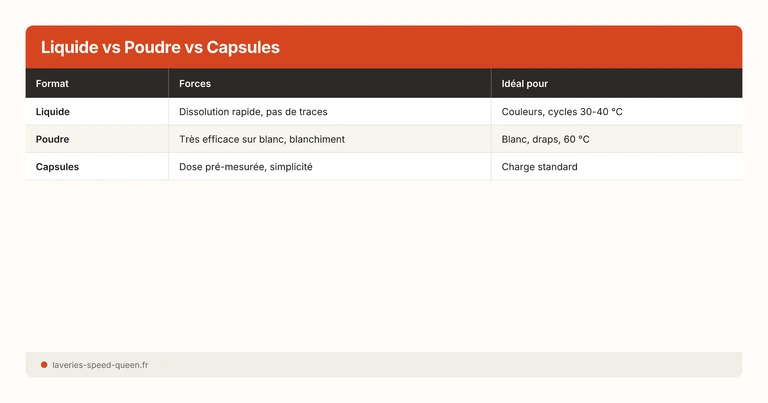
Liquid, powder or pods: the comparison
The format is not cosmetic: it changes product behaviour, dosage margin and textile result.
| Format | Strengths | Limitations | Ideal for |
|---|---|---|---|
| Liquid | Rapid dissolution at low temperatures, fewer marks on darks, adjustable dosage | Less effective on heavy oxidisable stains and dull whites | Colours, black, 30-40 °C cycles |
| Powder | Very good effectiveness on whites, often enriched with oxygen-based bleaching agents (e.g. sodium percarbonate), performs well at 60 °C | May leave residue on dark textiles or in too-short/cold cycles | White laundry, sheets, tea towels, stain recovery |
| Pods / capsules | Pre-measured dose, limits overdosing, quick to use | Higher price per wash, non-adjustable dose, risk of accidental ingestion by children (Poison Control Centre data) | Users seeking simplicity with a standard load |
AISE recommendations remind us that the dose should follow the soil level, load and water hardness. A pod remains a fixed dose; it does not cover every case.
If your main goal is brilliant whites, combine format choice and a suitable wash protocol in our guide whitening yellowed laundry.
Composition: what you need to read on the label
The European regulatory framework
Regulation (EC) No 648/2004 on detergents requires the display of ingredient categories by concentration ranges:
- more than 30%
- 15-30%
- 5-15%
- less than 5%
This reading does not give the exact formula, but it allows you to identify the categories to watch based on your use.
Ingredients to watch based on your priority
Optical brighteners
They absorb UV and re-emit a bluish light, creating the impression of a brighter white. They are not cleaning agents. On dark colours or sensitive laundry, their presence may be unnecessary.
MI/MCI preservatives (MIT/MCI)
Methylisothiazolinone and Methylchloroisothiazolinone are recognised skin sensitisers according to ECHA. MI has been restricted since 2016 in leave-on cosmetics, but some uses remain authorised at low concentrations in rinse-off products.
Fragrances and declarable allergens
The European framework requires the declaration of 26 fragrance allergens in cosmetics (Regulation EC 1223/2009) and this list serves as a practical reference for sensitive profiles. For detergent, prefer fragrance-free formulas if you experience skin reactions.
PFAS focus
The European PFAS restriction was submitted to ECHA in 2023 and remains under evaluation. PFAS are not generally banned in detergents to date, but they are under reinforced regulatory surveillance.
To limit irritants linked to prolonged textile contact, also see our guide on detergent residues and sensitive skin.
Reading a label in 30 seconds
Spot the dominant range (>30%, 15-30%, 5-15%, <5%).
Check for fragrances if sensitive skin or baby laundry.
Identify enzymes and optical brighteners based on your goal (stain removal vs colour care).
Check preservatives if you have a history of skin sensitisation.
Compare the recommended dose with your local water hardness.
Ecolabels: which ones are reliable?
A useful label must be based on a public specification, an external audit and explicit chemical criteria.
EU Ecolabel
European standard (Regulation EC 66/2010). It imposes aquatic toxicity limits, biodegradability requirements and a list of restricted substances.
Ecocert Eco-detergent
Requires a minimum of 95% naturally derived ingredients and excludes conventional petrochemical surfactants.
Nature & Progres
Stricter standard than many private ones: no synthetic ingredients in the certified formula.
Scanning apps
Yuka and QuelProduit speed up aisle sorting, but their scores remain partial: they can over- or under-weight certain ingredients depending on the context of use.
For the system-level view (water, dosage, energy consumption, equipment), read our analysis on eco-friendly laundromat technologies.
By use: which detergent for which laundry?
White laundry
Powder at 60 °C with oxygen-based bleaching agents. This is the most robust combination against greying and ingrained stains.
Coloured laundry
Liquid at 30-40 °C, without optical brighteners. It limits marks and better preserves dark shades.
Delicates, wool, silk
Neutral-pH liquid detergent, without aggressive enzymes or bleaching agents. Gentle programme and reduced spin.
Baby and sensitive skin
Fragrance-free, dye-free formula, certified hypoallergenic, with extra rinsing. See baby laundry care and detergent residues and sensitive skin.
Sportswear
Liquid detergent without fabric softener to preserve breathability and elasticity of technical fibres. Details in our sportswear guide.
Heavily soiled laundry
Powder + targeted pre-stain treatment before the machine. The full protocol is in tough stains: solutions.
Quick decision: which detergent to pick today?
Looking mainly for a fabric softener alternative?
Do not mix everything into the same question. Detergent choice and white vinegar use do not address exactly the same need. If you are hesitating about rinsing, fabric softness or the value of vinegar in the softener compartment, also read
white vinegar and laundry: useful applications, limits and mistakes to avoid
.
Use this matrix before each wash.
| If your priority is… | Recommended format | Associated setting | Why |
|---|---|---|---|
| Black and dark colours without marks | Liquid | 30-40 °C, normal rinse | Faster dissolution, fewer visible deposits |
| Whites to brighten and oxidisable stains | Powder | 60 °C if textile compatible | Oxygen-based bleaching agents often more present |
| Ease of use without measuring | Pod | Standard load, non-very-hard water | Convenient fixed dose, no manual calibration |
| Reactive skin / infant | Plain liquid | Low dose + extra rinse | Fewer fragrance additives and fine adjustment |
| Synthetic sportswear | Liquid | 30-40 °C, no fabric softener | Preserves breathability and textile elasticity |
| Heavily soiled laundry | Powder + pre-treatment | Programme suited to the fibre | Mechanical + chemical action remains best |
If you are hesitating between two formats, keep the same product and correct the dose first. It is the most cost-effective lever for results and rinsing.
Safety: pods, containers and storage
Detergent choice includes household safety, especially with children.
Pods out of sight and out of reach: high, locked storage after each use.
Dry hands before handling: the water-soluble film dissolves on contact with moisture.
Close the container immediately: avoids visual attraction and accidental grabs.
Never decant into a food container: possible confusion for a child.
Store away from sunlight: improved chemical stability and packaging safety.
Poison Control Centres report that pod exposures mainly involve young children. Proper storage reduces the risk.
Detergent tips
Dissolve properly: in a short cold cycle, liquid reduces the risk of visible deposits.
Match the format to the programme: powder for 60 °C, liquid for 30-40 °C.
Pre-treat before washing: detergent is not a universal stain remover on old stains.
Rinse skin-contact laundry more: underwear, pyjamas, baby sheets.
Store dry and sealed: humidity and heat degrade enzymes and formula stability.
Measure every dose: graduated cap, dispenser or scale for powder.
Real-life cases: what to do depending on the problem
| Problem observed | Likely cause | Primary adjustment | Secondary adjustment |
|---|---|---|---|
| Persistent odour on towels | Under-dosing + temperature too low + insufficient rinsing | Switch to powder and 60 °C programme if textile compatible | Complete drying outside the drum and machine maintenance |
| White marks on black jeans | Poorly dissolved powder or overdosing | Switch to liquid and reduce the dose | Add a rinse if drum is full |
| Whites greying over cycles | Insufficient temperature and no oxidiser | Use a powder on a suitable cycle | Check sorting with colours and drum overloading |
| Itching after washing | Overdosing, fragrance or poorly tolerated preservative | Fragrance-free formula + low dose | Double rinse on skin-contact textiles |
| Sportswear smelling quickly | Detergent/softener deposits in technical fibres | Liquid without fabric softener | Quick wash after use, ventilated drying |
| Ingrained stain not removed | Chemical action alone insufficient | Pre-treat before washing | Adjust temperature by fibre and stain type |
Concentrated, standard or professional detergent
A concentrated detergent is not automatically stronger: it contains less water, so a smaller dose achieves the equivalent active quantity.
Practical points:
- Concentrated: lower dose, risk of overdosing if you keep your old visual benchmarks.
- Standard: more forgiving of measuring errors, but higher transport volume.
- Professional: formulated for automatic dosing, as in laundromats, with consistent results cycle after cycle.
The useful criterion remains the amount of active substance actually used per kilogram of dry laundry.
Mini 2-week trial protocol
Before concluding that a detergent “doesn’t work”, test a stable method over four to six cycles.
Week 1: keep your current detergent and only correct the dosage based on water and load.
Week 1: note the visual result, odour and textile feel after drying.
Week 2: change a single parameter (liquid/powder format), not several.
Week 2: compare on the same type of laundry (e.g. white sheets or sportswear).
Decision: keep the combination that delivers cleanliness + rinsing + skin tolerance.
Dosage: the forgotten variable
AISE states that 30 to 40% of households overdose detergent. This overdosing increases residue, does not improve cleaning and complicates rinsing.
Three factors drive the actual dose:
- Water hardness (TH)
- Soil level
- Load size
In Toulouse, the typical hardness is 25-30 °f, a transition zone between moderately hard and hard depending on the neighbourhood. This justifies adjusted dosing, not a systematic maximum dose.
Key message
Before switching detergent, correct the dosage over two consecutive cycles. In practice, this correction more often improves the result than a product change.
For a detailed sensitive-skin protocol, follow our article on detergent residues.
And at the laundromat?
As an Amazon Partner, we earn a small commission on purchases made via the affiliate links in this article — at no extra cost to you. This helps us maintain this site and produce free guides.
At Speed Queen laundromats, professional detergent is included and auto-dosed. You do not need to choose a format or adjust the dose manually. The formulas used are biodegradable and phosphate-free. Discover our 3 laundromats in Toulouse and Blagnac and see the guide first time at a laundromat to get started.
Common mistakes
- Too much detergent: excessive foam, incomplete rinsing, residue on fibres.
- Pods and children: accessible storage = risk of accidental ingestion.
- Powder on black laundry in a short cycle: visible marks and possible deposits.
- Hand-wash detergent in a machine: unsuitable formulation and excess foam.
- Storing detergent in sunlight: accelerated degradation of enzymes and fragrance.
- Relying on bleach for everything: not a universal solution, textile risk, incompatibilities depending on fibres.
Compliance memo
- The detergents regulation governs category labelling, not the full recipe.
- A reliable label is based on a public standard and a third-party audit.
Sources
- Regulation (EC) No 648/2004 on detergents (ingredient category labelling)
- AISE (International Association for Soaps, Detergents and Maintenance Products) - household dosage recommendations
- ECHA - PFAS restriction dossier submitted in 2023 (procedure ongoing)
- Regulation (EC) No 66/2010 - EU Ecolabel
- ANSES - reference information on chemical substances, skin sensitisation and everyday product safety
- Poison Control Centres - prevention of accidental detergent pod exposures
- Essential oils and detergent: good idea?
- Soap nuts and laundry balls: our opinion