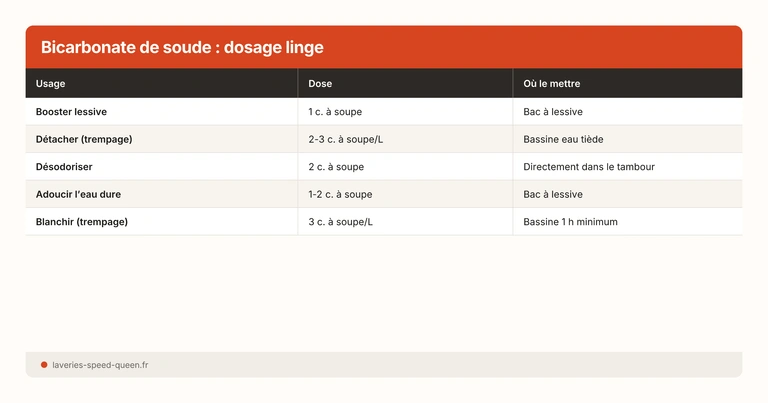
In short: baking soda is a useful supplement to detergent, not a replacement. It softens hard water (better rinsing, softer laundry), neutralises persistent odours and helps revive whites. But it has no surfactants — it does not degrease or wash. Use it as a booster, with the right dose.
At a glance
Supplement, not replacement -- baking soda has no surfactants. It does not wash laundry on its own.
Softens hard water -- 1-2 tbsp in the drum improve rinsing and make laundry softer.
Neutralises odours -- pH ~8.3 deactivates the acidic molecules responsible for bad smells.
Helps with whitening -- soaked in hot water, it revives dull whites. Gentler than bleach.
What baking soda really does for laundry
Baking soda↗ (NaHCO3) is a mild alkaline mineral salt. Its pH of around 8.3 gives it three useful properties for laundry — but not the one most commonly attributed to it.
It softens hard water
Baking soda neutralises the calcium and magnesium ions responsible for water hardness. Result: detergent lathers better, rinsing is more thorough, and laundry feels softer. This is its most useful everyday application, especially in hard water areas.
It neutralises odours
Bad laundry odours (sweat, mildew, smoke) are often caused by acidic compounds. The alkaline pH of baking soda neutralises them chemically -- it does not mask the smell, it deactivates it. That is why it works better than fragrances on stubborn odours.
It helps whiten (when soaking)
In a hot solution (50 °C+), baking soda has a mild whitening effect that revives dull whites. It is not a powerful bleaching agent like sodium percarbonate or bleach, but it is gentler on fibres and sufficient for regular maintenance.
What baking soda does NOT do
Baking soda does not wash laundry. It has no surfactants — those molecules that encapsulate grease and lift it from fibres. Without detergent, a baking soda cycle only rinses laundry in softened water but does not degrease it. Always use it alongside detergent.
Dosage chart by use
| Use | Dosage | Method | When |
|---|---|---|---|
Soften water (daily) | 1-2 tbsp (15-30 g) | Directly in the drum with laundry | Every wash if hard water |
| Boost detergent | 1 tbsp (15 g) | In the drum, in addition to regular detergent | Very dirty or smelly laundry |
| Deodorise | 2-3 tbsp (30-45 g) | Soak in a basin of warm water, 1-2 h | Stubborn odours (sport, mildew, smoke) |
| Revive whites | 3 tbsp (45 g) | Soak in hot water (50 °C), 2-4 h | Dull or yellowed whites |
| Pre-treat a stain | Paste (3 parts baking soda + 1 part water) | Apply to stain, leave 30 min | Organic stains (coffee, tea, sweat) |
| Machine maintenance | 3-4 tbsp (45-60 g) | Empty cycle at 60 °C | Once a month |
Baking soda vs white vinegar vs percarbonate
These three natural products have complementary uses, not interchangeable ones.
| Product | pH | Main action | Best laundry use |
|---|---|---|---|
| Baking soda | ~8.3 (mild alkaline) | Soften water, neutralise odours | Daily detergent booster, deodoriser |
| White vinegar | ~2.5 (acid) | Dissolve limescale, remove residue | Natural softener (in rinse tray), machine descaler. Full guide |
| Sodium percarbonate | ~10.5 (strong alkaline) | Oxygen bleaching | Whiten whites, deep stain removal. Full guide |
Do not mix baking soda and vinegar in the same bath
Baking soda (base) + vinegar (acid) = spectacular but pointless fizzy reaction. The two cancel each other chemically and you get salty water (sodium acetate). If you want both effects, use baking soda in the wash and vinegar in the rinse — in separate steps.
The real uses of baking soda on laundry
Baking soda has genuine, verifiable uses. But it also has limits that “natural cleaning” blogs often overlook. Here is an honest assessment, use by use.
What it does really well
1. Soften hard water (its best use)
Baking soda neutralises the calcium and magnesium ions that harden water. In hard water, these ions deposit in fibres and stiffen them. Baking soda neutralises them, allowing detergent to work better and laundry to come out softer. This is its most cost-effective use: 1-2 tablespoons in the drum each wash is enough. If your water is soft (less than 15 °fH), this use is unnecessary.
2. Neutralise odours (proven effectiveness)
The alkaline pH of baking soda (~8.3) chemically neutralises the acidic compounds responsible for most bad odours: sweat (butyric acid, isovaleric acid), mildew smell (acidic volatile organic compounds). Unlike fragrances that mask the smell, baking soda destroys it chemically. That is why it works on stubborn odours where scented softener fails.
3. Help with light stain removal (as a supplement)
The baking soda paste (3 parts powder + 1 part water) has a slight mechanical abrasive effect and a chemical effect on acidic stains (coffee, tea, sweat, grass). It is a useful pre-treatment before machine washing, not a standalone stain remover.
What it does only moderately
4. Revive dull whites
Baking soda has a modest whitening effect when soaking in hot water (50 °C). It can revive slightly dull whites, but does not produce the oxygen bleaching of sodium percarbonate. For badly yellowed whites, percarbonate↗ or a dedicated whitening protocol will be more effective.
What baking soda does NOT do
This section matters because many online sources attribute properties to baking soda that it simply does not have.
| Common belief | Reality | What to use instead |
|---|---|---|
| ”It washes laundry” | No. No surfactants = no degreasing. It never replaces detergent. | |
| ”It disinfects” | No. pH 8.3 = too low to kill bacteria and dust mites. | Wash at 60 °C or oxygenated agent |
| ”It whitens like bleach” | No. Very slight whitening effect, incomparable with an oxidiser. | Sodium percarbonate in hot water |
| ”It removes all stains” | No. Useful on light acidic stains. Ineffective on grease, dried blood, ink. | Targeted stain remover matching the stain type |
| ”It replaces fabric softener” | Partially. It softens water but has no anti-static effect or fragrance. | White vinegar in the rinse or suitable softener |
The 'baking soda laundry' trap
Some homemade detergent recipes use baking soda as the main ingredient. The problem: without surfactants, laundry is rinsed in softened water but not degreased. Greasy dirt builds up in fibres wash after wash, and bacteria thrive in the damp, uncleaned environment. The long-term result: laundry that smells bad and turns grey.
Detailed instructions by use
Hard water: best daily use
If your water is hard (>25 °fH), add 1-2 tbsp of baking soda to each wash. Detergent lathers better, rinsing is more effective, laundry comes out softer. This is the most cost-effective use of baking soda.
Sport odours: 1 h soak
Synthetic sportswear retains the bacteria that cause odours. Dissolve 2 tbsp in a basin of warm water and soak for 1 h. Baking soda neutralises the organic acids behind the smell. Then wash normally. Full sport guide.
Dull whites: hot water soak
Dissolve 3 tbsp in 50 °C water and soak white laundry 2-4 h. For stronger whitening, prefer sodium percarbonate which releases active oxygen.
Stain pre-treatment: baking soda paste
Mix 3 volumes of baking soda + 1 volume of water to make a paste. Apply to the stain (coffee, tea, grass), leave 30 min, then wash. Effective on organic stains, insufficient on grease.
Summary chart: effectiveness by stain type
| Stain type | Baking soda effectiveness | Recommended method | More effective alternative |
|---|---|---|---|
| Sweat / yellow marks | Good | Paste 30 min before wash | Yellow marks guide |
| Coffee / tea | Medium | Paste + immediate wash | Coffee stain guide |
| Grass | Medium | Paste 30 min | Grass stain guide |
| Grease / oil | Low | Ineffective alone | Grease stain guide |
| Blood | Low | Ineffective (set protein) | Blood stain guide |
| Red wine | Low | Ineffective alone | Wine stain guide |
| Ink | None | Do not attempt | Ink stain guide |
| Odours (sport, mildew, smoke) | Very good | Soak 1-2 h in warm water | — |
Which textiles to avoid
- Silk -- the alkalinity of baking soda can weaken silk protein fibres. Use a neutral pH product for silk.
- Delicate wool (cashmere, mohair) -- same risk as silk. Wool tolerates baking soda in very small doses, but the risk is not worth it on precious items.
- Textiles with waterproof coating -- baking soda can damage DWR (water-repellent) treatments. Wash technical jackets with specialist detergent.
- Fragile-dyed fabrics -- alkalinity may cause some artisanal or unfixed dyes to run. Test on a hidden corner.
Baking soda at the laundromat: useful?
At Speed Queen laundromats, detergent and softener are already included and dosed automatically. Baking soda is not needed as a supplement — the products are formulated to work in machine conditions (water hardness, temperature, cycle time).
Baking soda remains useful at home for two purposes before visiting a laundromat:
- Deodorising pre-soak: if your laundry has stubborn odours (sport, mildew), soak 1-2 h in a basin with 2 tbsp of baking soda before bringing the laundry to the laundromat. The professional cycle will finish the job.
- Stain pre-treatment: apply a baking soda paste on sweat marks or coffee stains 30 minutes before washing at the laundromat. The mechanical and chemical action of Speed Queen machines will complete the stain removal.
At Speed Queen, everything is already optimised for an impeccable result in ~1 h, wash + dry. Check our prices for a full cycle.
Common mistakes
- Believing baking soda washes laundry -- it softens and deodorises, but without surfactants it does not degrease. Detergent remains essential.
- Adding too much -- beyond 3 tbsp per cycle, baking soda can leave white residue on dark laundry. Dose sparingly.
- Mixing with vinegar in the same bath -- chemical reaction that cancels both products. Use them in separate steps.
- Using on silk or fine wool -- alkalinity weakens these fibres. Use a neutral pH product instead.
- Confusing with percarbonate -- percarbonate (Na2CO3-H2O2) is a powerful bleaching agent. Baking soda (NaHCO3) is a mild alkaline salt. They are not the same product.
Methodology and sources
Dosages are practical recommendations based on manufacturer usage guides (La Baleine, Biovie) and literature on natural cleaning products. The chemical properties of NaHCO3 (pH, solubility, interaction with calcium) are established.
Sources and references
- ADEME, Laundry care: 10 tips for health and environment, accessed 23 March 2026
- Handbook of Chemistry and Physics, data on NaHCO3 (pH, solubility, acid-base reactivity)
- UFC-Que Choisir, Textile stain removers: how do vinegar and baking soda perform?, accessed 23 March 2026
- White vinegar and laundry: uses and limits
- Sodium percarbonate for laundry
- Fabric softener: useful or not?
- Which detergent to choose?
- Homemade detergent: recipe and limits
- Tough stains: solutions
- Sportswear care
- Washing at 60 °C: which clothes?
As an Amazon Partner, we earn a small commission on purchases made via the affiliate links in this article — at no extra cost to you. This helps us maintain this site and produce free guides.
Baking soda is a good supplement, but for a complete and effective wash, nothing replaces properly dosed detergent. At Speed Queen laundromats, detergent and softener are included and dosed automatically — guaranteed result in ~1 h, wash + dry. Also see
our guide to choosing the right detergent
.